Tuesday, July 15, 2008

No. 162 - William Mulholland Memorial Fountain

William Mulholland Memorial Fountain

William Mulholland Memorial Fountain
1940 – Walter S. Claberg
Riverside Drive and Los Feliz Boulevard – map
Declared: 10/6/76

More than 3,000 people showed up on the night of August 1, 1940, to watch the nine-year-old granddaughter of the late William Mulholland, Patricia, press the button that would begin the flow of water through the giant fountain dedicated to her famous ancestor. It would’ve been awesome had she told the crowd, “There it is. Take it,” but my guess is she didn’t.

William Mulholland Memorial Fountain

Located in the middle of nearly four acres of land at the intersection of Los Feliz and Riverside, the William Mulholland Memorial Fountain honors the self-taught engineer who, in the words of the Los Angeles Times, “slaked the Southland’s thirst.”

William Mulholland Memorial Fountain

Born in Belfast in 1855, future thirst-slaker William Mulholland came to L.A. in 1877 and, living in a shack near where his memorial fountain is today, soon got a job with the City Water Company as a zanjero (he was a ditch tender). Mulholland worked his way up in the company and, when the city took over water supply operations in 1902, he was appointed chief engineer of the Municipal Water Bureau.

William Mulholland Memorial Fountain

From 1908 to 1913, Mullholland took on the Herculean task of overseeing the construction of the more than 230 miles of the $24 million Los Angeles-Owens River Aqueduct. This included surveying the land, raising bond issues, acquiring/swindling the land and water rights from Owens Valley property owners, and supervising more than 5,000 workers. A decade after that water gushed, he also conducted the survey which ultimately led to the Colorado River to L.A. aqueduct, bringing sweet, sweet water to thirsty Angelinos (in 1941).


William Mulholland Memorial Fountain

In March 1928, the two-year-old St Francis Dam, built during Mulholland’s tenure, collapsed, killing around 450 people. The engineer took the blame and resigned by the end of the year. (WARNING: The Weid Canyon Dam, AKA the Hollywood Reservoir Dam, HCM No. 421, shares the design of the doomed dam from San Francisquito Canyon. In fact, after the Santa Clarita River Valley disaster, Mulholland “ordered the water lowered in the Hollywood Reservoir… subsequent studies found its base also lacked sufficient width to “withstand uplift and earthquake loading, or against basal sliding,” elements that may have contributed to the failure of the Saint Francis.” I hope you folks living beneath that Hollywood Hills dam saw Earthquake, and not just for Lorne Greene acting the part of Ava Gardner’s father.)

William Mulholland Memorial Fountain

According to his L.A. Times obituary, William Mulholland took his last drink of water on July 22, 1935, in his home at 226 South St Andrews Place. (Here’s where I need to point out that the night I was taking this picture, an old-timer across the street said Mulholland never lived there. He – the old-timer, that is, not Mulholland – then rattled off all the home owners in the house’s history, saying that, in 1935, the owner would’ve been a man named Grant.) In any event, here’s the house. I wish I lived there. (Pay no attention to the photographer's shadow.)

226 South St Andrews Place

The fountain’s dedication ceremonies nearly sixty-eight years ago featured both the L.A. Police Band and the city’s Civic Chorus in addition to speechifying by a whole string of city officials and Times publisher Harry Chandler.

The fountain measures ninety feet in diameter, and its water reaches a height of fifty feet. Ground-breaking ceremonies were held on March 30, 1940, with Mulholland’s daughter, Rose, taking first-spade duties.

William Mulholland Memorial Fountain

To fully appreciate why the landmark, restored and rededicated in 1996, is sometimes known as the ‘Kool Aid’ Fountain, you need to swing by the intersection at nighttime. As you can tell by the shots here, the fountain sports a whole rainbow of colored lights, and it’s sure a terrific place to spend a few moments in the evening.

William Mulholland Memorial Fountain

Sources:

Mulholland, Catherine William Mulholland and the Rise of Los Angeles University of California Press 2000 Berkeley and Los Angeles, CA

Pitt, Leonard and Dale Pitt Los Angeles A to Z 1997 University of California Press 2000 Berkeley and Los Angeles, CA

“Mulholland of Aqueduct Fame Dies” The Los Angeles Times Jul 23, 1935, p. 1

“Los Angeles Remembers Famous Aqueduct Builder” The Los Angeles Times Mar 31, 1940 p. A1

“Thousands See Dedication of Mulholland Memorial” The Los Angeles Times Aug 2, 1940 p. A1


Up next: Site of the First Official Walt Disney Studio

continue reading...

Saturday, July 12, 2008

No. 161 - Wolfer Printing Company Building

Wolfer Printing Company Building

Wolfer Printing Company Building
1929 – Edward Cray Taylor and Ellis Wing Taylor
416 Wall Street – map
Declared: 9/15/76

Every source I’ve looked at, including Gebhard and Winter, McGrew and Julian, and the Los Angeles Cultural Heritage Commission, says this Tudor Revival building was put up in 1929. Every source, that is, except the city’s ZIMAS page. It claims the building dates back to 1917. I almost want get off the couch, hustle downtown to the Department of Building and Safety, and conduct a little more research to see what’s what. Almost.

Wolfer Printing Company Building

No matter how old, this brick structure was built for the Wolfer Printing Company. It’s founder, William Wolfer, Sr, was born on July 21, 1872, emigrating here from New Jersey at the age of six. In 1952, the Printing Industries Association, Inc., honored him with an award of merit for sixty-seven years of commercial printing service. He died in 1957 in his daughter’s Studio City home. At the time of his death, he was no longer associated with the printing business, but owned the Wolfer Printers Supply Co.

Wolfer Printing Company Building

Edward Cray Taylor and Ellis Wing Taylor were the architect and engineer behind the Wolfer Building. Born in Chicago, the brothers would also build Yuma’s Masonic Temple, listed on the National Register of Historic Places. Edward Cray also designed the Glassell Park Elementary School, which, while listed on the Register last year, is not a Los Angeles Historic-Cultural Monument. E.C. Taylor died in his Beverly Hills home in 1946 at the age of 49. Engineer Ellis Wing, who was married to silent film actress Anne Cornwall, gained fame by designing airplane factories, including the Douglas plant in Long Beach and San Diego’s Consolidated factory. He died in 1951 in his Arcadia home (where's 1075 Singing Wood Drive?).

Wolfer Printing Company Building

While on Wall, I popped in a couple of the individual shops for any signs of the building’s old interior but saw few. One, maybe, is what looks like a vintage hanging lamp. Reconstituted fluorescently, but is there anyone out there who recognizes such an apparatus? Old? New? I think it was hanging in the J-W-T store.

Wolfer Printing Company Building
Another interior.

Also, I walked around the top of the neighboring building/parking lot to see if I could get a good shot of that mural evident in this old picture from the city’s Department of City Planning website (I see mountains, I see trees… ). I couldn’t, but you can still see a bit of it in the lower picture here:

Wolfer Printing Company Building

Part of the old Mrs M. M. Shaw subdivision, the area of the Wolfer Printing Company Building today is in L.A.’s Skid Row. You really know what city’s skid row you’re in when those on hard times ask you not for change but for which studio you’re shooting location shots.

Wolfer Printing Company Building

Sources:

“Veteran Printer Honored With Award of Merit” The Los Angeles Times Sep 12, 1952 p. 5

“William Wolfer Sr., 85, Early Day Printer, Dies” The Los Angeles Times Sep 3, 1957 p. B2

“E.W. Taylor, Designer of Plane Factories, Dies” The Los Angeles Times Jan 21, 1951, p. B7

Up next: William Mulholland Memorial Fountain

continue reading...

Wednesday, July 9, 2008

No. 160 - Manzanar

Manzanar Cemetery Monument, 1943

Manzanar
1942 - 1945
Highway 395, Inyo County – map
Declared: 9/15/76

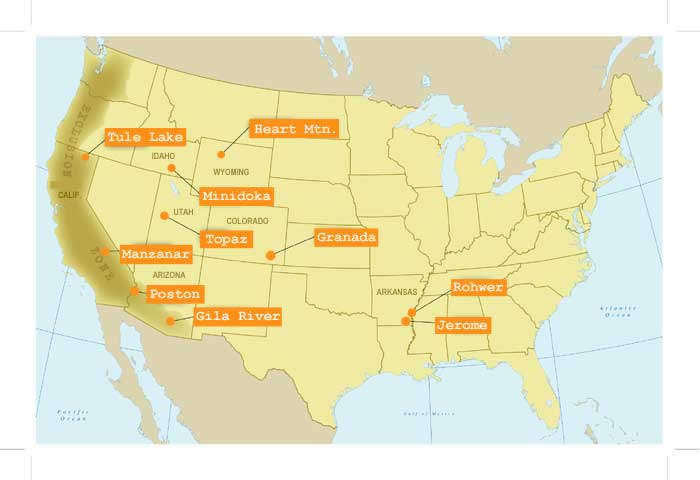
The United States operated ten concentration camps to hold Japanese-Americans during World War II. The Manzanar War Relocation Center, located in the Owens Valley about 220 miles north of Los Angeles, was not the biggest but it was the first, admitting the initial eighty-two of its more than 11,000 prisoners on March 21, 1942. Ninety-two percent of Manzanar detainees came from the county of Los Angeles; seventy-six percent from the city proper.

Manzanar
Manzanar
Above: the original military sentry post and internal police post, built by internee Ryozo Kado in 1942.

On February 19, 1942, just two months after the attack on Pearl Harbor, FDR signed Executive Order 9066, effectively setting up military camps and allowing for the forcible removal of more than 110,000 Japanese-Americans from their homes. Truth is, the government had been preparing a tent city for potential prisoners at Manzanar, calling it Camp Owens, as early as June 1941, half a year prior to the Japanese attack. Also, a list of United States Nisei (second-generation Japanese-Americans) was delivered to President Roosevelt, per his request, about a week before 12/7/1941. Clearly, the mass internment was not just a reaction to the Pearl Harbor bombing.

Manzanar
Manzanar
Manzanar - Shepherd Ranch Ruins
Above: the middle shot is the location of the camp's baseball fields, the lowest are ruins of the John Shepherd Ranch. Shephered had his orchards here from 1864 - 1905.

The man who oversaw the relocation was the Army’s West Coast Commander, Lieutenant General John L. DeWitt, a poster child for the abuse of civil liberties if there ever was one.

About two-thirds of all those eventually incarcerated at Manzanar were American citizens by birth. Many of them received as little as four days notice to get rid of what they owned and be prepared to be relocated either initially to temporary assembly centers, like the one at the Santa Anita racetrack, or, later, directly to Manzanar.

Manzanar - Construction
Manzanar, Old Orchards to the Left
Manzanar
From top to bottom: the camp under construction, photo by Clem Albers, 4/2/42; some of the remaining fruit trees planted by the Owens Valley Improvement Company around 1910; Block 34's mess hall garden.

By the time the U.S. Army leased 6,000 acres for the relocation center, the agricultural town of Manzanar (Spanish for apple orchard) had been deserted for about seven years, since a few years before that, in 1929, the city of Los Angeles wrapped up acquiring the town’s land and water rights. (What L.A. did to the Owens Valley, of course, is almost as hilarious as the story of the war camp itself. And, unless I’m wrong, the city profited from the feds leasing the land during WWII, too. Right?)

Manzanar - Morgue, Garbage Can, Heating Plant
Manzanar - Laundry Room
Manzanar - Children's Village
From top to bottom: that's the camp's morgue over to the left; the site of the laundry room; and Children's Village. Sisters Mary Suzanne and Mary Bernadette ran Children’s Village, taking care of the center's fifty or so orphans. The two had previously run a Los Angeles orphanage for children of Japanese ancestry.

New camp residents were met with barbed wire fences and eight guard towers manned by military police with submachine guns and searchlights. Armor and Wright, in their book, Manzanar, describe the housing conditions:
“The main camp at Manzanar consisted of 560 acres, on which were constructed nine wards of four blocks each. Each block contained sixteen barracks, or one-story buildings, twenty by one hundred feet. Of the sixteen buildings, fourteen were residential, one of double size was the mess hall, and the last was a meeting/recreation hall.”
While the spaces of twenty by twenty-five feet were designed for families of four, the average held eight people, sometimes reaching eleven.

The remaining 5,500 acres held military police housing, a reservoir, a sewage treatment plant, and agricultural fields.

Manzanar - BLK. 23 BLDG. 29
Manzanar - Block 3
Manzanar - Kendo Dojo
From top to bottom: Block 23, Building 29; site of Block 3, home to 227 Japanese-Americans from Bainbridge Island, near Seattle; the Kendo Dojo.

The War Relocation Authority
took over operation of Manzanar from the U.S. Army on June 1, 1942. Later that year, in December, military police shot to death two detainees and wounded ten others during a protest.

Manzanar - Pet Cemetery
Manzanar Cemetery Monument, 1943
Manzanar - Cemetery
From top to bottom: the pet cemetery; the cemetery monument; remaining graves. About 150 Japanese-Americans died at Manzanar. Only fifteen were buried here; most of the others were cremated. Today, only half a dozen are still buried in the cemetery. Because individual gravestones were not affordable, the Manzanar Cemetery Monument was dedicated in August 1943. Its inscription reads, “Memorial to the Dead.”

The camp’s population began to decrease as prisoners received work passes and young men volunteered for service in the armed forces (go figure). Also, in December 1944, the Supreme Court ruled loyal citizens could not be detained in detention centers against their will. The Manzanar War Relocation Center finally closed on November 21, 1945. Freed prisoners were given train fare and $25. Following the war, nearly all of the camp’s 800 buildings were dismantled or relocated.

Manzanar - Warehouse Area
Manzanar
Manzanar
Top to bottom: warehouse area; Dorothea Lange photo, 6/9/42; the net factory, where internees made camouflage netting for the U.S. military.

Geographically, Manzanar is located in the Owens Valley between the Sierra Nevadas on the west and the Inyo Mountains on the east. The big mountain you see in these shots is not Mt Whitney. Whitney’s nearby, but this peak is Mt Williamson, just more than 100 feet shorter than Whitney.

ManzanarManzanar
Manzanar
Manzanar - Blocks 10 and 9
Top to bottom: Mt Williamson; site of the Manzanar Free Press; the location of Manzanar High School; and Blocks 9 and 10. The Manzanar Free Press was launched on April 11, 1942, edited by Roy Takeno, and ran until New Year’s Day, 1944. Manzanar High opened in October 1942 and graduated classes the following three years. Some of the camp's first prisoners, from Terminal Island near San Pedro, were housed in Blocks 9 and 10.

In addition to its Los Angeles HCM status (one of only two outside the city), Manzanar today is recognized as a California Historical Landmark, a National Historic Landmark, and is listed in the National Register of Historic Places. In 1997, the National Park Service bought more than 814 acres of Manzanar land from Los Angeles.

Manzanar National Historic Site Interpretive Center

Today, the Manzanar Interpretive Center (above) is in the camp’s old high school auditorium-gymnasium. Built by detainees in 1944, it later served as a V.F.W. social hall and then a garage and shop for the Inyo County Road Department. It opened as the current wonderful and moving museum in April 2004. The museum, the military police sentry post, the internal police post, and the cemetery memorial are the only remaining structures of the Manzanar camp. (An old mess hall was moved to the site in late 2002 and is not original to the camp.)

Manzanar National Historic Site Interpretive Center

You owe it to yourself to explore the Park Service’s official Manzanar site. Or, better still, visit Manzanar in person. You might want to choose a better time of year than summer. I spent around three hours walking the site on that brutally hot Saturday back in June, and I’m still drinking fluids like hotcakes.

Manzanar

Sources:

Houston, Jeanne Watkatsuki and James D. Houston Farewell to Manzanar Laurel-Leaf 1973 New York

Armor, John and Peter Wright Manzanar Times Books 1988 New York


Up next: Wolfer Printing Company

continue reading...

Monday, July 7, 2008

No. 159 - Ralph J. Bunche Home

Ralph J. Bunche Home

Ralph J. Bunche Home
1908
1221 East 40th Place – map
Declared: 7/27/76

While not the home most associated with Dr Ralph J. Bunchea nice one, designed by Hilyard R. Robinson, still stands in D.C., and then there’s the National Historic Landmark in Queens, N.Y. – it’s in this simple California cottage off South Central where the future Nobel Peace Prize winner lived for about a decade beginning in 1917.

Ralph J. Bunche Home

Ralph Johnson Bunch was born in Detroit, Michigan, on August 7, 1903. His family moved from there to Cleveland to Knoxville to Toledo by the year 1909. When Ralph was ten, the Bunch Bunch packed up and relocated to Albuquerque. He lost his parents in 1917 – his mom to TB, his dad to desertion. It was after this when his grandmother, aunt, and uncle bundled up Ralph and his sister and headed to Los Angeles. They first rented a bungalow at 1219 Griffith Avenue, but had to leave when the owner realized the family was black (Ralph’s uncle, like his grandmother, was light-skinned, and had unintentionally fooled the racist). The family wound up moving to this home on what was then named 37th Street.

Ralph – his grandmother by this time had added an ‘e’ to his last name – enrolled at Thirtieth Street Intermediate School (now John Adams Junior High), and then, the following year, Jefferson High, just half a block away from the Bunche home. In 1922, he graduated from Jeff as the senior class valedictorian.

Dr Ralph J. Bunche
Bunche in 1927, swiped from the L.A. Public Library website.

While continuing to live at home, Bunche attended UCLA (then called the University of California Southern Branch, it was located on Vermont where City College is today), earning tuition money through a variety of jobs. At UCLA, Bunche played football and basketball, wrote for The Bruin, and co-founded a new debate society after he was refused admittance to the UCLA club (he was black, remember). Having majored in political science, Ralph graduated in 1927 summa cum laude, again as class valedictorian.

Ralph J. Bunche Home

Well, once Bunche leaves L.A., his life story becomes a lot more boring: he receives his master of arts degree in political science from Harvard; organizes and chairs the first Political Science Department at Howard University; has three children with his wife, Ruth; is awarded the Julius Rosenwald Fellowship for African research; earns his Ph.D. in political science and international relations at Harvard (the first African American to receive a doctorate in poli-sci); writes a couple of books, including A World View of Race in 1936 and, with Gunnar Myrdal in 1944, The American Dilemma; joins the OSS, focusing on Africa; helps draft the U.N. Charter; serves on the U.S. delegation at first session of U.N. General Assembly in London; after the assassination of Count Bernadotte in 1948, becomes acting mediator in Palestine; negotiates an Israeli/Egyptian armistice; in 1950 becomes the first African-American to be awarded the Nobel Peace Prize; becomes U.N. undersecretary to Dag Hammarskjold and then U Thant; and receives the Presidential Medal of Freedom.

Sickly for much of his life, Dr Ralph J. Bunche died in New York on December 9, 1971. He’s buried in the Bronx.

As for the house, Bunche’s Aunt Nelle lived there until she died in 1975. After years of abandonment, the building was bought by the Dunbar Economic Development Corp. in 1996 with their intention of converting the cottage into a museum. A variety of funding issues stalled the project for years, but, with restoration completed (for which it won a Los Angeles Conservancy preservation award in 2006), the former Bunche home today is the Dr Ralph J. Bunche Peace & Heritage Center.

Ralph J. Bunche Home

Sources:

Urquhart, Brian Ralph Bunche: An American Life W.W. Norton & Company, Inc. 1993 New York, NY

Schraff, Anne E. Ralph Bunche: Winner of the Nobel Peace Prize Enslow Puclishers, Inc. 1999 Springfield, NJ

“Riordan Cuts Red Tape to Begin Restoration of Nobelist's Home” The Los Angeles Times; Mar 12, 1999, p. B4


Up next: Manzanar

continue reading...