Thursday, January 10, 2008

No. 103 - Forthmann House and Forthmann Carriage House

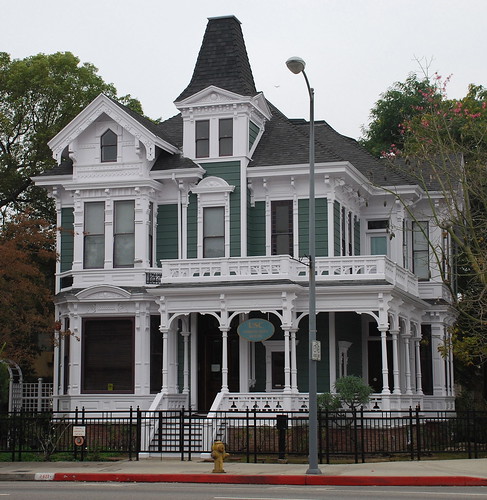
Forthmann House

Forthmann House and Forthmann Carriage House
1880s – Burgess J. Reeve
2801 South Hoover Boulevard (house) – map
812 East Edgeware Road (carriage house) – map
Declared: 10/4/72

If you’re interested in visiting all of Los Angeles Historic-Cultural Monument No. 103, you’ve got some driving to do.

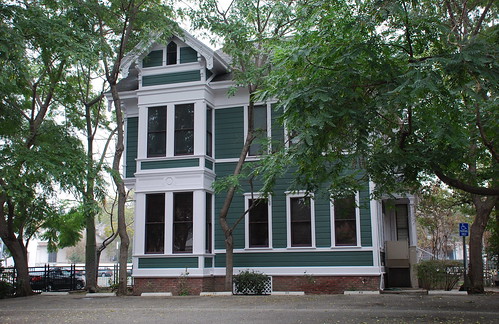
Forthmann House

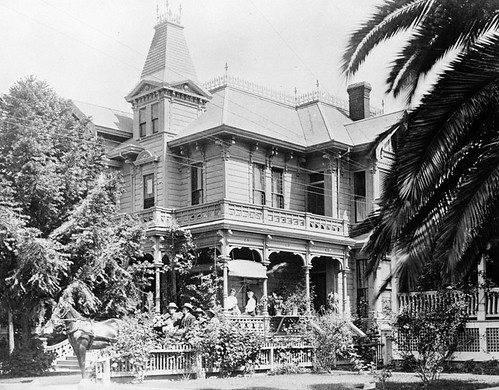
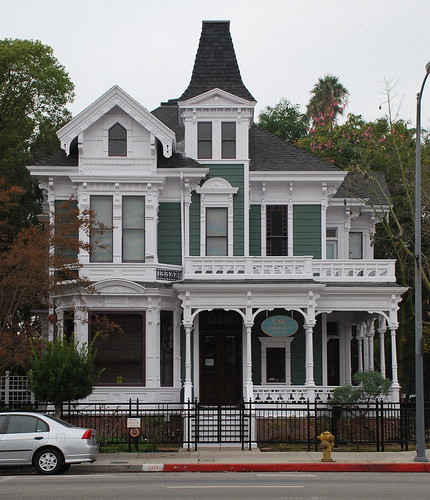
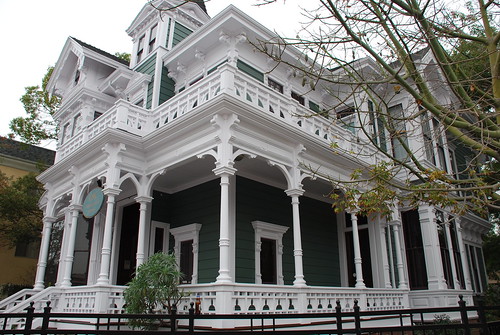
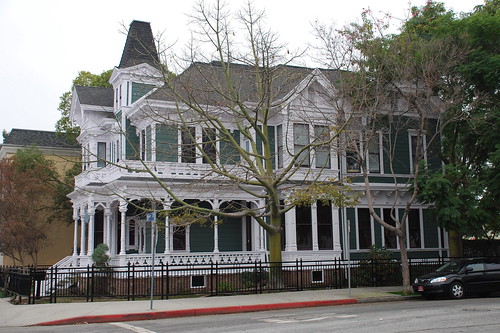
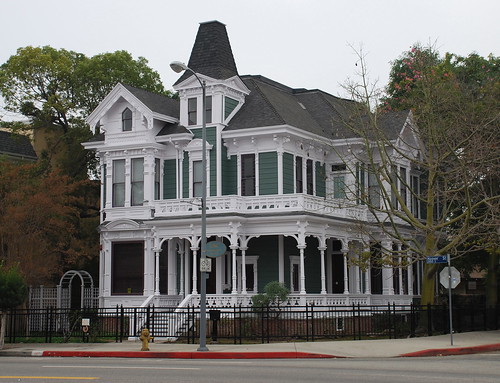
Sometime in the 1880s, Burgess J. Reeve designed a 4,200 square foot, eleven-room Victorian mansion for John A. Forthmann. Forthmann, a German immigrant, had made his money from founding and running the Los Angeles Soap Co. The business, most famous for its White King brand (“It takes so little”), at one point covered about sixteen acres of downtown. Forthmann died in 1922.

In the shot just above, from USC's Digital Archive and taken around 1900, John Forthmann is one of the guys in the buggy. Probably the cleanest one. Because he was in the soap business.

Forthmann House

Different references mention different styles of the house, but mainly as a mix of Italianate and Eastlake. The house, along with its carriage house, stood at 629 West 18th Street, just off Figueroa.

Forthmann House

Forthmann House

Flash forward a century. In 1989, about seventeen years after its designation as a city landmark (and about a year after the Los Angeles Soap Co. finally closed its doors), the house was picked up and relocated to its current location on Hoover. According to Historic Places in Los Angeles County, published in 1978 by the Historical Society of Southern California, several additions had been made to the second floor at some point. Today the home – one of the oldest in the city – is the headquarters for USC’s Real Estate Development Corp.

I hope you're sitting down, because here's a shot of the back of the building.

Forthmann House

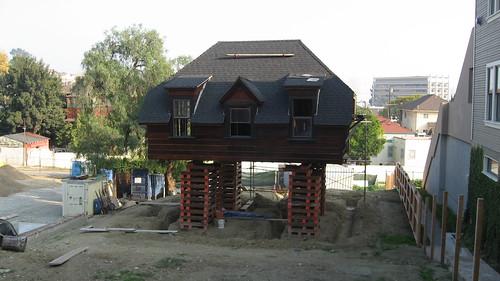
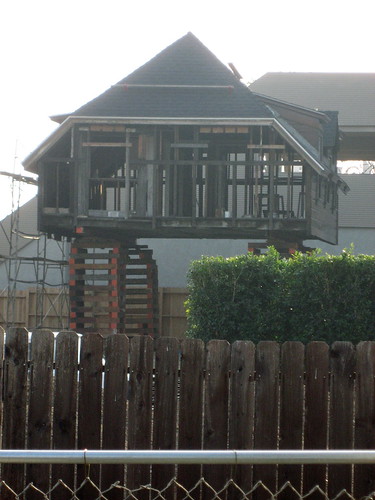
The bad news? When the house was relocated, the Forthmann Carriage House was left behind. The good news? Sixteen years later, in 2005, the carriage house, officially part of HCM 103, was saved from demolition when it was moved, in the opposite direction of its old partner, to 812 East Edgeware Road in Angelino Heights. It stands there today, fairly well stripped and awaiting restoration. If anyone can tell me why it’s perched so high up on stilts, please do. Maybe just waiting for a foundation, I reckon.

Forthmann Carriage House

Forthmann Carriage House

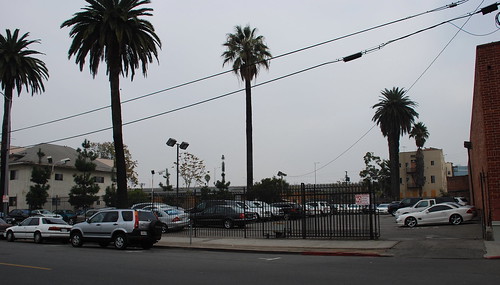
Oh. Below is a picture of the house and carriage house's original location, on West 18th Street. The site's about one block south of the Santa Monica Freeway and one block east of the Harbor Freeway. Somewhat ironic, as Forthmann insisted using a horse and buggy until the day he died. You can bet he'd be really thrilled if he were alive today. Really thrilled, and really old.

(Site of) Forthmann House and Forthmann Carriage House

Forthmann House

Up next: Cole's P.E. Buffet/Pacific Electric Building

continue reading...

Sunday, January 6, 2008

No. 102 - 1030 Cesar E. Chavez Avenue Residence

1030 Cesar E. Chavez Avenue Residence

1030 Cesar E. Chavez Avenue Residence
c. 1880
1030 Cesar E. Chavez Avenue – map
Declared: 10/4/72

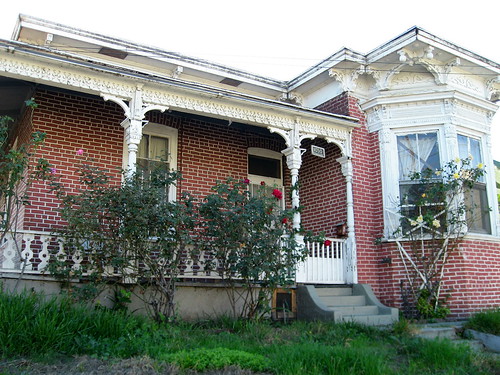
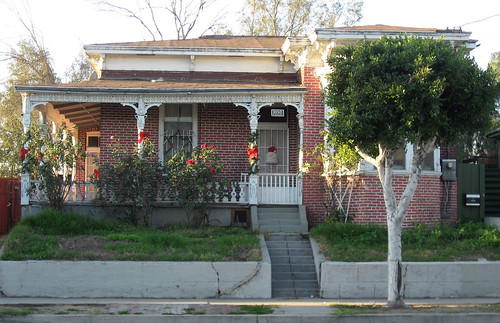
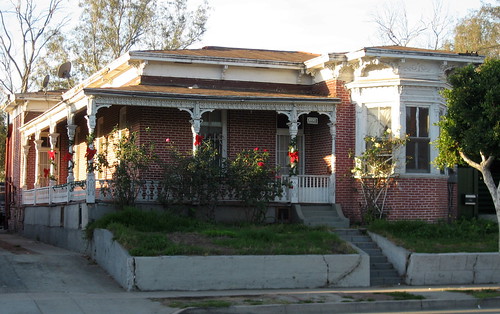
Is there another Victorian/Queen Anne home made of brick remaining in Los Angeles? (That’s not rhetorical; I really don’t know.)

Now, if you’ve driven by this house on Chavez and given it a first thought, much less a second one, I’d be surprised. While I don’t spend much time in the area, I can say I’ve never noticed it.

1030 Cesar E. Chavez Avenue Residence

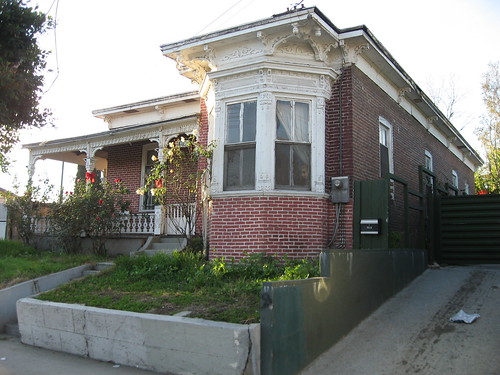
Three of the four books I’ve seen mentioning this landmark refer to this one-story structure’s broad floor plan as an indication that, at some point, the builder had intended to add a second story and then, at some other point, abandoned the idea. If you see the home in person, I bet you’ll agree this was the case.

1030 Cesar E. Chavez Avenue Residence

Oh. One other thing. I briefly suffered a bit of confusion tracking down this monument because, up until late 1993, this portion of Cesar E. Chavez Avenue was called Macy Street. While you know (or should know) who Cesar Chavez was, Macy Street was named for Dr Obed Macy and his son, Oscar. Harris Newmark, in Sixty Years in California, wrote that when he set foot in Los Angeles in 1853, he...
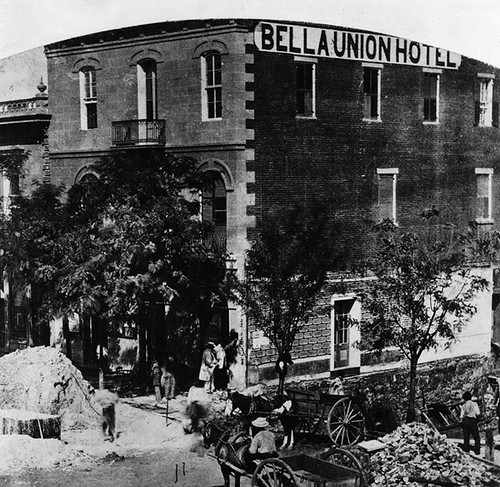
… arrived at the only real hotel in town, the Bella Union, where stages stopped and every city function took place. This hotel was a one-story, adobe house enlarged in 1858 to two stories, and located on Main Street above Commercial; and Dr. Obed Macy, who had bought it the previous spring from Winston & Hodges, was the proprietor.
The elder Macy arrived in Southern California around 1850, settling in El Monte. He moved downtown a year later, bought the Bella Union, and opened the Alameda Baths. He died on July 19th, 1857. Oscar Macy was a newspaper editor and businessman, also serving as city treasurer during the 1880s.

Bella Union Hotel

The Bella Union was the home of the Los Angeles Star newspaper, had served as the County Courthouse, housed Pio Pico, and was later the site of a celebration when the telegraph connected San Francisco and L.A. (1860) among many other notes. The hotel became the Clarenden in 1873 and the St Charles in 1875. The Bella Union building was razed in 1940 (and the Pico Building (1868), shown in the picture next to the hotel, was torn down in 1957).

But I digress; enough of the Macys and the Bella Union Hotel. Historic-Cultural Monument No. 102 is this brick home, standing here for about 130 years, an unassuming piece of L.A. history.

1030 Cesar E. Chavez Avenue Residence

Up next: Forthmann House and Carriage House

continue reading...

Wednesday, January 2, 2008

No. 101 - Union Station Terminal and Landscaped Grounds

Union Station, Los Angeles

Union Station Terminal and Landscaped Grounds
1939 – John and Donald B. Parkinson
800 North Alameda Street – map
Declared: 8/2/72

In Landmarks of Los Angeles, McGrew and Julian point to the coincidence of 1939 seeing the opening of both the city’s Union Station – “the last of America’s great railroad stations” – and the Arroyo Seco Parkway – “the first freeway in the west”, stretching from downtown to Pasadena. Also, it bears noting that the Parkway more or less began in L.A.'s Chinatown, the community relocated to make way for L.A. Historic-Cultural Landmark No. 101.
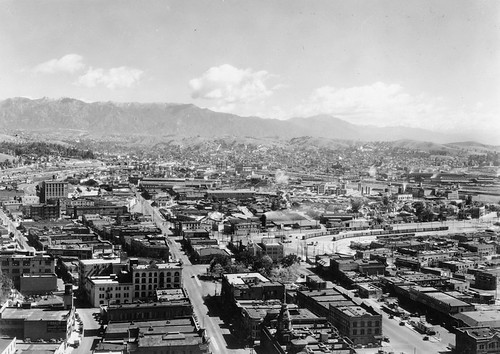
Site of Union Station, Los Angeles
This is the site, towards the lower right, mainly, of today's Union Station.


While there had been talk, negotiations, and promises for such a facility for decades, it wasn’t until 1933, when three of the biggest railroad lines – the Southern Pacific, Santa Fe, and Union Pacific – got together to create the terminal terminal. (By the way, try and find a reference that doesn’t use the words “pool” and “resources” when referring to the banding together of the three companies.)

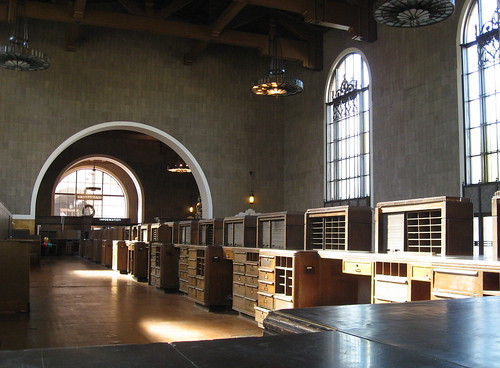
Below is the old ticket concourse. Back in the day, you’d wait in line in front of one of thirty windows to get your ticket.

Union Station, Los Angeles

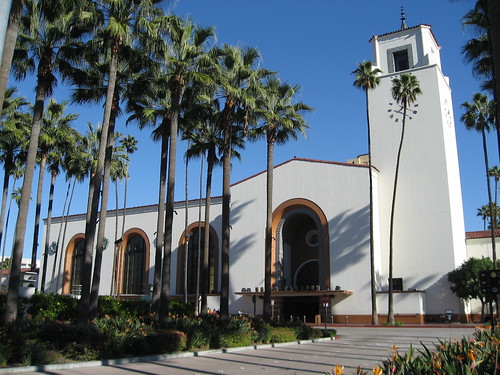
The architectural team of the Parkinsons, John and Don, was hired to build this monument to transportation (Parkinson and Parkinson also designed HCM Nos 278, the Title Guarantee and Trust Company Building, and 575, the Security Savings and Trust Bank, among many others.) With help from J. H. Christie, H. L. Gilman, R. J. Wirth, color consultant Herman Sachs, and landscaping artist Tommy Tomson, they came up with the resulting design in the Streamline Moderne and Spanish Colonial/Moorish style.

In order for construction to begin, though, the city first had to clear forty-plus acres of L.A.’s Chinatown, moving the community up and over a few hundred yards. Prior to the being Chinatown, the land comprised of acres and acres of vineyards.

Poor Chinatown. It's safe to say that, had it been just a year or so later, because of the explosion in automobile use, this railway station would not have been built, and the community would probably still be standing in its original location.

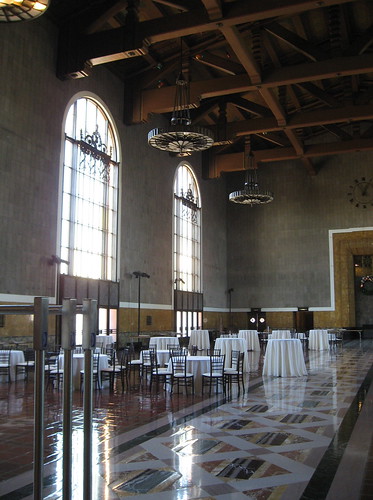
Another shot of the ticketing area, now used for private events. I was at a Christmas party here years ago and had too much to drink.

Union Station, Los Angeles

The eleven million dollar building opened on May 3, 1939, and saw one and a half million people pass through its doors in its first three days. L.A. mayor Fletcher Bowron and Culbert Olson, the state’s governor, presided over dedication ceremonies. There was also a parade, highlighting the history of L.A. transportation, with horsemen, muleskinners, stagecoaches, horse-car trolleys, and an appearance of the Southern Pacific's No. 1 engine from 1869.

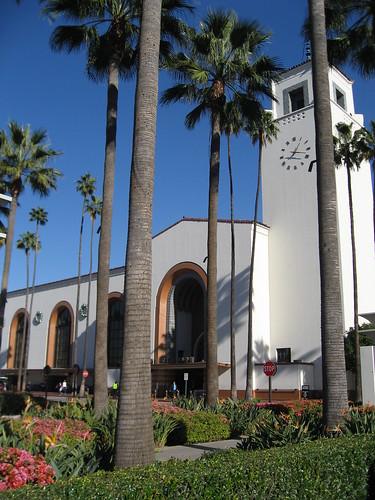
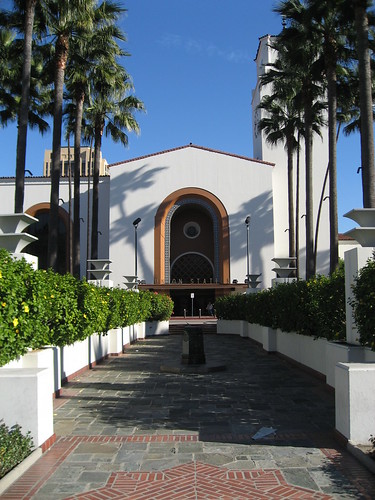
The station's main entrance, Christmastime, 2007:

Union Station, Los Angeles

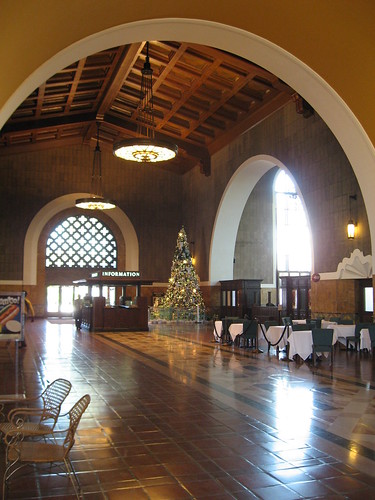
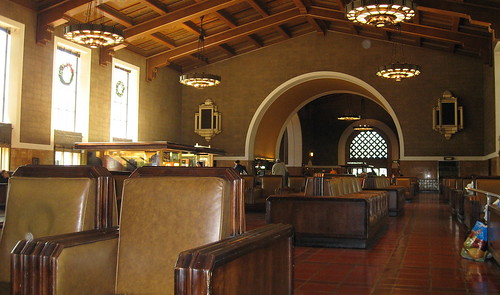
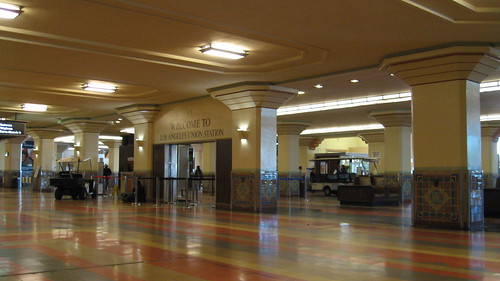
Here’s the interior waiting room, 52 feet from floor to ceiling. The lower part of the walls is made of travertine marble, and the upper part is acoustical tile made partially of ground corncobs (no lie). The floor is terra cotta tile and inlaid marble.

Union Station, Los Angeles

Union Station, Los Angeles

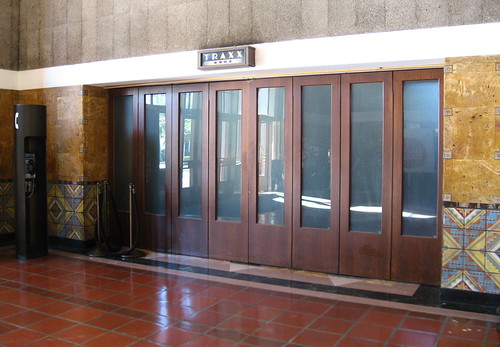
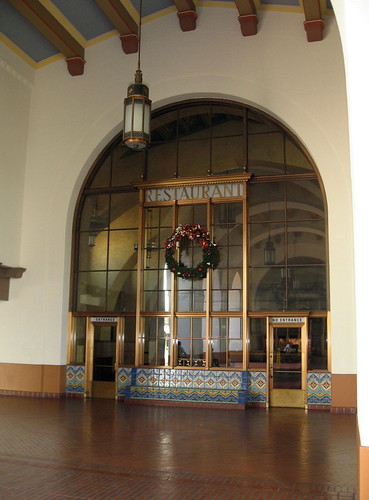
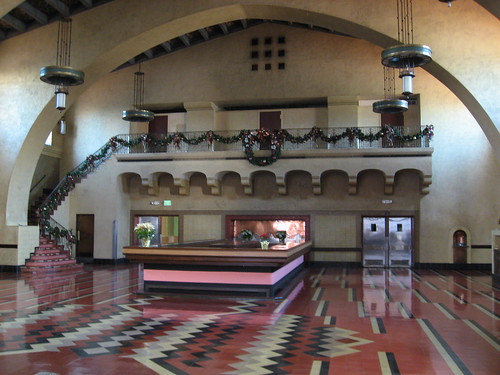
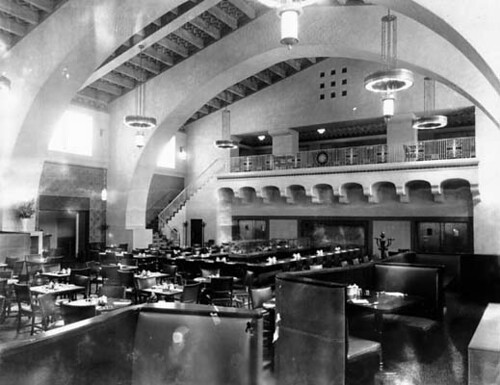
Below is Traxx Restaurant, formerly used by Western Union for sending wires.

Union Station, Los Angeles

Union Station, Los Angeles

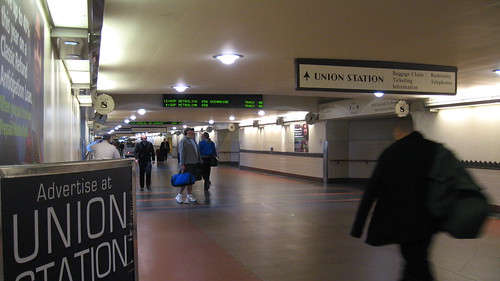
By the time the 1970s rolled around railway passenger and freight service in the U.S had reached its nadir (Union Station was sometimes seeing less than ten passenger trains a day). Amtrak began servicing the complex in 1971, but things really began to turn around in the early 1990s with the introduction of Metrolink service followed by the Metro’s Red, Purple, and, eventually, Gold lines. Patsaouras Transit Plaza, an addition opening in 1995, serves bus lines and shuttles.

Union Station, Los Angeles

Union Station, Los Angeles

Today Union Station is busier than ever, seeing 201 arrivals and departures daily (the odd number is a result of a single departure/arrival after midnight).

Union Station, Los Angeles

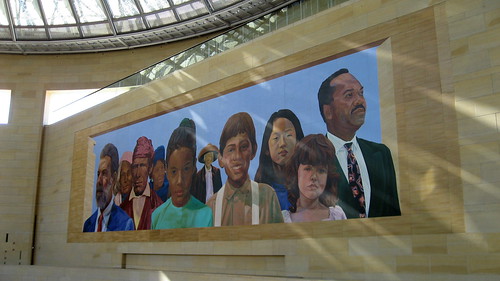
In the 1990s, with renovations and additions to Union Station to accommodate the new subway service, several pieces of public art were commissioned. 1995 saw the unveiling of Richard Wyatt, May Sun, and Paul Diez's "City of Dreams/River of History". The installment includes a few pieces including this 79-foot long mural by Wyatt.

Union Station, Los Angeles

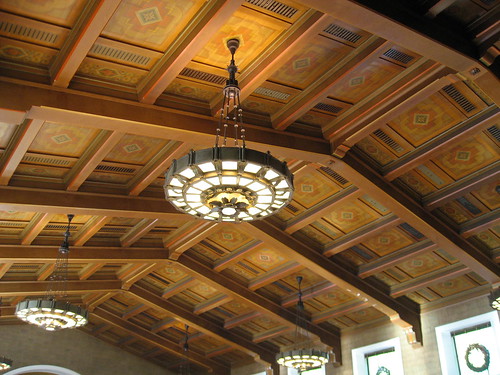
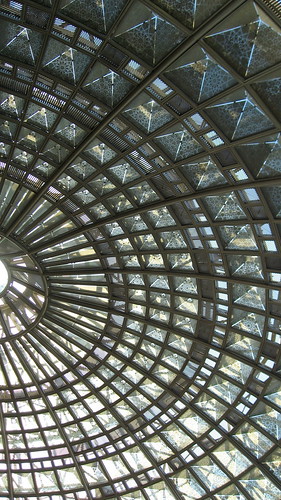
Looking up in the east lobby by the mural, you see this ceiling.

Union Station, Los Angeles

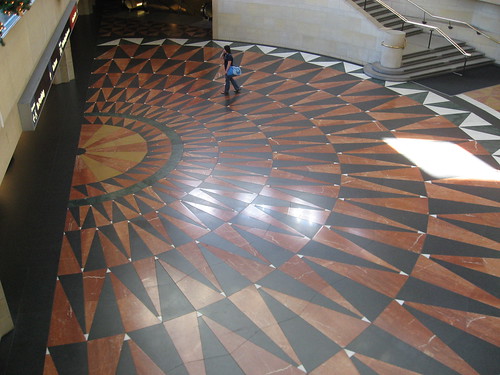
Looking down, this floor.

Union Station, Los Angeles

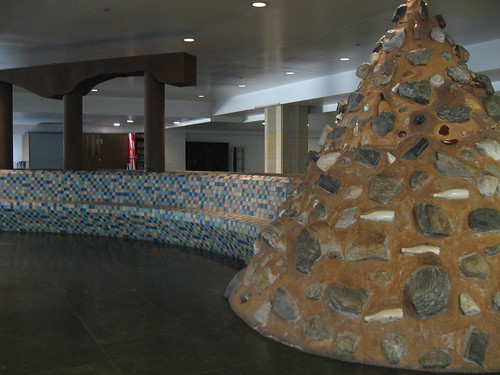
Below is May Sun's "Riverbench". Embedded in that mountain and in the "river" laid in the top of the bench are vintage artifacts found in the station's excavation. Nearly everything - bottles, kitchenware, etc. - is a remnant from when the area was the city's Chinatown. (If you want to see images of tons of pieces of old Chinatown dug up during construction, search USC's Digital Archive site. The webpage is also the source of the black and white photo above.)

Union Station, Los Angeles

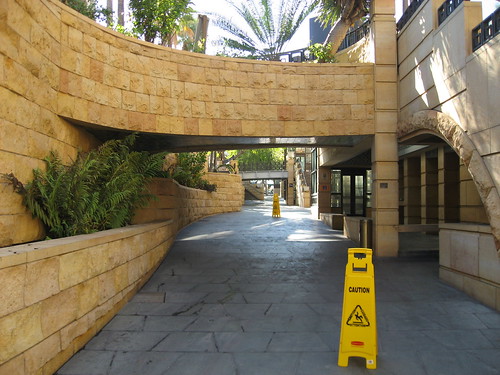
The stretch below, not including the caution marker, is the entrance to 1995's "La Sombra el Arroyo" by the artist team called East Los Streetscapers.

Union Station, Los Angeles

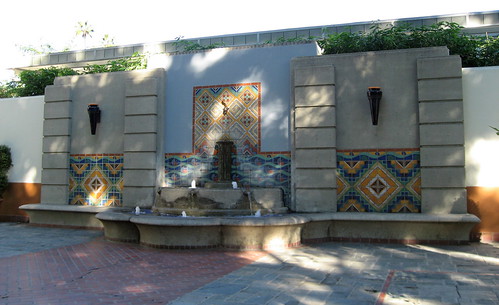
There are enclosed patios are on each side of the main waiting room. This is a picture of the restored fountain in the north patio.

Union Station, Los Angeles

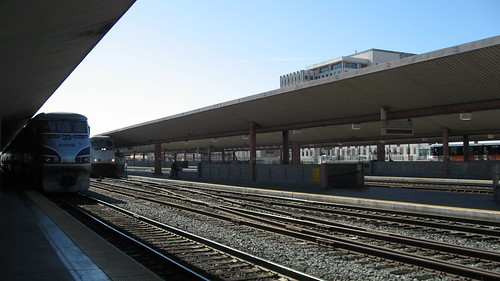
Back in the day, passengers exiting Union Station would leave through the southern garden patio, below.

Union Station, Los Angeles

Next to the southern garden held Fred Harvey’s last Harvey House restaurant to be built as part of a railway station. At its busiest, the restaurant served 800 people an hour. Designed by Mary Colter, Union Station’s Harvey House closed in the late 1960s. It's used today for special events.

Union Station, Los Angeles

Union Station, Los Angeles

Harvey House, Union Station, Los Angeles

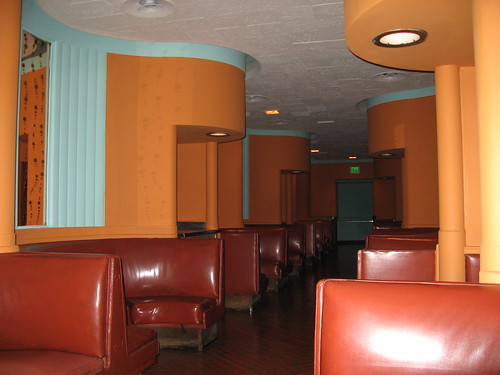
Also part of the old Harvey House is this small bar and dining area, which you really can't fail to appreciate in person.

Union Station, Los Angeles

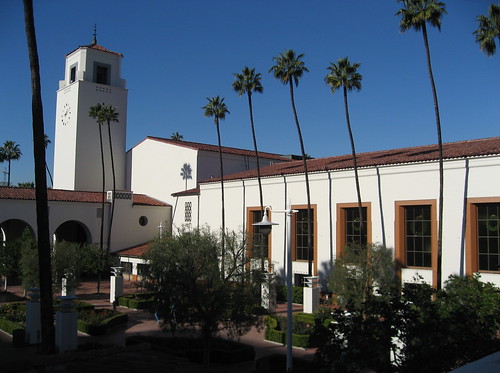
The clock tower is 135 feet tall.

Union Station, Los Angeles

If you haven't yet taken a Los Angeles Conservancy walking tour of Union Station, you really need to do so. They're held the third Saturday of each month, running $10 or $5 for Conservancy members (cheap!).

Union Station, Los Angeles

Source:

“Union Station Celebration Opens Today, Transportation Parade to Start Three-Day Dedication Festival” Los Angeles Times; May 3, 1939, p. 1


Up next: 1030 Cesar E. Chavez Avenue Residence

continue reading...
Monday, December 31, 2007

No. 100 - General Douglas MacArthur Park
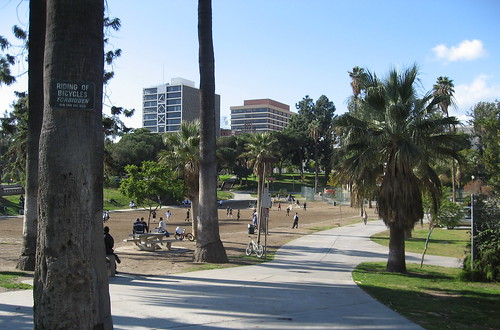
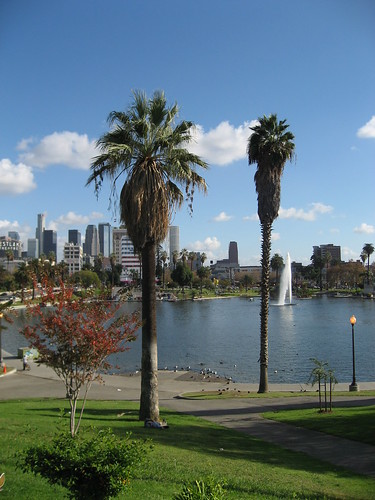
MacArthur Park

General Douglas MacArthur Park
1880s
Area enclosed by Sixth, Seventh, Alvarado, and Park View Streets – map
Declared: 5/1/72

Back at the end of the Civil War, the city of Los Angeles failed to auction off a plot of more than thirty acres westward of the city limits at even twenty-five cents an acre. Too swampy and too far out of town it was, a community dump known locally as the Dead Sea.

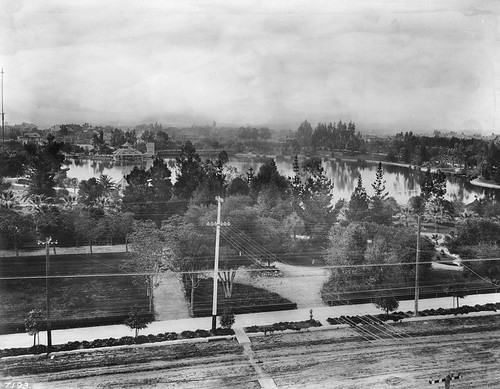
Westlake Park, Los Angeles
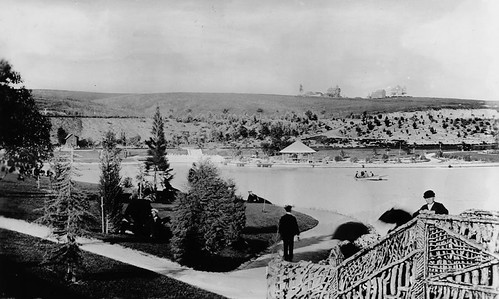
One of the earliest pictures of Westlake Park, from around 1892.

More than twenty years later, in 1887, a group of citizens in the area lobbied the city and Mayor William Workman to transfer the land into a public park. By this time, there were plans to run a streetcar line out to the southeast corner of the lot to service the growing development in the area, like in the new Bonnie Brae tract.

MacArthur Park

Referring to it as “the Southwest Park”, a Los Angeles Times article from April 18, 1887 reported
Residents of the southwestern quarter of the city are moving in the matter of securing an appropriation from the city for the improvement of their park. The land reserved for the purpose comprises thirty-five acres, lying north of Seventh and west of Alvarado streets. There is an unsightly gully running through it, which the intention is to make an artificial lake or pond covering about fifteen acres. For this the city has available water, and the expense of turning it in need not be inordinate. For the rest, the park grounds surrounding the proposed lake are a series of rolling hills, having naturally a rich friable [friable adj easily reduced to tiny particles - ed.] soil, and these, under the gardener’s hand, might be rendered very delightful.
MacArthur Park

Development of the land kicked into high gear in 1889 when a group of West Side citizens rallied to begin assessing local property owners five dollars per lot to put toward the park’s improvement. The city agreed to match the funds. It was also in that year L.A.’s brand new Parks Commission undertook the construction of the lake and boathouse for swimming and boating and a bandstand for afternoon concerts.

The space became Westlake Park (Westlake’s sister, Eastlake Park in East L.A., became Lincoln Park in 1917).

Westlake Park, Los Angeles
Circa 1908.

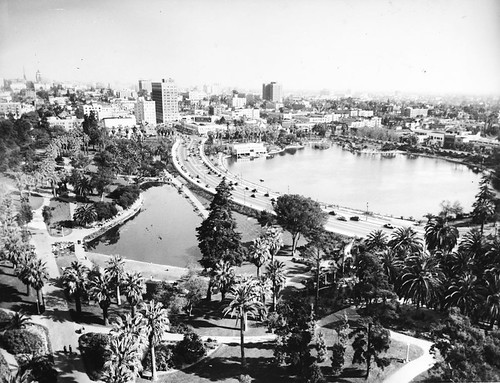
MacArthur Park, Los Angeles

By the early 1930s, Wilshire Boulevard, ending at the west side of the park, had been developed as the fashionable “Fifth Avenue of the West”. In 1934 Westlake Park was bisected with a viaduct in order to connect Wilshire with Orange Street on the eastside of the park. Orange was widened and renamed Wilshire. The northern half of the lake, to the left in the picture above, was later drained.

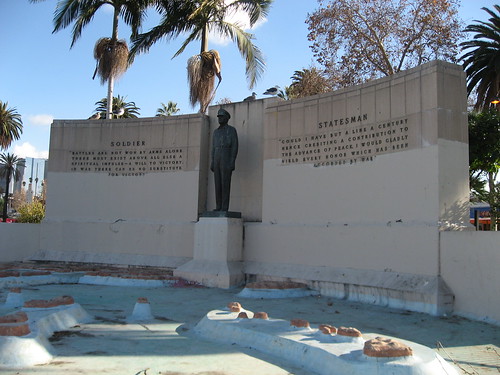
MacArthur monument, MacArthur Park

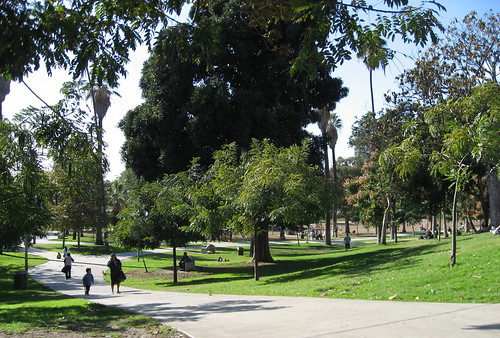
With the U.S. entering World War II just six months earlier, Los Angeles honored the army’s top dog by renaming Westlake Park Gen. Douglas MacArthur Park in May 1942. A 1955 park monument (above) by Roger Noble Burnham has Mac overlooking shapes representing the Philippine Islands where he served as Allied commander.

Band Shell, MacArthur Park

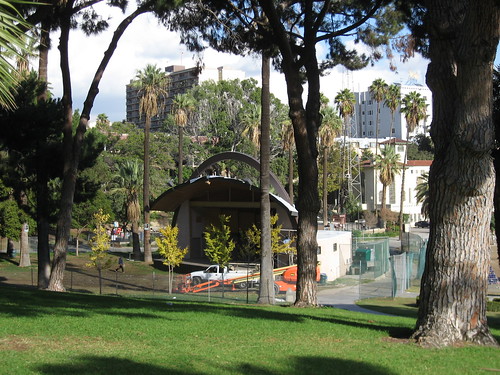
Above’s the Levitt Pavilion for the Performing Arts. The Friends of the Levitt Pavillion – MacArthur Park produces an annual summer concert season featuring dozens of performances.

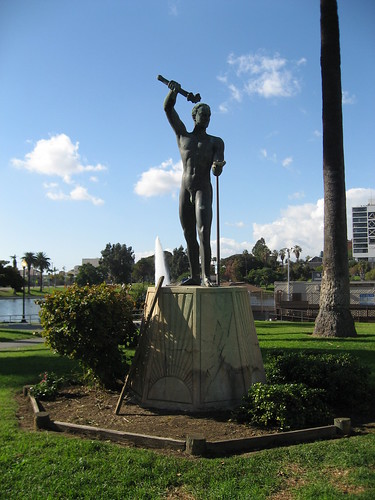
Below is Nina Saemundsson’s “Prometheus”, dedicated in April 1935.

"Prometheus", MacArthur Park

MacArthur Park

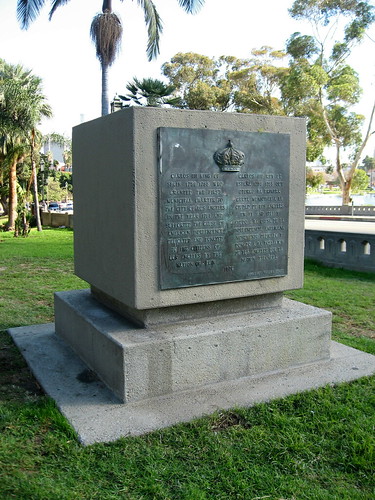
Here’s a blocky 1976 monument dedicated to Carlos III of Spain, supporter of the colonies in the American Revolution. The losing side never gets a monument.

King Carlos III Monument, MacArthur Park

MacArthur Park

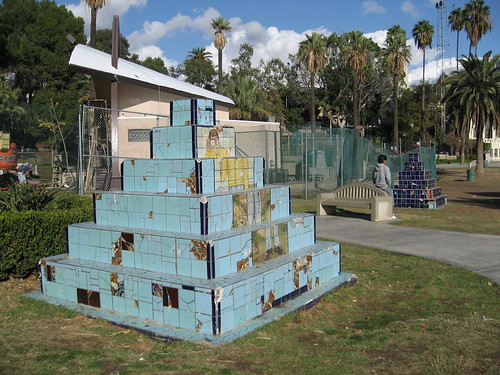
Below is a pair of tiled pyramids made by Judy Simonian with tile by German Rogerio in 1985. The two pyramids are connected with a speaking tube.

Tile Pyramids, MacArthur Park

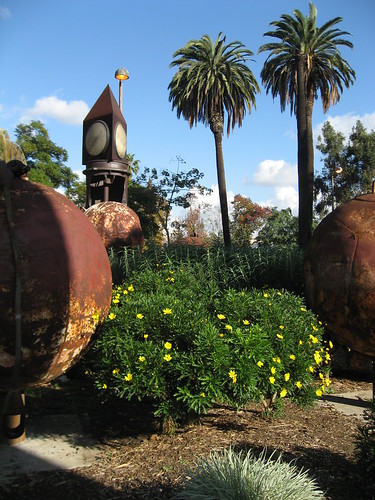
George Herms created "Clock: Monument to the Unknown", below, in 1987 to represent the passage of time.

Clock: A Monument to the Unknown, MacArthur Park

MacArthur Park

General Otis Statue, MacArthur Park
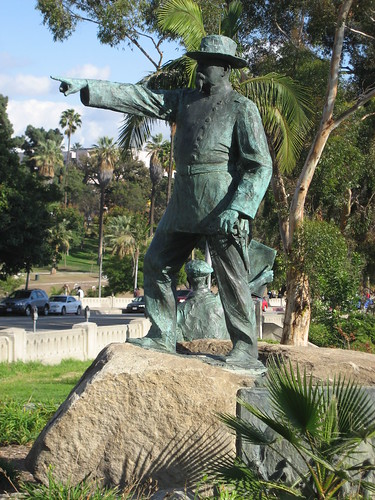
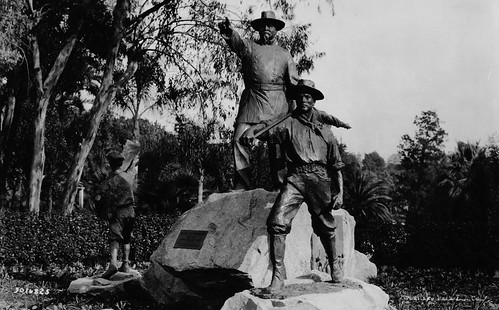
Artist Paul Troubetskoy created in 1920 this statuary tribute to General Harrison Gray Otis. There originally was a third statue – that of a soldier – but he disappeared after apparently being hit by a car. It’s said to be in storage at the Otis Art Institute.

General Harrison Gray Otis Statue
"The Elks' Club is thataway."

MacArthur Park

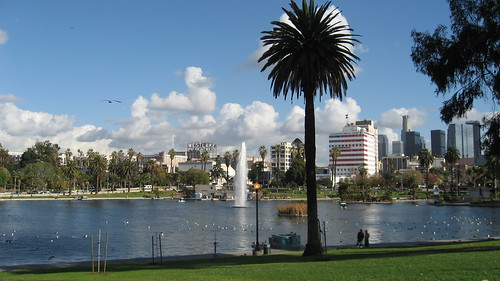
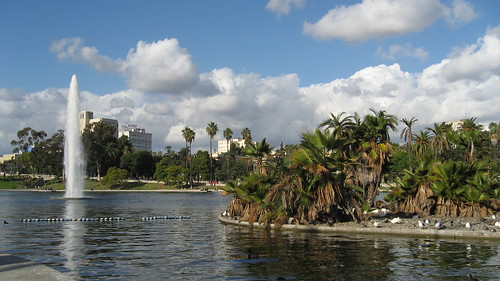
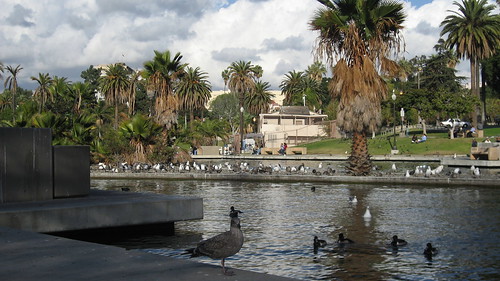
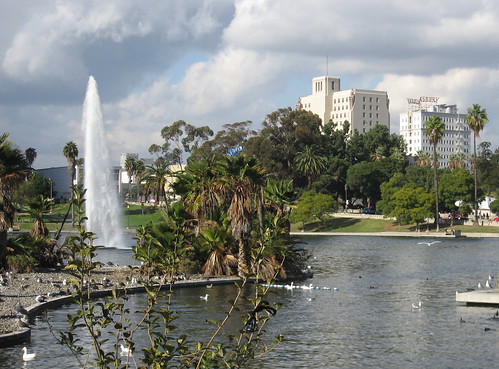
The lake in MacArthur Park has been drained a few times over the years, most notably for construction of the Metro’s Red Line. And while it appears that the park’s worst times are behind it, extremely unfortunate incidents still occur there, in the past year most notably this and this.

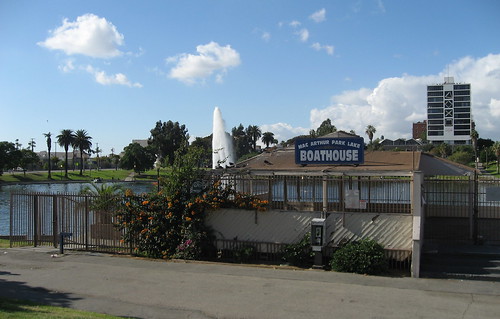
Boathouse, MacArthur Park

MacArthur Park

The black and white shots in this post are from USC’s Digital Archives site. Thanks, USC.

MacArthur Park

Sources:

“The Southwest Park.” Los Angeles Times; Apr 18, 1887, p. 1

“To Improve Westlake Park.” Los Angeles Times; Mar 10, 1889, p. 2

“Westlake Park.” Los Angeles Times; May 12, 1889, p. 3

Ralph Hancock. Fabulous Boulevard. Funk & Wagnalls Company 1949 New York


Up next: Union Station Terminal and Landscaped Grounds

continue reading...