Laurelwood Apartments
1948 – R.M. Schindler
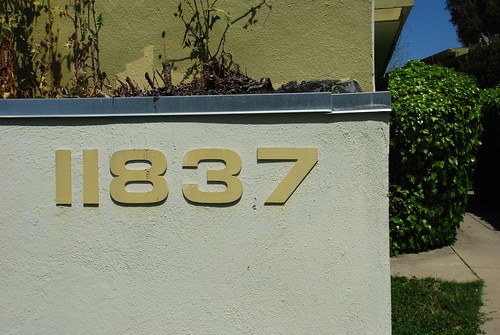
11833 and 11837 Laurelwood Drive, Studio City – map
Declared: 4/22/80
Celebrating this year the 60th anniversary of its completion, R.M. Schindler’s Laurelwood Apartments has had healthier days. The landmark’s condition has been such the city just last year did what it had never done before – took away the owner’s privileges provided by the Mills Act, a 1972 tax incentive program helping owners rehabilitate and preserve their historic properties.
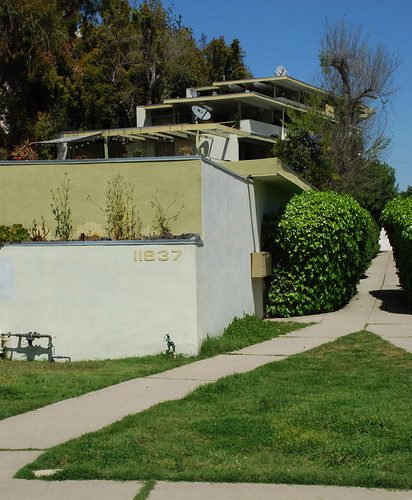
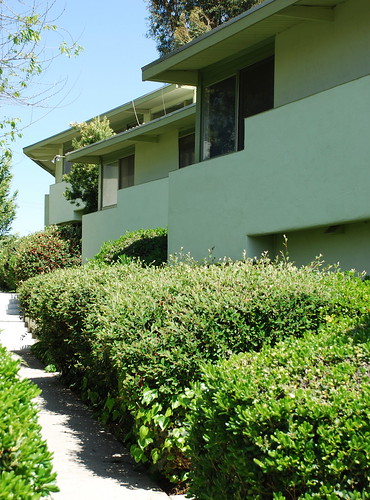
In his career, architect Rudolph Schindler designed about fifty residences (HCM No. 122, for instance) but just four apartment complexes. For the Laurelwood, he was given to work with a plot about an acre in size on two banks of a hill overlooking Ventura Boulevard. He created a two-level complex split into a pair of separate buildings each containing five, two-unit blocks on either side of a central walkway. Schindler gave the ground apartments garden patios, while the upper ones got roof decks.

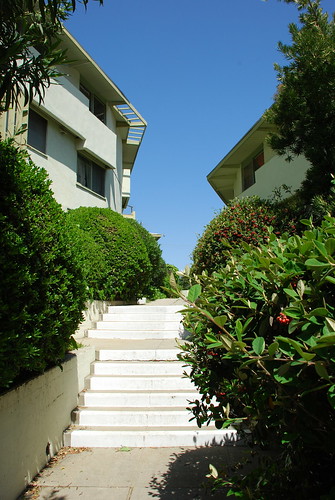
Some of the things which set the Laurelwood apart when it was completed in 1949: wide eaves extending from a flat roof; clerestory windows; L-shaped living/dining areas; patios accessible through sliding glass windows; and garages separating the street from the living space.
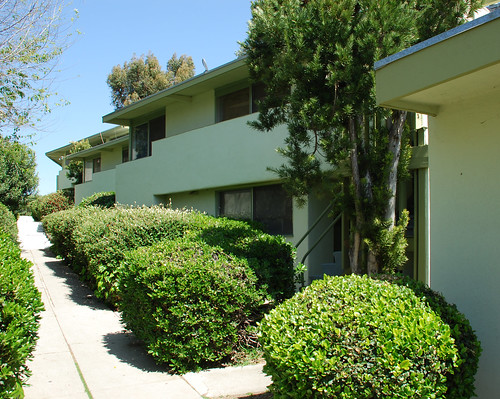
The Laurelwood Apartments came this close to being bulldozed, not once but twice. The first time was after the owner, Laurelwood Properties Ltd, notified renters on New Year’s Eve 1979 of its plans to raze the complex along with the smaller one next to it to make way for fifty-eight new condos. Tenants and preservationists scrambled to have the city designate the Laurelwood a Historic-Cultural Monument which it did in April 1980. The owner surrendered in the demolition fight and instead put the monument up for sale.

Six years later, in the summer of 1986, owner Steve Hartunian of Empire Properties, who had bought the landmark in 1984 for about $900,000, filed for a demo permit. This time, the Cultural Heritage Commission and the Department Parks and Recreation put a freeze on the process, pressuring Hartunian to opt for selling the property rather than wage the war required to tear down the Laurelwood.
Helen Jameson purchased the property in January 1987 for $1.6 million. However, she turned around and put the complex up for sale the following year when City Council extended by six months a one-year hold on any large renovations at the Laurelwood. The city explained “the moratorium was imposed to prevent landlords from using renovation projects as an excuse for removing tenants so they can raise rents beyond levels spelled out in city rent-control rules.” In any event, Jameson changed her mind and kept the Laurelwood.
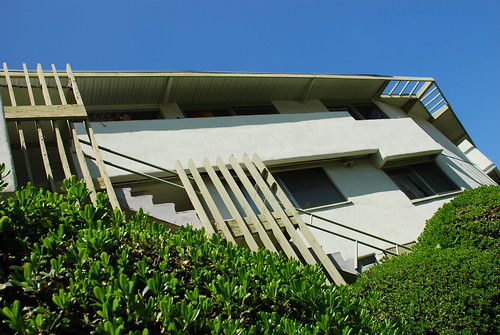
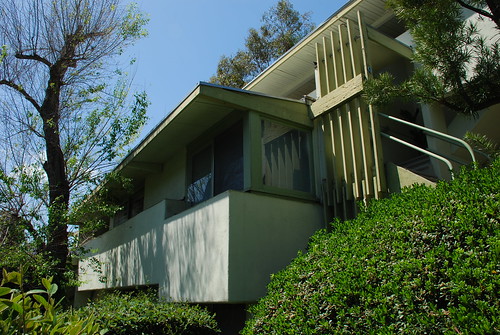
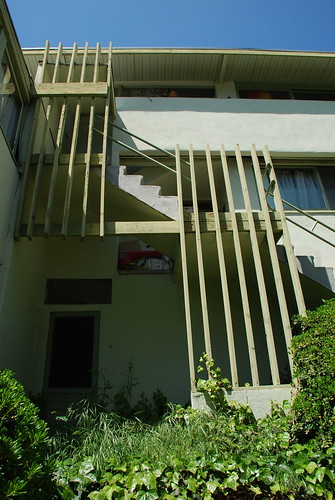
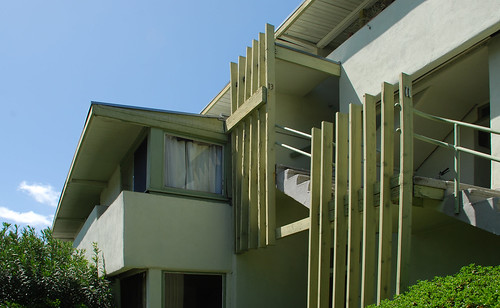
Jump ahead a decade. The Cultural Heritage Commission toured Laurelwood Apartments in February 2007 and found the monument lacked even the basic maintenance and rehabilitation work required as part of the Mills Act contract. Here are some notes of the Commission’s findings:
- Exterior plaster wall finished that are cracked or missing and peeling paint.
- Deteriorated exterior wood finishes including dry rot and peeling paint.
- Spauled and cracked concrete surfaces.
- Inappropriately placed electrical conduits on the exterior surfaces of the building.
- Missing light fixtures.
- Unrepaired planter boxes.
- Deteriorated and missing privacy fences at ground floor gardens and the use of inappropriate fence and screening materials including wooden lattice panels, wood and chicken wire.
- Deteriorated stairways. This is also noted as a life-safety hazard to the occupants of the building.
- Rook leaks and interior water damage.
- Inappropriate roof repairs.
- Trash and other debris lay throughout the property.
- Inappropriately placed plumbing along the front façade.
- Missing façade signage.
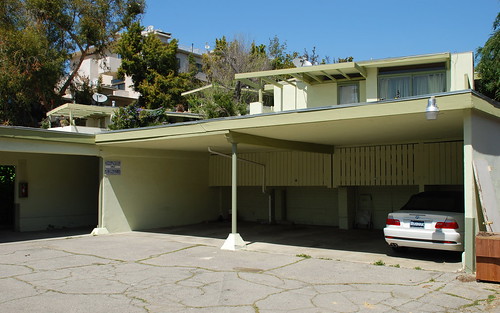
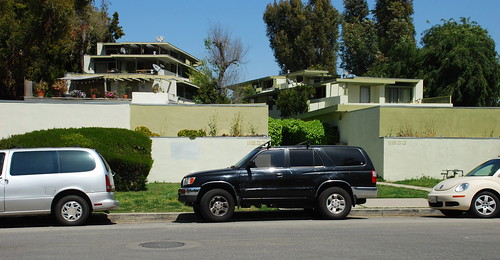
Though there’s been some talk recently of converting the Laurelwood apartment buildings into condominiums (condominia?), the lack of required parking sort of dashes those development dreams (the Laurelwood is sandwiched between a 1990s complex and the older Twin Palms). I don’t have a good feeling about the future for this Schindler work, called one of “the best examples of hillside development because of its unobtrusive design.” The city’s landmark designation seems to be the sole reason we’ve still got it, and history has shown us even that isn’t a guarantee against a monument’s removal.
Sources:
Ryon, Ruth “Schindler Units Face Possible Razing” The Los Angeles Times; Jan 20, 1980, p. I2
Igler, Marc “Preservationists, Tenants Fight to Save Laurelwood” The Los Angeles Times; Jul 5, 1986, p. V_A6
Ryon, Ruth “Schindler ‘Masterpiece’ on the Market” The Los Angeles Times; Jul 20, 1986, p. H12
Pool, Bob “Rent-Control Ruling Ban on Renovations Threatens Landmark” The Los Angeles Times; July 19, 1988, p. 8
Up next: Westminster Presbyterian Church
continue reading...