Showing posts with label Hollywood. Show all posts
Tuesday, March 31, 2009
No. 227 - Janes House
Janes House
1902 – Oliver Dennis and Lyman Farwell
6541 Hollywood Boulevard – map
Declared: 4/3/80
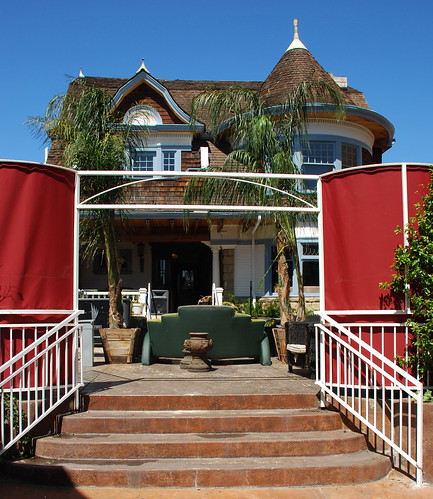
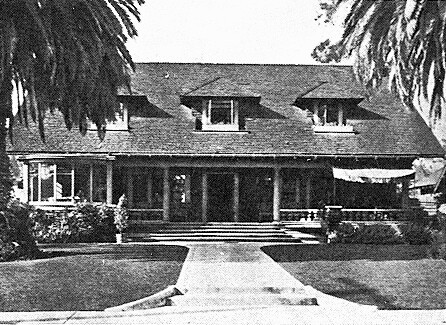
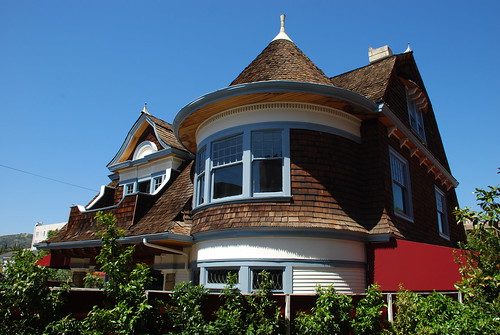
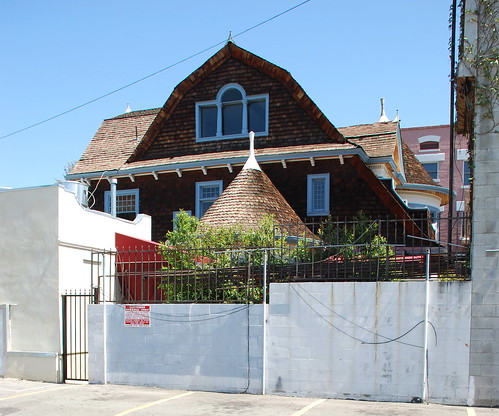
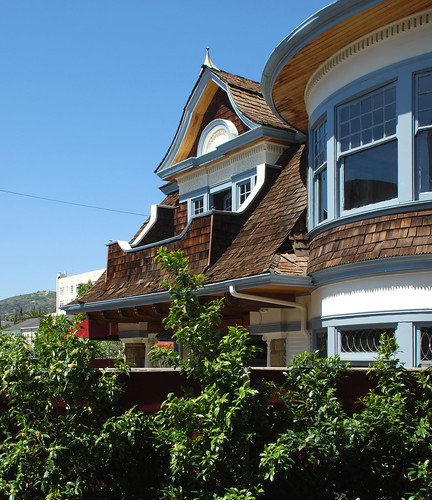
Welcome to the oldest building in Hollywood, a Queen Anne/Dutch Colonial Revival single-family house designed by Oliver Dennis and Lyman Farwell for H.J. Whitley, the Father of Hollywood. While it was Whitley who built the home in 1902, it’s associated with the family who bought the house the following year, the Janes of Aurora, Illinois.
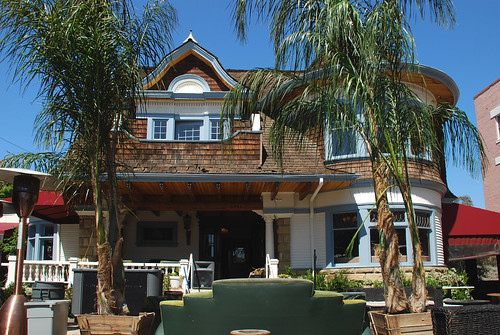
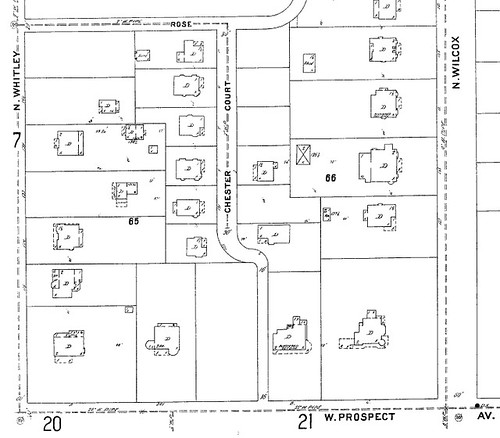
Herman Nelson and Mary Ruth Janes had been running a furniture business in Aurora when they purchased this home at what was then 241 West Prospect Avenue for $10,000. This was in June 1903. Here’s a Sanborn fire insurance map of the area from the company’s May 1907 volume. The Janes House is the second building from the left along the bottom (Rose is now Yucca; Chester Court is Hudson Ave).
Even though they bought it in 1903, it looks like the Janes – along with kids Mabel Howley, Carrie Belle, Mary Grace, and Robert Donald – didn’t move in until 1905. Six years later, mother Mary, Mabel, Carrie, and Grace opened the Misses Janes Kindergarten here with fifteen students each paying a tuition of five dollars a month. The ladies, who were also responsible for rounding up the children in the morning, usually via the Red Cars that ran up Hollywood Boulevard (Prospect’s name as of 1910), later expanded the school to include the primary grades. By the end of World War I, the Misses Janes private school featured courses were French and esthetic dancing.
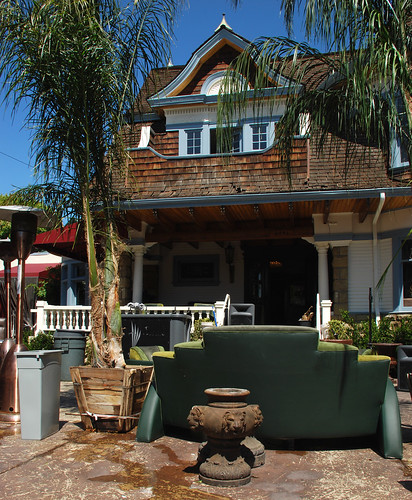
It was a successful school, too, with more than 1,000 students attending here between 1911 and the time it closed in 1926. With Hollywood bigshot names of DeMille, Lasky, Ince, Beery, Chaplin, and Laemmle, the kids would attend classes outdoors, weather permitting (and in Los Angeles, it almost always permits). The Misses Janes School shut down after its final graduation exercises held at Hollywood High on June 19, 1926. An “at-home” for all former pupils of the school was held the following Saturday.
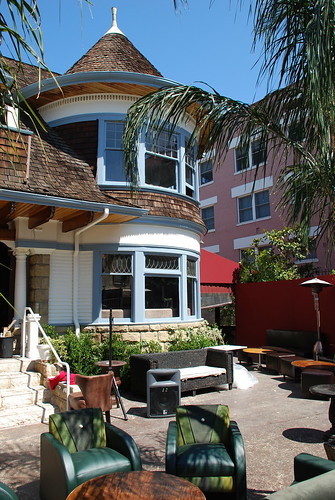
The Janes House also served as a local meeting place. Legend has it the first gathering to establish the Hollywood Bowl was held here.
After the school shut down, brother Donald set up a gas pump in the front yard and catered to motorists by opening Janes Auto Service. The gals continued to live in the home, though. Carrie Belle, in her forties, was the first (and only?) sister to get hitched, marrying Ernest Collier in the 1930s. After his death in 1964, she rented the space out front along the boulevard to street vendors.
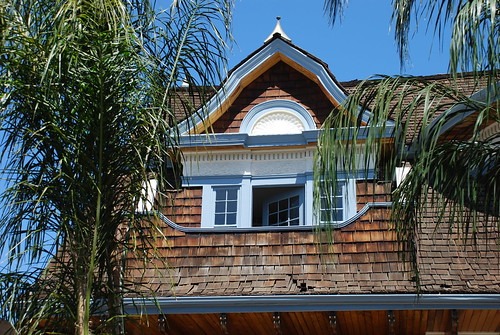
Saying the home lacked architectural significance, the Cultural Heritage Board declined to designate the Janes House a monument in 1972. Eight years later, however, the group claimed the building had enough historical significance to warrant landmark status.
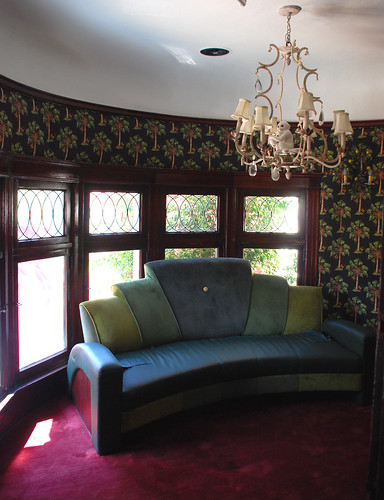
Now, from most accounts, it sounds like the living conditions at the Janes House in the 70s was a little grim. A man named Guy Miller, inventor of the Vocabumat, moved in as an ostensible caretaker around 1975, about two years after Grace died. After living a few months in a nursing home, Mabel passed away in 1978 right around the same time brother Donald died. After spending the last few years of her life in the kitchen sleeping on a window box converted to a bed, Carrie Belle was moved to a Studio City convalescent home in March 1982. She died the following January at the age of 94. That sure was a ton of change Carrie Belle witnessed outside her front door over the course of her sixty-seven year stint living on Hollywood Boulevard.
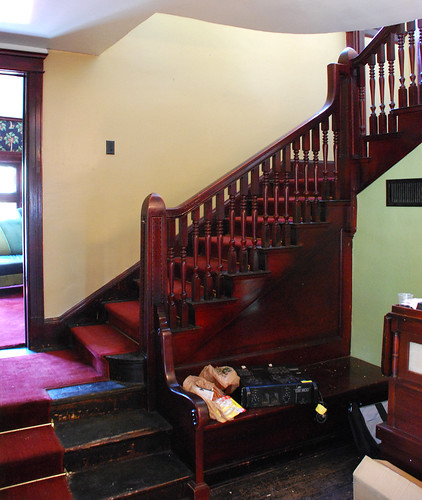
Even before Carrie Belle passed on, her court-appointed conservator was working on selling the home for development. Despite the efforts of Mr Miller and Hollywood Heritage, the house was put up for sale in January 1984 for $695,000. The city, citing the building’s landmark status, delayed a demo permit issued a few months later. In the summer of 1984, developers Sayam Bamshad and Parviz Ebrahimian outbid Hollywood Heritage and bought the Janes House for $600,000.
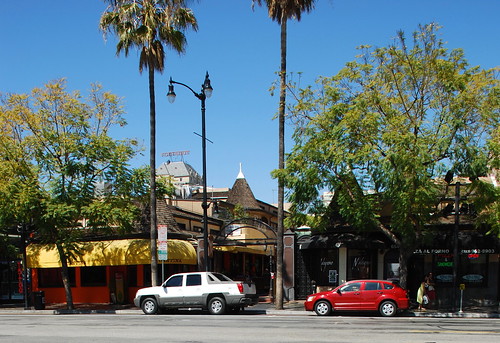
Rather than demolish the historic building, in September 1985 the new owners moved the home toward the back of the lot, building the Janes Square Landmark Shopping Center out by the boulevard. The shopping center features two rows of buildings mirroring the style of the landmark separated by a courtyard leading back to the Janes House. The Greater Los Angeles Visitors and Convention Bureau set up shop in the former schoolhouse in August 1986. Here’s a picture of the shopping center where the Janes House originally stood:
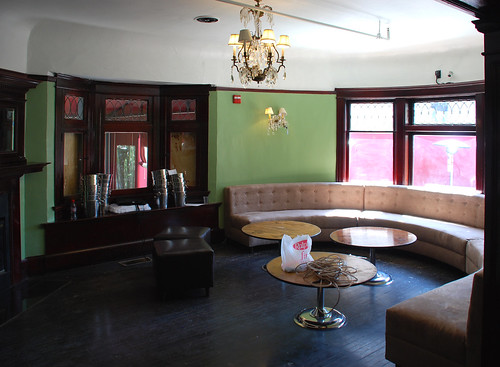
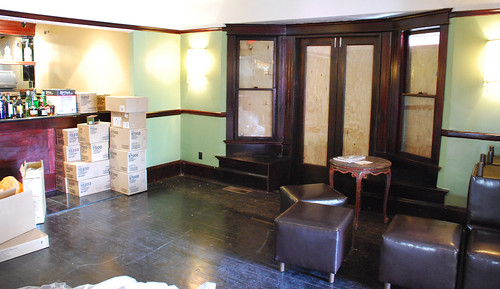
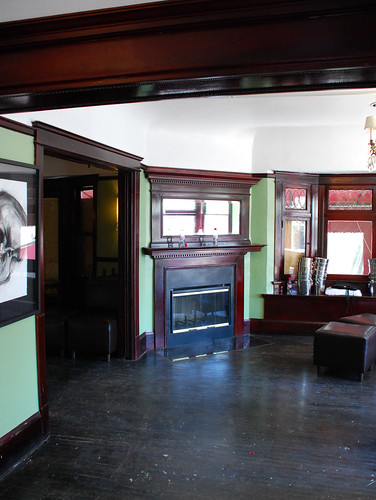
In 2006, the Jane House was converted into the southern food restaurant called Memphis. It failed quickly, but that isn’t stopping Kimoon Kim and Katie Matthews taking a crack at opening a new restaurant here, appropriately named Janes House. The place opens in a few weeks (these interior shots here were snapped as the owners prepped the place for a test run).
Sources:
“Southern California’s Institutions of Learning Stand Unequaled in America Today.” The Los Angeles Times; Aug 17, 1919, p. III17
“Hollywood High School to Graduate Its Largest Class Next Week.” The Los Angeles Times; Jun 19, 1926, p. 8
Smith, Jack “Janes Sister Carries On” The Los Angeles Times; Jun 2, 1980, p. G1
Morain, Dan “Pioneer’s Home” The Los Angeles Times; Oct 3, 1982, p. WS1
Morain, Dan “Owener Dies; Home’s Future Uncertain” The Los Angeles Times; Jan 20, 1983, p. WS1
“Supervisors Agree to Save Old House” The Los Angeles Times; Sep 1, 1983, p. WS7
Curtius, Mary “Sale of Victorian House Collapses” The Los Angeles Times; Jan 19, 1984, p. WS1
Braun, Stephen “$540,000 Cash Offered for Victorian House” The Los Angeles Times; Aug 12, 1984, p. WS1
Braun, Stephen “Develop Buys Victorian for $600,000” The Los Angeles Times; Aug 16, 1984, p. WS_A8
Stambler, Lyndon “Hollywood Blvd. House Moves Aside – a Bit – for Progress” The Los Angeles Times, Sep 15, 1985, p. WS1
Fanucchi, Kenneth J. “Hollywood Visitors Bureau finds New Home in Historic Janes House” The Los Angeles Times; Aug 28, 1986. P. WS_A3
Up next: Laurelwood Apartments
continue reading...
Posted by
Floyd B. Bariscale
at
10:33 PM
21
comments
Labels: Hollywood
Thursday, March 26, 2009
No. 226 - (Site of) Masquers Club Building
(Site of) Masquers Club Building
c. 1918
1765 North Sycamore Avenue – map
Declared: 8/29/79
I’ll admit I never heard of the Masquers Club until this landmark popped up on the list. However, I sure recognize many of its former members, including just about every name actor of the 1930s and 40s I can think of. And the genesis of the old clubhouse itself – gone for nearly twenty-four years now – lies with another actor, one I thought I didn’t know but I guess I really did.
Eight men in May 1925 got together to form Hollywood’s first actors club, one, like the Lambs in New York, which would be a “social sanctuary for actors and the theatrically inclined.” For a fleeting moment the men were calling themselves the Jesters, but when they found out the Shriners laid claim to that name, it was Earle Foxe who came up with the name Masquers (you may remember Foxe from such films as The Cub Reporter’s Temptation, Ladies Must Dress, and Rah! Rah! Heidelberg!). And it was the club’s first president, Robert Edeson (A Man’s Prerogative, The Colonel’s Peril, and Has the World Gone Mad!), who coined its motto, “We laugh to win.”
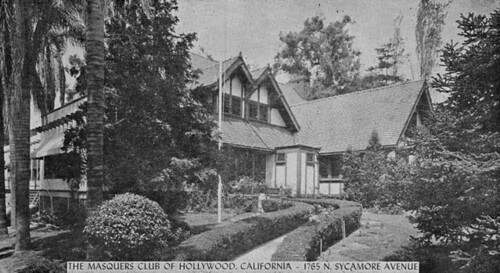
The club set up headquarters in the home below at 6735 Yucca Street (it, too, is gone). The Masquers remained here until the end of April 1928 when they relocated a couple of blocks west to North Sycamore (6735 later served as club for the Shriners).
The Masquers’ first home, on Yucca.
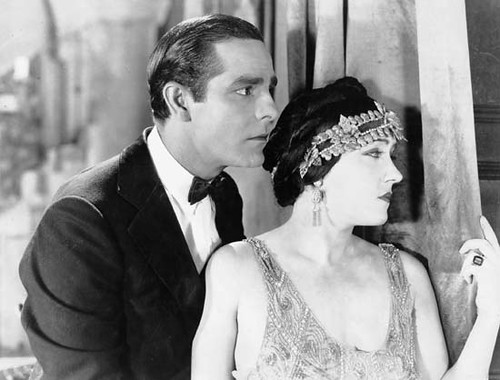
Now we leave that narrative thread to pick up this one: Antonio Moreno, born Antonio Garride Monteagudo in Madrid in 1887, was a popular Latin lover-type in silent films, appearing with Gloria Swanson, Pola Negri, Dorothy Gish, Greta Garbo, and Clara Bow. His career lasted until 1959, a few years after he acted in The Creature from the Black Lagoon and John Ford’s The Searchers. Sometime in the mid-teens, Moreno built himself a two-story Tudor home with fifteen rooms just above Hollywood Boulevard. In 1928, he sold his home to the Masquers whose alterations to the building were to accommodate an English tavern, theater, stage, dining area, kitchen, switchboard, reception office, and entrance lobby. Moreno was a Masquer himself, and was one of the club’s few life-members. (Antonio gets the nod for having lived in two Historic-Cultural Monuments, building with his wife, Daisy Canfield, Silverlake’s Canfield-Moreno Residence, HCM No. 391.)
Moreno and Gloria Swanson in My American Wife
In 1930, when club membership was limited to 700 men, the Los Angeles Times called the Masquers Club Building “one of the most charming, old-fashioned, two-story houses on Sycamore street. It is surrounded by spacious ground filled with trees and shrubs and a large parking space for cars as naturally everybody owns a car. On the first floor is a large dining-room with a small stage at one end on which the club revels are presented every six weeks.” I can’t figure if the “naturally everybody owns a car” line is sardonic or not.
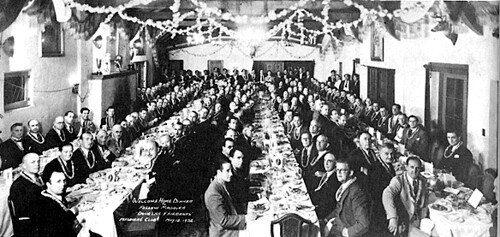
The Masquers club was the type of fraternal organization you’d expect it to be, I guess. Charitable functions, all-male public performances which the club called “revels” (the first being held in downtown’s Philharmonic Auditorium), the annual picnic, or “mess”, often held at John Ford’s Encino ranch, and lots of dinners and tributes and such (the picture below is of a 1932 wing-ding honoring Doug Fairbanks). Oh, and the partying, too. A police raid in April 1930 netted a case each of gin and whiskey when a copper pressed a button under the cafĂ©’s manager’s desk revealing a secret compartment behind a wall (“I’m shocked. Shocked!”). Go figure – booze on the premises, what with members at one time or another John Barrymore, Errol Flynn, John Gilbert, Buster Keaton, Frank Sinatra, Stan Laurel, Humphrey Bogart, Joe E. Brown, and W.C. Fields.
Honoring Douglas Fairbanks
The Masquers Club was also in the movie business, co-producing as an entity a series of two-reelers for RKO from 1931 to 1933. And it members, along with those of the Dominos (a Masquers Club for dames) and the Hollywood Cricket Club, were instrumental in the 1933 founding of the Screen Actors Guild. Plus, the clubhouse served as a military canteen and entertainment center during WWII.
In late 1965, the Masquers began to admit skirts into the mix but as “auxiliary members”. Some Masquerettes whose names I recognize: Maureen O’Hara, Mia Farrow, Jane Wyman, Gena Rowlands, Jane Wyman, Edith Head, and Lee Meriwether.
Masquers presidents – called “harlequins” – included Joe E. Brown, Frank Morgan, Pat O’Brien, Charlie Chase, Lou Costello, and Gene Autry. Producer Joe Pasternak was a harlequin from 1970-1978, and the club’s last harlequin on North Sycamore was actor Tony Caruso.
By 1985, the Masquers Club was in big trouble. The organization was struggling with a mortgage of $2,200 on top of being in debt to the tune of about $335,000 (I can’t answer why, after nearly sixty years, the Masquers didn’t own their clubhouse). Membership was low, and with dues at $10 per month, the club would’ve needed a whole hell of a lot of Masquers to make even a dent toward recovery.
In stepped Century City’s Urban Pacific Development Corp, buying the city landmark for $475,000. The good news was the money allowed the club to continue, the bad news its clubhouse would be razed to make way for a fifty-unit apartment building. The Cultural Heritage Board didn’t raise a fuss since the Masquers were leaving and the building had been so altered since Moreno built it seventy years earlier. Last minute attempts at preserving – and maybe even moving – the building failed. Members held a final wake for the clubhouse on Saturday night, April 28, very, very close to the 57th anniversary of their moving in.
Here’s the site of the Masquers Club landmark today, home of Westbury Apartments:
The Masquers moved downtown to the Variety Arts Center on Figueroa where owner Milt Larsen donated that landmark’s third floor to the club for use as its new headquarters. Although some of it disappeared in the club’s final days on Sycamore, the Masquers’ extensive memorabilia collection went with them. I have no idea where all that stuff, including the club’s famous nude murals by Henry Clive, eventually wound up.
Although it has no clubhouse, the Masquers Club still exists today with William Malin as its current harlequin. Membership is by invite only, although at $55 a year (cheap!) it’s less expensive today than it was twenty-five years ago.
Sources:
“Button Pressing Reveals Liquor” The Los Angeles Times; Apr 13, 1930, p. A5
Thompson, Paul “Show Without Women Will be Given” The Los Angeles Times; May 4, 1930, p. B11
Dean, Paul “Unmasking Masquers: End of a Landmark?” The Los Angeles Times; Apr 25, 1985, p. H1
Up next: Janes House
continue reading...
Posted by
Floyd B. Bariscale
at
10:57 PM
7
comments
Labels: Hollywood
Thursday, November 13, 2008
No. 198 - KCET Studios
KCET Studios
1920
4401 Sunset Boulevard – map
Declared: 9/20/78
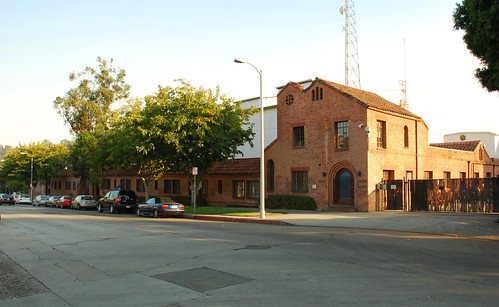
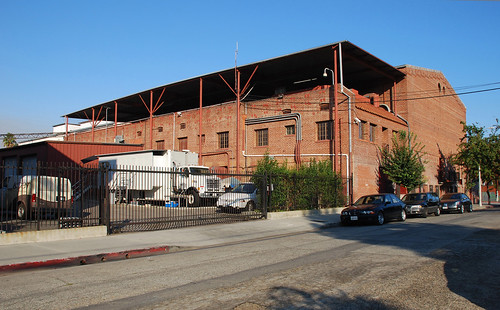
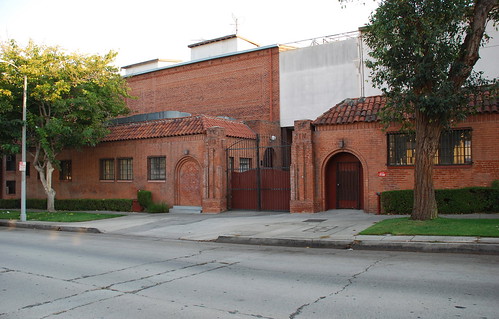
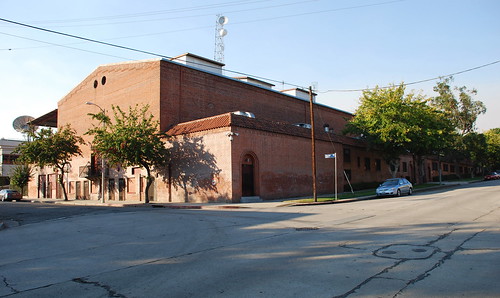
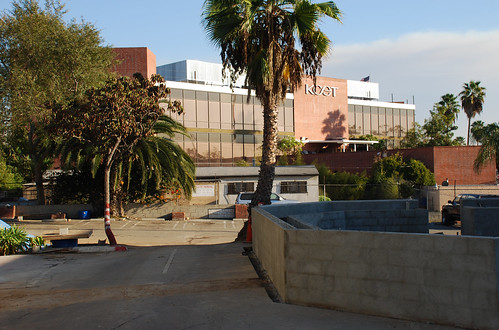
The ample, red-brick building fronting the south side of the 4300 block of Sunset Drive in Los Feliz holds nearly ninety years of Hollywood history. But while the structure dates back to 1920, the property’s ties with Hollywood filmmaking go back a few years farther, to 1912.
Born in 1851 in present-day Poland, Siegmund “Pops” Lubin emigrated to the United States in 1876. Edison film distributor, theater owner, studio head, and maker of cameras, projectors, and printing machines, Lubin set up his Lubin Manufacturing Company in Philadelphia around the turn of the century. In 1912, Lubin opened a west coast branch on a chunk of land at 1425 Fleming Street (now Hoover). Lubin made just a couple of films here before selling the property to the Essanay Film Company the following year, moving on the East Los Angeles. “Pops” Lubin died near Atlantic City in September 1923.
Essanay, which got its name from the ‘S’ and ‘A’ initials of its founders, George K. Spoor and Broncho Billy Anderson, lasted on Fleming Street for just a couple of months, but long enough to churn out twenty one-reel westerns.
Vacant throughout the summer of 1913, the property saw the Kalem Company move in that October. (Kalem was named for owners George Kleine, Samuel Long, and Frank Marion. Folks back then really liked their initials, apparently.) Kalem made films here into early 1917, going out of business by year’s end.
By the beginning of 1918, theatrical agency Willis & Inglis had moved onto the property, building a couple of stages and setting it up as a rental studio. With that August’s arrival of movie producer Jesse D. Hampton, the lot was soon known as Hampton Studio. Jesse split about five months later, but not before having made more than two dozen films with stars including William Desmond and H.B. Warner.
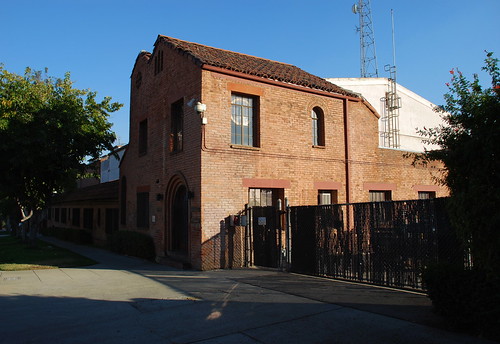
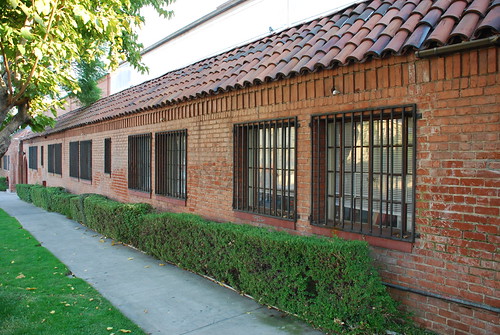
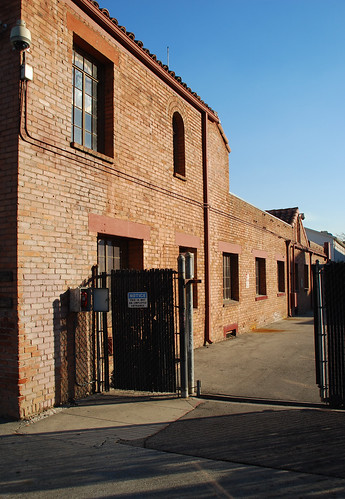
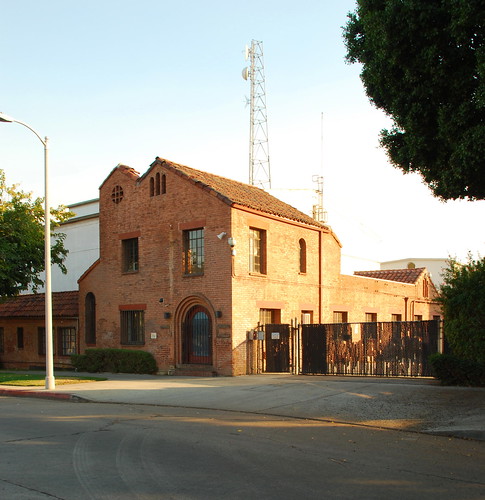
Willis & Inglis founded Charles Ray Productions with Ray in 1920. (Charles Ray, it turns out, was a pretty big cheese as an actor in the late teens and early twenties. Why didn't I know he was so famous?) It was when Charles Ray Productions took over the property that this good-looking brick building was built. (KCET uses a Sunset Boulevard address, but to get a look at the exterior of the old studio, you need to drive around the block – something I had never done.)
Charles Ray Productions – along with Charles Ray – went bankrupt by 1923 after a string of failures, most notably that year’s The Courtship of Myles Standish. (Although the studio’s reconstruction of the Mayflower became a local tourist attraction, no copies of the film survive.) It was the Bank of Italy (later the Bank of America) which took the lot into receivership and re-addressed the property from 1425 Fleming Street to 4376 Sunset Drive.
The bank returned the lot to its days of the late teens when it became once again a rental studio. It remained rental after former actress Jean Navelle bought the property in 1927. She lost it after the Crash of ’29, and the studio went back into the hands of the Bank of Italy. In 1933, Martha J. Like, the mother of sound engineer and head of International Recording Engineers, Ralph M. Like, bought the lot. This was after Ralph had converted Stage A for sound and just a year after he built what is today’s Stage B of KCET. The lot became home to Like’s Action Pictures and, later, Mayfair Pictures.
W. Ray Johnston’s Monogram Pictures Corporation, a company who’s history stretched back to 1915, bought the lot from Like in 1943, having rented the studio for years (they had been based at the former Tiffany Studios nearby at 4516 Sunset). While under the Monogram moniker, the studio produced tons of movies, mostly in the ‘B’ and ‘C’ categories. Charlie Chans, Joe Palookas, Bowery Boys, and Cisco Kids were produced here, along with those Jiggs & Maggie and Bomba, the Jungle Boy, films. And don’t forget all those western: Jimmy Wakely; Whip Wilson; and more than sixty Johnny Mack Brown westerns.
In 1946, Allied Artists was formed as a subsidiary company to Monogram. While Allied was created to concentrate on bigger budgeted films, I know them mainly for such movies as Invasion of the Body Snatchers and Attack of the Fifty-Foot Woman (but Love in the Afternoon and Friendly Persuasion were theirs, too). Allied retired the Monogram name in 1953.
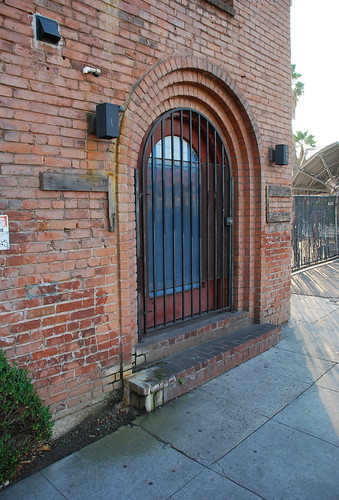
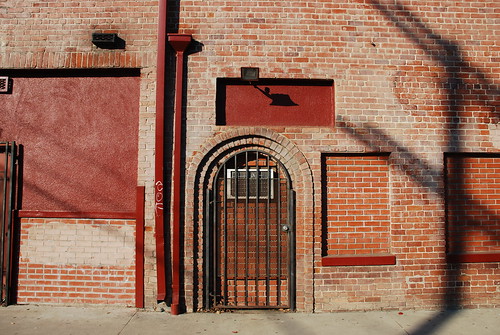
So are the bars over the brick wall left over from when there was a door there, or are they there to protect the air conditioner?
Allied Artists gave up producing for distributing and fled to New York City in 1964. The property became a rental lot once again. ColorVision bought “Pops” Lubin’s old property in 1967 but went bankrupt two years later. In the summer of 1970, the L.A. Times announced public television station KCET was buying the 3.5 acre lot for $800,000. Community Television of Southern California the station’s parent company, finalized its purchase of the property in 1971. KCET relocated from its original home at 1313 North Vine Street in October 1971. The new $3.2 million studio was dedicated November 18, 1971.
One last note about the studio: in 1979, an employee’s errant karate kick exposed behind a damaged wall an ornate screening room dating to the Charles Ray days. It’s now being used as a meeting room.
I lifted maybe 79% of the information in this post from KCET’s history page on its website. Go to it for a lot of lot history along with photos of the property through the years. I emailed them to find out who assembled the article so I could give him or her an extra thanks, but I didn’t hear back. (Update: As I expected, the piece was written by Marc Wanamaker. Thanks, Marc.)
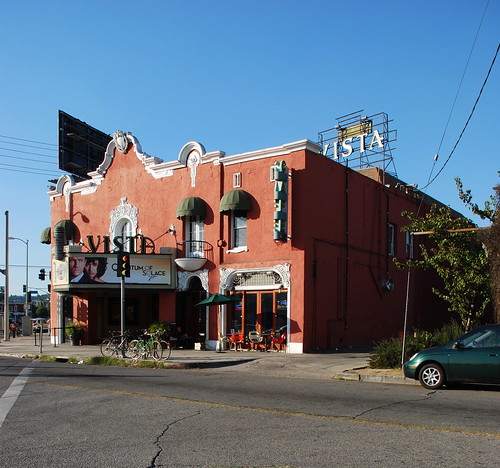
The Vista Theater close by.
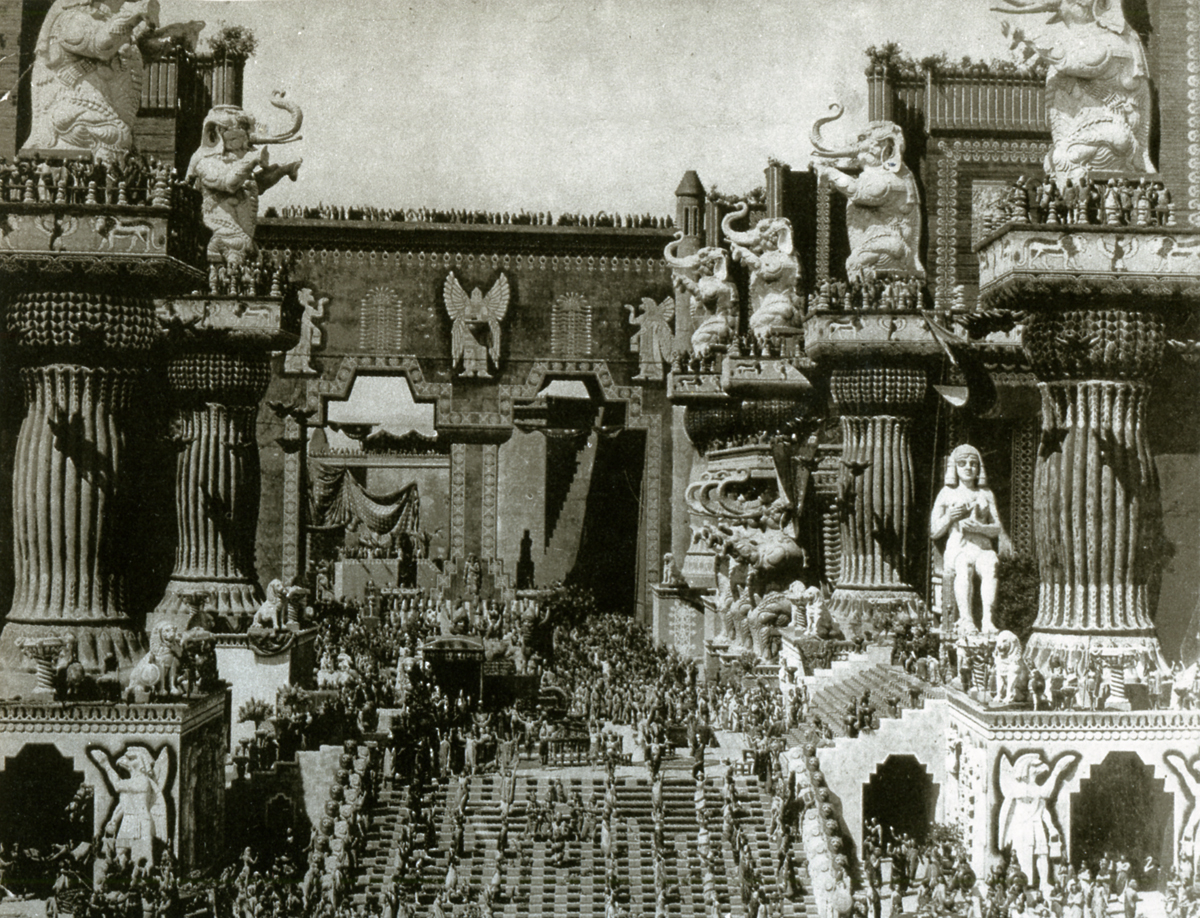
Oh. And when you swing by HCM No. 198, make sure you visit the old Vista Theater at 4473 Sunset Drive nearby. Designed by Lewis A. Smith, it opened as Bard’s Hollywood Theater in October 1923 on the site of the filming of D.W. Griffith’s Intolerance.
Sources:
Knapp, Dan “Allied Artists Studio Purchased by KCET” The Los Angeles Times; Jul 27, 1970, p. D14
“Koch, Sharon Ray “Fete Hails New Home of KCET” The Los Angeles Times; Nov 17, 1970, p. G1
“$3.2 Million Studio Dedicated by KCET-TV” The Los Angeles Times; Nov 19, 19171, p. A26
Turpin, Dick “KCET Will Build Administrative Plant” The Los Angeles Times; Aug 10, 1975, p. D1
Kaplan, Sam “Remnant of Old Hollywood” The Los Angeles Times; May 6, 1979, p. K1
Up next: David Familian Chapel of Temple Adat Ariel
continue reading...
Posted by
Floyd B. Bariscale
at
6:44 PM
7
comments
Labels: Hollywood
Monday, October 27, 2008
No. 194 - Hollywood Walk of Fame
Hollywood Walk of Fame
1960
Hollywood Boulevard between Gower Street and La Brea Avenue, Vine Street between Yucca Street and Sunset Boulevard – map
Declared: 7/5/78
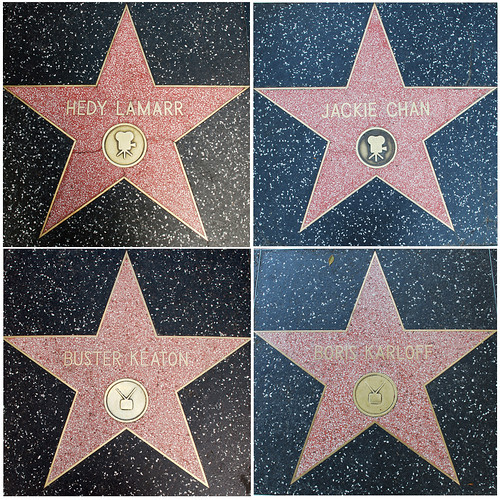
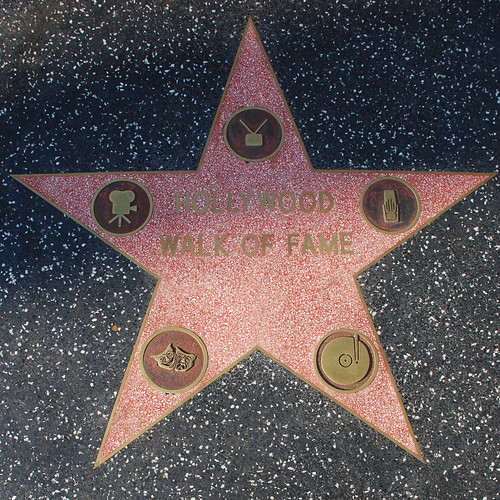
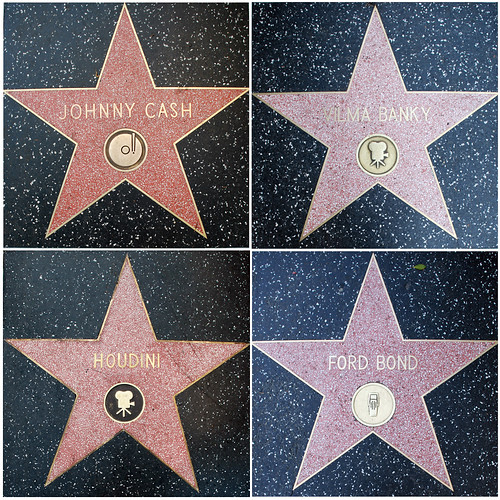
So two things I’ve learned from researching for this post. First, it turns out we just missed the fiftieth anniversary of the Walk of Fame’s first (demonstration) star’s dedication. Secondly, for years I’ve been telling guests from out-of-town during the obligatory walks down Hollywood Boulevard that the Hollywood Chamber of Commerce hands out stars in four categories: radio; movies; TV; and recording. But, guess what? There’s actually a fifth category, and it’s for the rare-as-hen’s-teeth live theater/live performance star. I did not know that. Here’s a good trivia question: just one person has been awarded a star in each of the five categories. Who is it? The answer’s after the sports pages.
Notice throughout the Walk how some radio microphones point up, some down. That’s sure possible, but I wonder if there’s a rhyme or reason.
It was the Hollywood Improvement Association’s president, Harry M. Sugarman, who came up with the idea of the Walk of Fame back in 1953. More than a million dollars was raised for the project, in large part by assessing businesses $85 per foot fronting the proposed 15,000-foot Walk. 2,500 pink terrazzo stars would be laid out in 3' x 3' squares along Hollywood Boulevard, from Gower to Sycamore, and up and down Vine, from Yucca to Sunset.
Six demonstration stars were dedicated on August 15, 1958, at Hollywood and Highland, at the site of the old Hollywood Hotel. Actor Preston Foster drew honors in a lottery to get the first star.
The groundbreaking ceremony for the $1,151,000 project was held February 8, 1960, with Sugarman, Linda Darnell, Gigi Perreau, Francis X. Bushman, Charles Coburn, and others attending. Afterwards, the group went to the Knickerbocker Hotel for lunch. I don’t know what they ate.
The Walk’s official dedication was part of 1960’s Santa Claus Lane Parade on November 23.
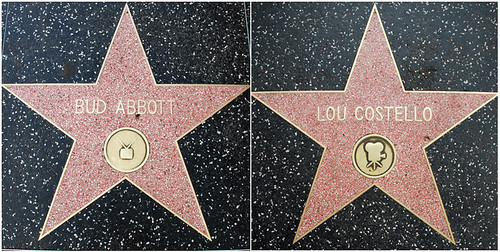
Bud & Lou...
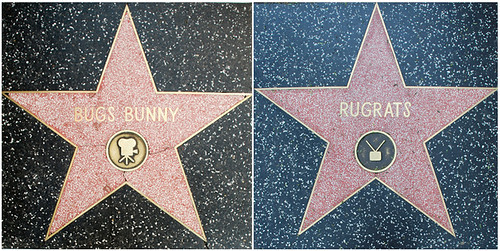
... cartoon characters...
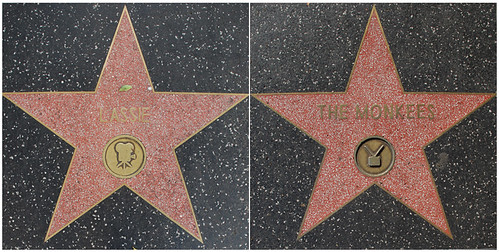
... and even animals.
1,558 stars were dedicated in the sixteen months following groundbreaking. Apparently stars were awarded to not only anyone who had ever entertained, but also to anyone who had ever been entertained.
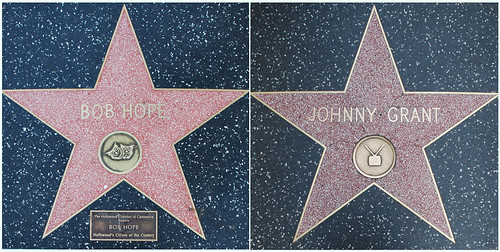
Hollywood’s Citizen of the Century and its Honorary Mayor.
Here’s something: Charlie Chaplin Jr, in October, 1960, lost a lawsuit against Hollywood’s Improvement Association and the Chamber of Commerce for not giving his dad a star on the Walk of Fame. (Charlie Sr eventually did receive a star, but not until the 1970s when Hollywood was less Commie crazy.)
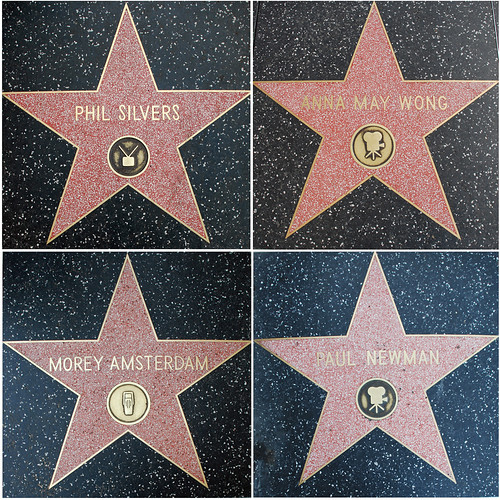
Hollywood’s Celluloid Heroes, some that you recognize, some that you’ve hardly even heard of.
In 1994, as star-space was running out, the Walk was extended another block westward to La Brea Avenue. Also, at Hollywood and La Brea, you can find the Silver Four Ladies of Hollywood, a gateway gazebo featuring anything but the likenesses of Dorothy Dandridge, Dolores Del Rio, Mae West, and Anna May Wong, a veritable United Nations of Hollywood stars. It’s also where the Beatles’ and Elvis’s stars are located.
The gazebo, what’s supposed to Dorothy Dandridge, and the Beatles and Elvis.
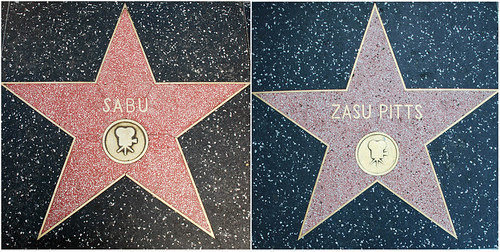
Sabu, Zasu. Zasu, Sabu.
You want a star on the Walk of Fame? Each year the Hollywood Chamber of Commerce’s Walk of Fame Committee reviews nominations during an official nomination period. The criteria for a star are professional achievement, longevity of five years in the entertainment field, and contributions to the community. If you’re alive, you need to attend the ceremony, if you’re dead, you’re off the hook (though you need to be dead for at least five years to be considered). Oh, and it costs $25,000.
After the Walk of Fame Committee gives you the okay, the Board of Directors of the Hollywood Chamber of Commerce and the Los Angeles City Board of Public Works need to give their approvals. Finally, L.A.’s City Council bestows it thumbs-up. Then you’re in.
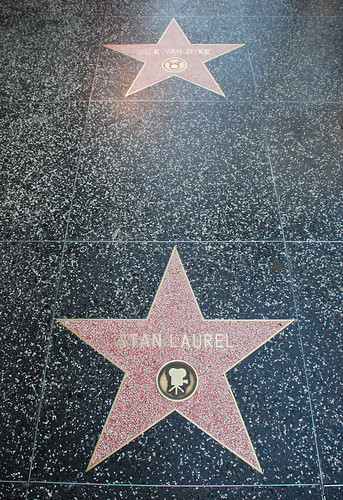
Dick Van Dyke got his star next to that to his idol, Stan Laurel.
The Chamber of Commerce dedicates about two stars per month on the two-and-a-half-mile Walk. Nineteen folks, including Howie Mandel, the late George Harrison, and the mostly-late Munchkins, got their stars in 2008. Twenty-five celebrities are scheduled to receive the recognition next year, including Cameron Diaz, Robert Downey, Jr, the Village People, and Tinkerbell.
This past summer, the MTA set up a Walk of Fame Restoration Committee after it was found the landmark needed $4.1 million in repairs. This followed the 2007 removal of 132 terrazzo squares (sixteen of which featured celebrities’ names) at Hollywood and Highland due to buckling and cracks. (The MTA claims the damage is the result of exposure to the sun. Others think the sidewalk sinking nine inches during subway construction in 1993 may have something to do with it.)
Clearly, I need to get to some of these dedication ceremonies.
One of Hollywood's shooting stars (Spade Cooley has a star, Robert Blake does not).
As part of the planned two-year renovation, the city’s Bureau of Engineering gave each of the 2,365 stars a grade from A to F. Ten stars got an F, fifty received Ds, and 718 earned a C. Those 778 stars, along with 2,155 blank terrazzo squares, will be replaced.
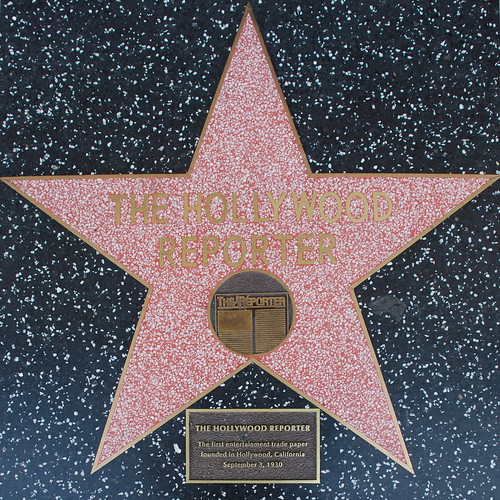
One of a few exceptions to the five categories.
Oh. The only person with a star in each of the five categories? The Singing Cowboy, Oklahoma’s Yodeling Cowboy, Public Cowboy #1, America’s Favorite Singing Cowboy – Gene Autry.
Finally, a Big Orange Landmarks congratulations to the person who suggested placing the Dead End Kids as the last and final star at the western edge of the Walk.
Sources:
“Group Lists Names for Hollywood Fame Walk” The Los Angeles Times; Aug 28, 1957, p. A6
“First Star Set in Hollywood Walk of Fame” The Los Angeles Times, Aug 16, 1958, p. B1
“Hollywood Gets Start on Its ‘Walk of Fame’” The Los Angeles Times; Feb 9, 1960, p. B1
“Chaplin Son Loses Suit on ‘Fame Walk’” The Los Angeles Times; Oct 14, 1960, p. 28
“Stars to Gather for Hollywood’s Walk Dedication” The Los Angeles Times; Nov 1, 1960, p. 21
Pool, Bob “Cost of Repairs for Hollywood’s Buckling Walk of Fame Trips Up Officials” The Los Angeles Times; Jul 17, 2008
Pool, Bob “Faded Stars to Shine Again on Hollywood Walk of Fame” The Los Angeles Times; Jul 22, 2008
Up next: Oviatt Building
continue reading...
Posted by
Floyd B. Bariscale
at
10:58 PM
4
comments
Labels: Hollywood
Subscribe to:
Posts (Atom)