Showing posts with label Southeast Los Angeles. Show all posts

Monday, July 7, 2008

No. 159 - Ralph J. Bunche Home

Ralph J. Bunche Home

Ralph J. Bunche Home
1908
1221 East 40th Place – map
Declared: 7/27/76

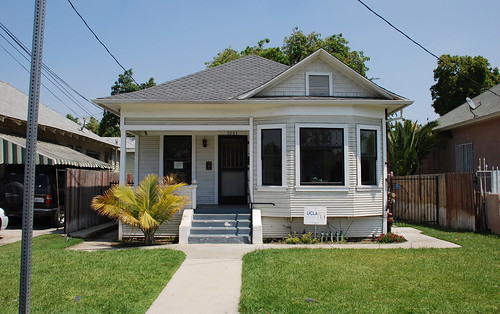
While not the home most associated with Dr Ralph J. Bunchea nice one, designed by Hilyard R. Robinson, still stands in D.C., and then there’s the National Historic Landmark in Queens, N.Y. – it’s in this simple California cottage off South Central where the future Nobel Peace Prize winner lived for about a decade beginning in 1917.
Ralph J. Bunche Home

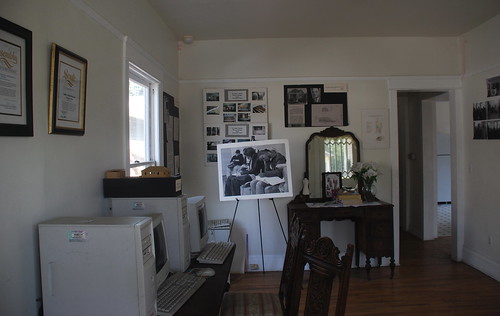
Ralph Johnson Bunch was born in Detroit, Michigan, on August 7, 1903. His family moved from there to Cleveland to Knoxville to Toledo by the year 1909. When Ralph was ten, the Bunch Bunch packed up and relocated to Albuquerque. He lost his parents in 1917 – his mom to TB, his dad to desertion. It was after this when his grandmother, aunt, and uncle bundled up Ralph and his sister and headed to Los Angeles. They first rented a bungalow at 1219 Griffith Avenue, but had to leave when the owner realized the family was black (Ralph’s uncle, like his grandmother, was light-skinned, and had unintentionally fooled the racist). The family wound up moving to this home on what was then named 37th Street.

Ralph – his grandmother by this time had added an ‘e’ to his last name – enrolled at Thirtieth Street Intermediate School (now John Adams Junior High), and then, the following year, Jefferson High, just half a block away from the Bunche home. In 1922, he graduated from Jeff as the senior class valedictorian.
Dr Ralph J. Bunche
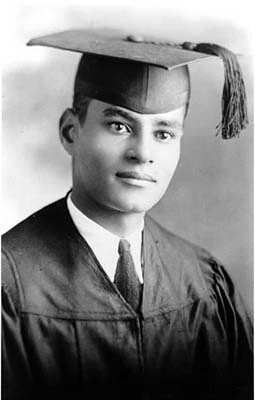
Bunche in 1927, swiped from the L.A. Public Library website.

While continuing to live at home, Bunche attended UCLA (then called the University of California Southern Branch, it was located on Vermont where City College is today), earning tuition money through a variety of jobs. At UCLA, Bunche played football and basketball, wrote for The Bruin, and co-founded a new debate society after he was refused admittance to the UCLA club (he was black, remember). Having majored in political science, Ralph graduated in 1927 summa cum laude, again as class valedictorian.
Ralph J. Bunche Home

Well, once Bunche leaves L.A., his life story becomes a lot more boring: he receives his master of arts degree in political science from Harvard; organizes and chairs the first Political Science Department at Howard University; has three children with his wife, Ruth; is awarded the Julius Rosenwald Fellowship for African research; earns his Ph.D. in political science and international relations at Harvard (the first African American to receive a doctorate in poli-sci); writes a couple of books, including A World View of Race in 1936 and, with Gunnar Myrdal in 1944, The American Dilemma; joins the OSS, focusing on Africa; helps draft the U.N. Charter; serves on the U.S. delegation at first session of U.N. General Assembly in London; after the assassination of Count Bernadotte in 1948, becomes acting mediator in Palestine; negotiates an Israeli/Egyptian armistice; in 1950 becomes the first African-American to be awarded the Nobel Peace Prize; becomes U.N. undersecretary to Dag Hammarskjold and then U Thant; and receives the Presidential Medal of Freedom.

Sickly for much of his life, Dr Ralph J. Bunche died in New York on December 9, 1971. He’s buried in the Bronx.

As for the house, Bunche’s Aunt Nelle lived there until she died in 1975. After years of abandonment, the building was bought by the Dunbar Economic Development Corp. in 1996 with their intention of converting the cottage into a museum. A variety of funding issues stalled the project for years, but, with restoration completed (for which it won a Los Angeles Conservancy preservation award in 2006), the former Bunche home today is the Dr Ralph J. Bunche Peace & Heritage Center.

Ralph J. Bunche Home

Sources:

Urquhart, Brian Ralph Bunche: An American Life W.W. Norton & Company, Inc. 1993 New York, NY

Schraff, Anne E. Ralph Bunche: Winner of the Nobel Peace Prize Enslow Puclishers, Inc. 1999 Springfield, NJ

“Riordan Cuts Red Tape to Begin Restoration of Nobelist's Home” The Los Angeles Times; Mar 12, 1999, p. B4


Up next: Manzanar

continue reading...

Tuesday, April 8, 2008

No. 131 - Dunbar Hotel

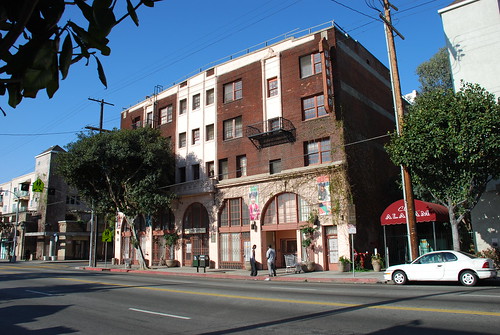
Dunbar Hotel

Dunbar Hotel
1928
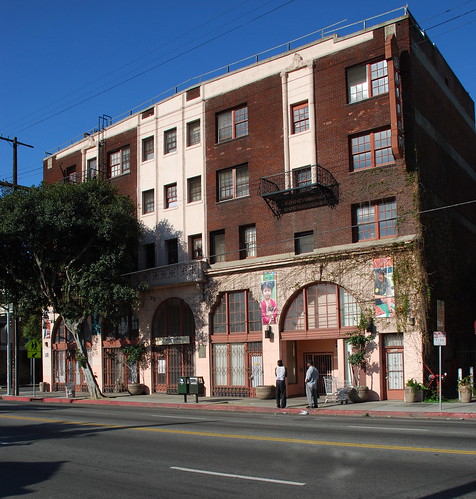
4225 South Central Avenue – map
Declared: 9/4/74
“It was a hotel – a jewel done with loving hands… It was full of sunshine and low voices and the sound of human laughter and running water. The hotel Somerville was an extraordinary surprise to people fed on ugliness – ugly schools, ugly churches, ugly streets, ugly insults. We were prepared for – well, something that didn’t leak, that was hastily clean and too new for vermin. And we entered a beautiful new inn with a soul… Funny that a hotel so impressed – but it was so unexpected, so startling, so beautiful.” – W.E.B. DuBois
Alright. It was irresponsible of me to include the above quote, not knowing the source. However, I lifted it from a display inside the hotel’s museum. I see no reason why anyone would make up something like that, and it sounds something Bill would say, so there you go.

Dunbar Hotel

John Alexander Somerville, born in Jamaica in 1882, came to the U.S. around the turn of the last century. He graduated from USC’s dentistry program as the school’s first black graduate, then became the first black man to pass California’s State Dental Board. (Later on, his wife, Pomona-born Vada Watson Jetmore Somerville, whom he married in 1912, became USC’s first female black graduate and California’s first black female dentist.) Somerville began his profession in a pair of rented rooms at Fourth and Broadway. In 1913, he co-organized the Los Angeles branch of the NAACP.

Dunbar Hotel
Dunbar Hotel
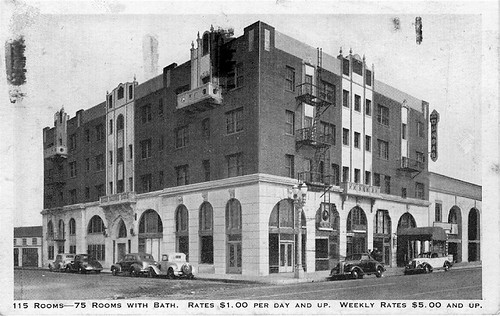
The black and white postcard above is from USC's Digital Archive.

In the 1927, fed up with Jim Crow and segregation laws, Somerville successfully built a 26-unit apartment building, the La Vada, at Vernon and Central. Every unit was rented and the complex paid off.

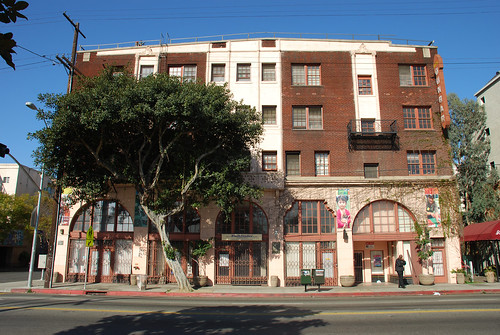
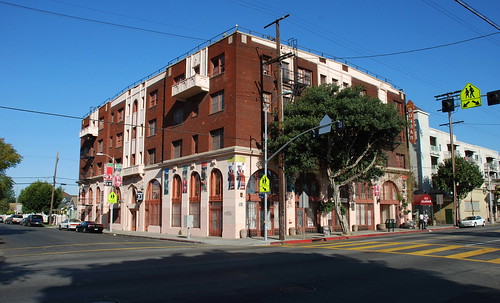
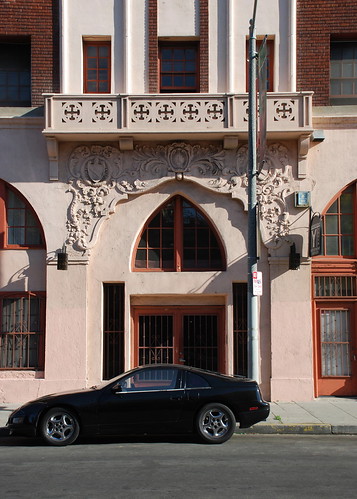
Encouraged by the success of the La Vada, Dr Somerville managed a loan of $100,000 to go toward a new project, a first-class hotel to serve L.A.’s black visitors. “The Pullman Company had hundreds of colored employees coming to Los Angeles daily,” he wrote in his autobiography. “Most of these men, many of whom came from fine homes, had to sleep in the cars at the station because they could not find sleeping quarters during their stay here.” The Hotel Somerville was completed in June 1928 as “the finest hotel in America catering to colored people.” Located at the corner of 41st Place and South Central Avenue, the building was actually about thirty blocks south of the then center of the black community at 12th and Central. However, with the success of the Hotel Somerville, it was only a matter of months before the surrounding vacant lots were bought up with new buildings sprouting almost overnight.

Dunbar Hotel

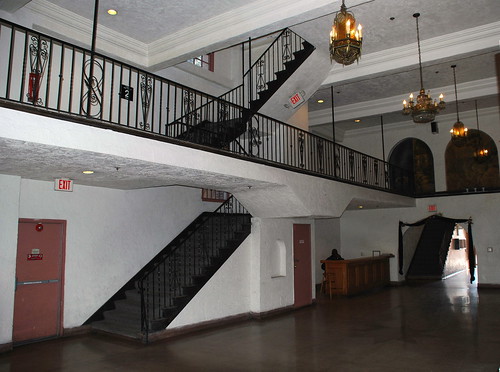
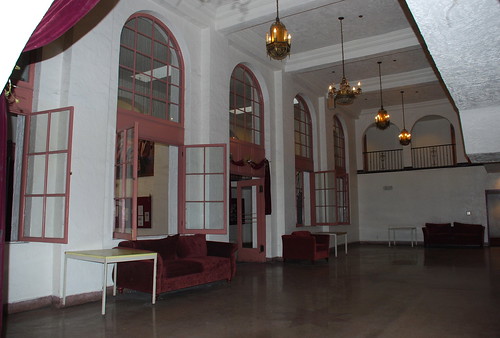
More than 5,000 people stopped by the four-story hotel opening day. Visitors were met with a ground floor that contained stores, a barbershop, a beauty parlor, and a flower shop. The Somerville’s dining room, managed by Fannie Burdette (one of my favorite names, ever), could hold 100 diners and featured a balcony for an orchestra.

Dunbar Hotel

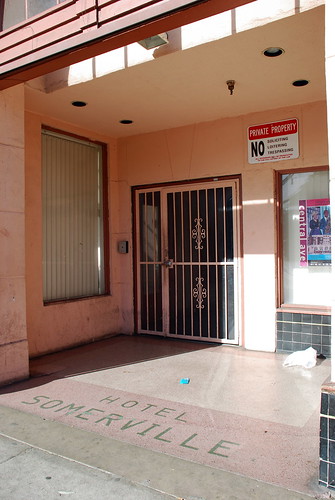
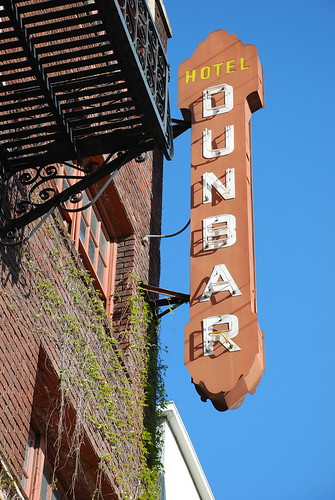
While the Hotel Somerville lettering above dates from the late 1980s restoration, the Dunbar sign below is pure 1930s.

Dunbar Hotel

Just after opening, the hotel, with its more-than-100 rooms, hosted the west coast’s first NAACP convention. Guests included Lincoln Steffens, Mary White Ovington, Arthur Spingarn, James Weldon Johnson, William Pickens, Charles W. Chestnut, and DuBois.

Dunbar Hotel

The following year’s stock market crash hit Somerville hard, and he would lose the La Vada and sell the hotel to gangster Lucius Lomax. Lomax renamed the Somerville the Dunbar in honor of the poet, Paul Laurence Dunbar. Lomax sold the hotel in 1934 to Father Divine’s (aka George Baker’s) Peace Mission Movement. The Nelson family took ownership by the late 1930s.

By the late 1920s, Central Avenue had become the “52nd Street of the West”, also drawing comparisons to Harlem’s 125th Street. The Dunbar was the major stopping place in L.A. for black entertainers, athletes, and writers. Guests included Duke Ellington, Count Basie, Bill “Bojangles” Robinson, Lena Horne, Eddie “Rochester” Anderson, Langston Hughes, Art Tatum, Cab Calloway, and on and on. I sure would love to get a glimpse of any old Dunbar registers.

Dunbar Hotel
Dunbar Hotel

Although you could hear live music in the hotel, like in the Turban Room bar, it didn’t hurt that one of the most happening clubs, the original Alabam, formerly the Apex, was right next door. Other clubs in the area included the Downbeat, the Memo, the Last Word, Dynamite Jackson’s, and lots more.

When looking back on the Dunbar as a meeting place and hangout, musician Jack Kelson, in Central Avenue Sounds, said it was his “… favorite spot on Central Avenue, that spot in front of the Dunbar Hotel, because that to me was the hippest, most intimate, key spot of all the activity. That’s where all the night people hung out: the sportsmen, the businessmen, the dancers, everybody in show business, people who were somebody stayed at the hotel.”

Dunbar Hotel
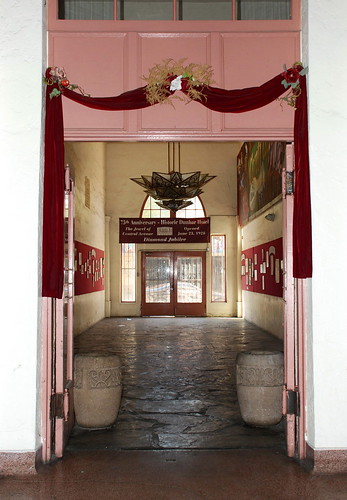
I was confused by the 75th Anniversary sign above, until I realized it was from five years ago. That means 2008 marks the 5th Anniversary of the 75th Anniversary!

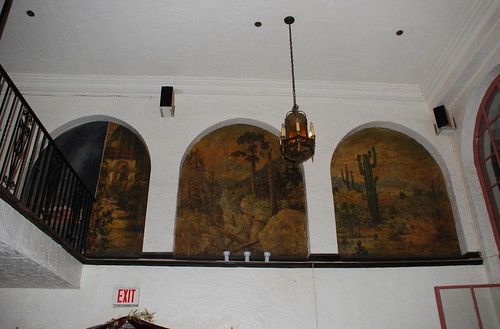
Bernard Johnson bought the hotel in the late 1960s with hopes of rehabilitating the structure and incorporating a museum. While the old Somerville was declared a city landmark in 1974, followed by its placement on the National Register of Historic Places in 1976, it wasn’t until 1988 when the non-profit Dunbar Economic Development Corporation was formed with the purpose of restoring the landmark. After a major rehabilitation, the Dunbar Hotel Apartments opened in 1989 with 73 low-income apartments, four commercial spaces, a museum, and senior center.

For a detailed report on the late eighties restoration, see this relative section in Affordable Housing through Historic Preservation. And click here to see adodom’s five-minute video tour of the Dunbar.

Dunbar Hotel

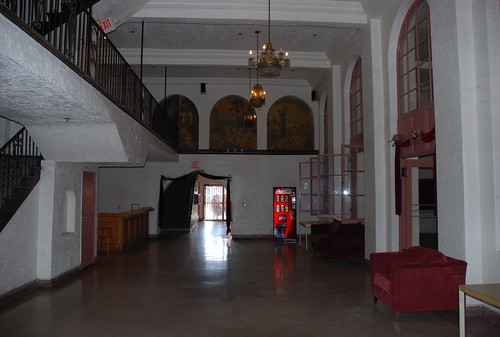
Don’t underestimate the importance of this building. During the Jazz Age and Depression, the Somerville/Dunbar played a major part in marking Los Angeles as the place where many African-Americans believed they could live better than anywhere else in the country. I’m not going to lie and say this is an area you want to sight-see around late at night, but I was there early Easter morning and was greeted by passersby, at least one friendly shopkeeper, and the Dunbar’s helpful security guard. And while any glimmer of Central Avenue’s glory days of 75 years ago are long gone, standing inside the hotel itself, it’s hard not to get the smallest sense of what it was like when the Dunbar was the center of life for so many people.

Dunbar Hotel

Sources:

Somerville, J. Alexander. Man of Color Lorrin L. Morrison 1949 Los Angeles, CA

Delvac, Esq. William F., Susan Escherich, and Bridget Hartman. Affordable Housing through Historic Preservation: A Case Study Guide to Combining the Tax Credits U.S. Department of Interior, National Park Service, Preservation Assistance Division, and the National Trust for Historic Preservation, Department of Public Policy 1995

Editorial Committee, Clora Bryant et al. Central Avenue Sounds University of California Press 1998 Berkeley and Los Angeles, CA

Flamming, Douglas. Bound for Freedom: Black Los Angeles in Jim Crow America University of California Press 2005 Berkeley and Los Angeles, CA


Up next: Stoney Point Outcroppings

continue reading...
Tuesday, June 19, 2007

No. 36 - Watts Station

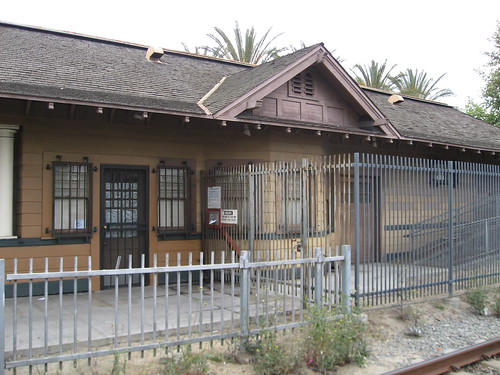
Watts Station

Watts Station
1904
1686 East 103rd Street – map
Declared: 12/3/65

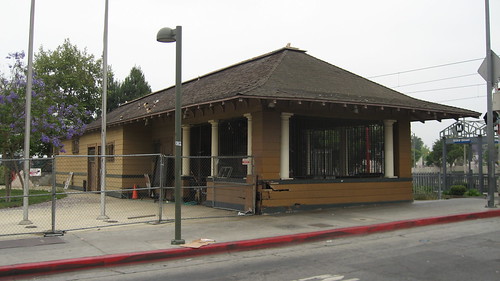
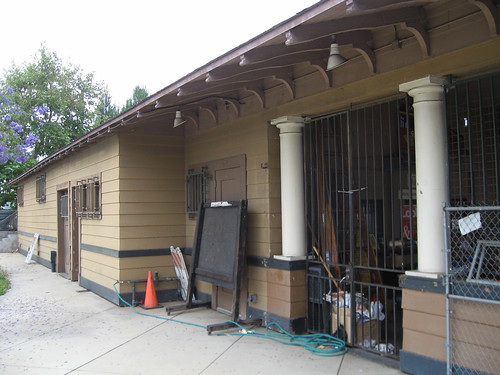
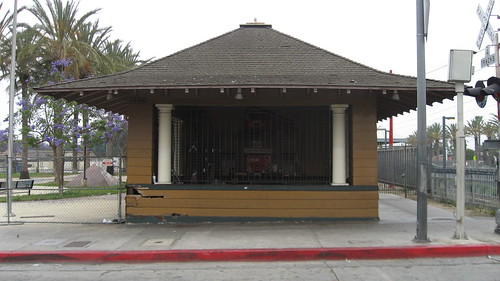
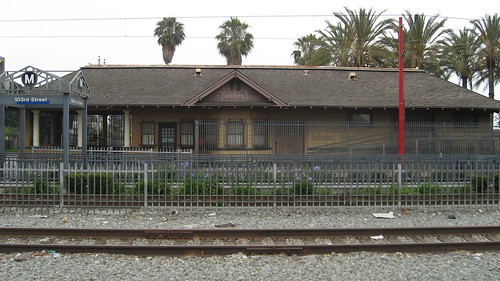
This single-story, clapboard structure, now more than a century old, has seen better days, that’s for sure.

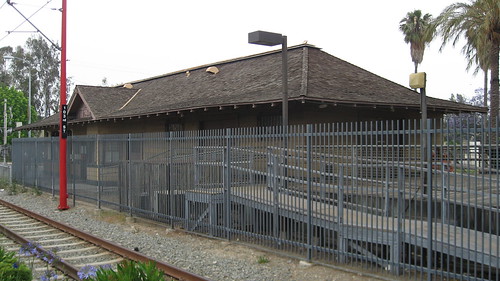
Watts Station

Built in 1904, Watts Station later became a main stop on the Red Car line. When the Red Cars stopped running in 1961, the station boarded the train to Deteriorationville. Oddly enough, according to a 1989 Los Angeles Times article, “the train station was the only structure that remained intact when stores along 103rd Street burned during the Watts riots.” That was in 1965.

Watts Station
Man, you gotta smack a building pretty hard to get the kind of damage you see on the corner above.

Watts Station

Well, if a major civil disturbance that resulted in $35 million in damages and 34 deaths couldn’t do in Watts Station, the 1970s were sure going to try. However, thanks in part to a two-decades long campaign led by Watts resident Freita Shaw Johnson, March, 1989, saw the re-opening of the station as what was to be a city Department of Water and Power customer service office and a Watts history mini-museum. The restoration to the building's original exterior design was paid for by a $700,000 grant from the Community Redevelopment Agency.

Watts Station

Today the building's part of the Metro Blue Line and is, once again, a train station. Now, it’s easy to complain and shake your head about the shape it’s in, but, on the other hand, I think it's more satisfying that not only is the building being used, but it’s actually in service per the original design of more than a century ago.

Watts Station was listed on the National Register of Historic Places on March 15, 1974.

Watts Station

Source:

Paul Feldman. “Watts New? Reopening of Historic Red Car Station as Museum and DWP Office Seen as Symbol of Hope, Renewal” Los Angeles Times; March 17, 1989, Metro; 2

Up next: Fire Station No. 23

continue reading...
Tuesday, April 17, 2007

No. 15 - Towers of Simon Rodia

Towers of Simon Rodia

Towers of Simon Rodia
1921 to 1954 – Simon Rodia
1765 East 107th Street – map
Declared: 2/15/63

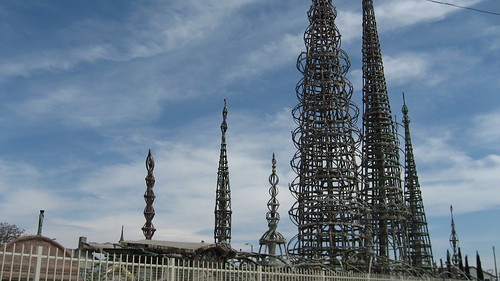
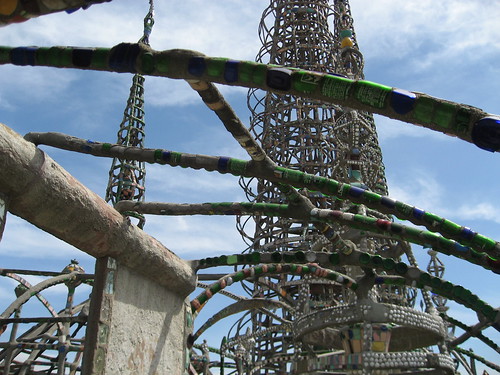
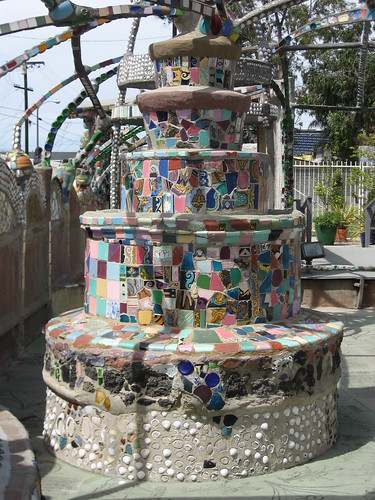
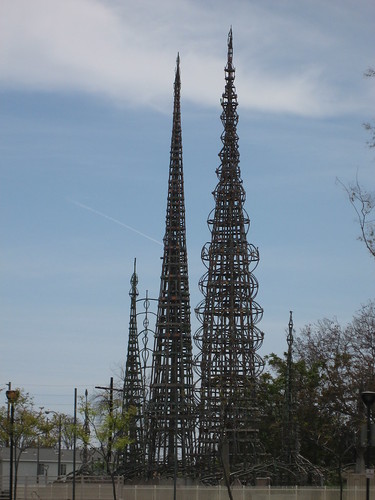
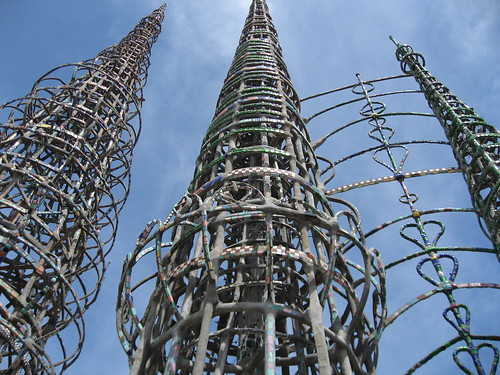
Officially named the Towers of Simon Rodia, HCM No. 15 is better known to you, me, and everyone else who’s ever heard of them as the Watts Towers.

These towers have got to be among the most photographed of all the Los Angeles monuments, but you can’t really appreciate this landmark by looking at a picture – you need to stand there, in what was one guy’s yard, to grasp the work of that one man.

Towers of Simon Rodia

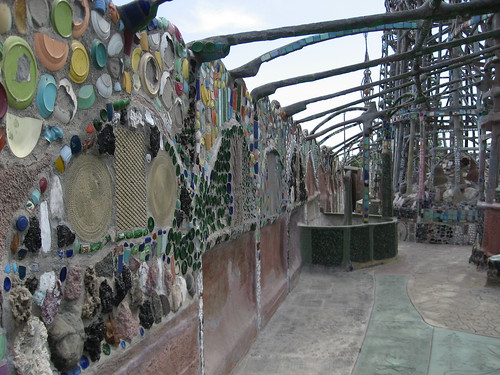
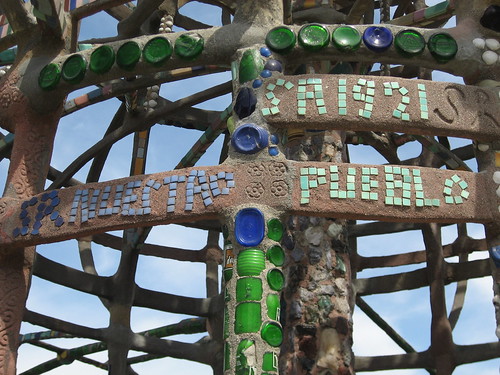
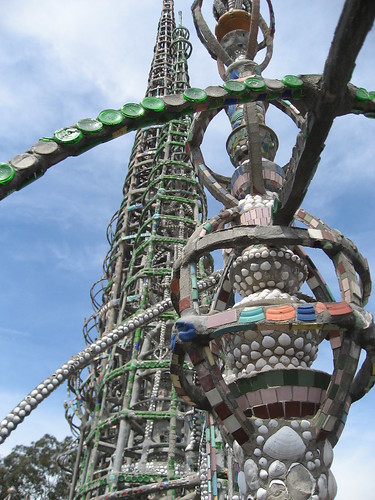
That one man was Simon Rodia, an Italian immigrant who spent time in Pennsylvania, Seattle, and Long Beach before settling on this triangular plot of land in Watts. In 1921, at the age of 42, wanting to do “something big”, he starts his monument by slapping up the walls first, using mainly bedsprings as structure. He calls his work Nuestro Pueblo (Our Town). Then, beginning within the narrower, east end of the wedge, he constructs the “Ship of Marco Polo”, a replica boat with a 28-foot spire.

Towers of Simon Rodia
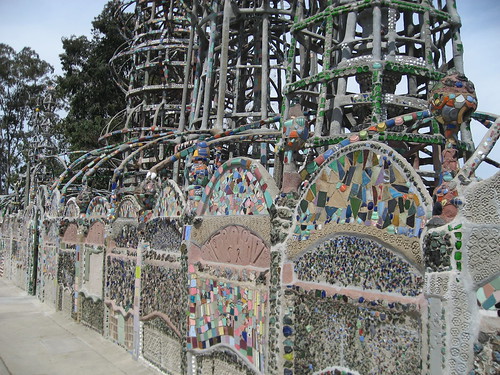
The south wall

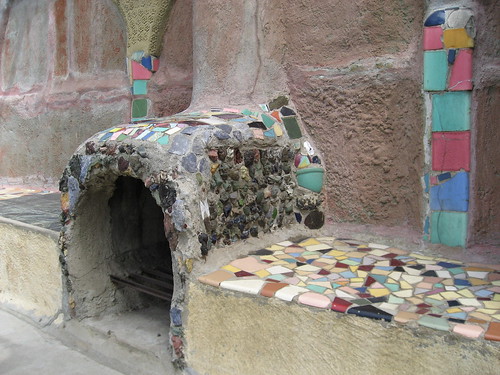
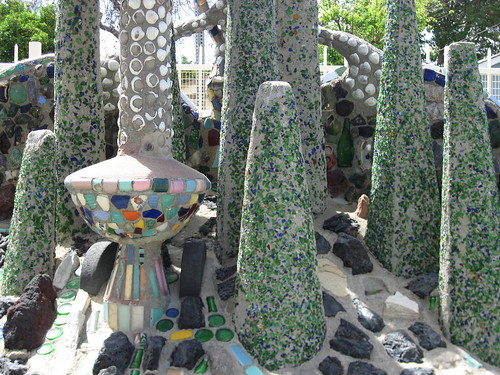
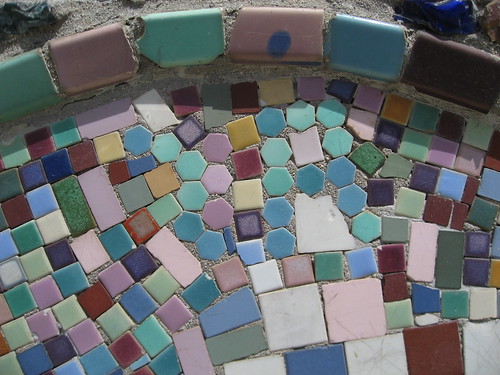
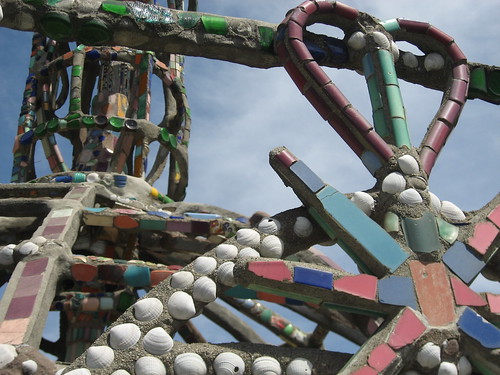
What did he use to build these monuments? Well, what didn’t he use? For starters, Simon didn’t use bolts or rivets, and he didn’t weld. However, he employed pieces of porcelain, ceramic tile, bottles, shards of pottery, scrap metal, rocks, china, sea shells he hauled in from the coast, and broken glass. (Man, I wish I would’ve owned stock in 7-Up and Milk of Magnesia back in the thirties – I’d be paying someone to write this post today.) He used steel pipes, steel rods, wire mesh, cement, and mortar for support. And if the three towers weren’t enough, he also constructed fourteen other structures within, including a patio, a gazebo, a fountain, and a bunch of bird baths. Within the mix, you’ll see lots of hearts, Simon’s initials, and the dates of 1921 and 1923. The tallest tower reaches just under 100 feet.

Towers of Simon Rodia - North wall
Inside of the north wall. Even the ground/floor is engraved. Rodia began adding those buttresses afer 1933's Long Beach earthquake.

Towers of Simon Rodia

Jump to 1954, and, project completed with his life’s work now a burden, Simon packed it in, gave his property to a neighbor, and lit out for Northern California. He died there in 1965, having never returned to his Watts home. Simon Rodia was about 75-years-old when he wrapped up. That makes it even more remarkable that he never used any scaffolding to build the towers. Of course, today Simon Rodia is best remembered for standing between Huntz Hall and Bob Dylan on the cover of the Beatles' Sgt. Pepper's Lonely Hearts Club Band album (upper right-hand corner).

Rodia’s house, adjacent to his art, burned down from an errant firecracker a year or so after he moved out.

Towers of Simon Rodia
The spire of the "Ship of Marco Polo" in the foreground

Towers of Simon Rodia - Rodia's Kiln
Rodia's kiln

Towers of Simon Rodia

In the late-50s, the city was eager to pull down the towers for safety reasons, but a subsequent stress test was passed with flying colors. The site remained unscathed during the '65 riots, too. However, the 1994 Northridge earthquake proved more debilitating, and the site was shut up until restoration could be completed seven years later.

Towers of Simon Rodia - Water fountain
A working (but not when I was there) fountain

Towers of Simon Rodia - Cactus garden
The cactus garden

Towers of Simon Rodia
"SR"

Towers of Simon Rodia

The Towers of Simon Rodia are now part of the California State Parks system (it's the smallest State Park) but are overseen by the Los Angeles City Cultural Affairs Department.

Listed on the National Register of Historic Places and designated a National Landmark, the site’s open for touring. So head to Watts, cough up the $7, and see Rodia’s work of art in person.

Towers of Simon Rodia

Up next: St Joseph’s Church,

continue reading...