Showing posts with label West Adams/Baldwin Hills/Leimert Park. Show all posts
Saturday, April 18, 2009
No. 229 - Westminster Presbyterian Church Building
Westminster Presbyterian Church Building
1931 – Quentin Scott
2230 West Jefferson Boulevard – map
Declared: 6/11/80
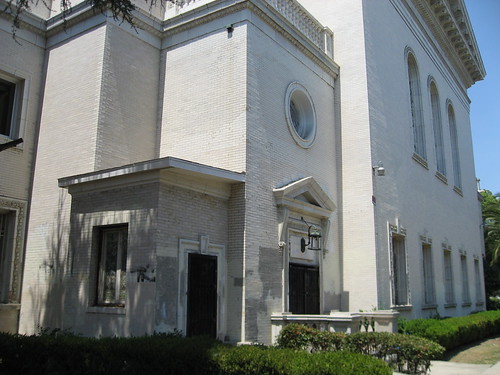
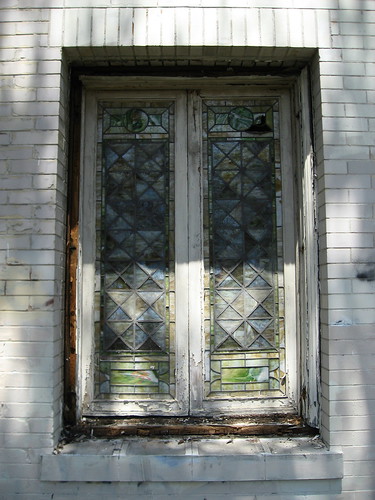
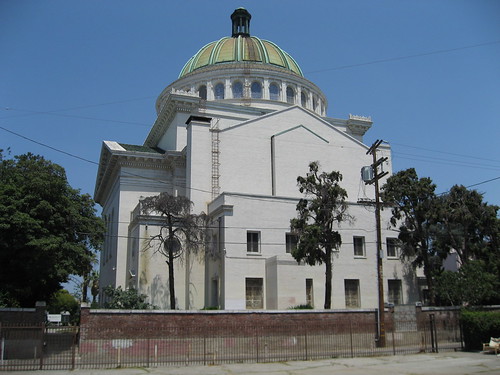
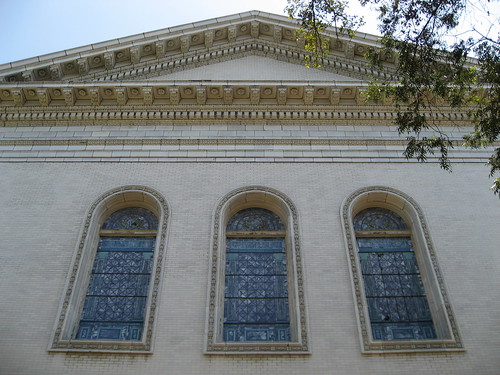
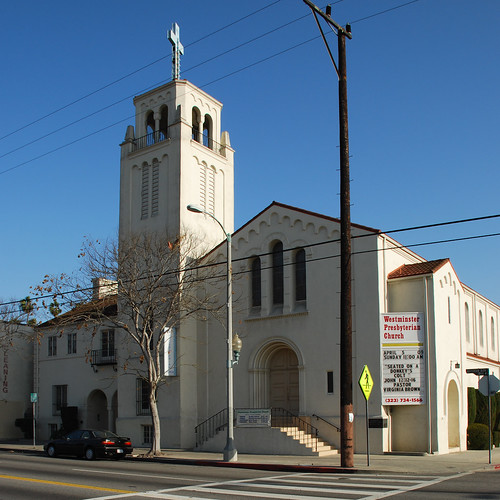
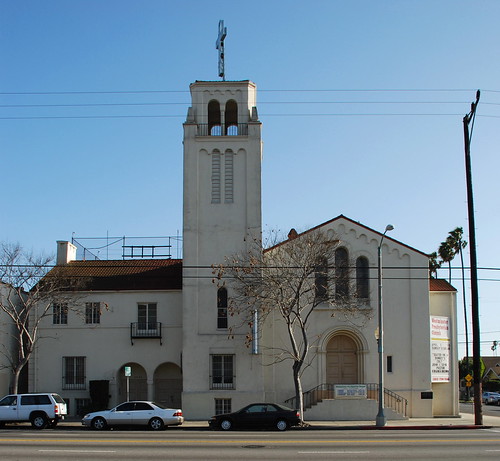
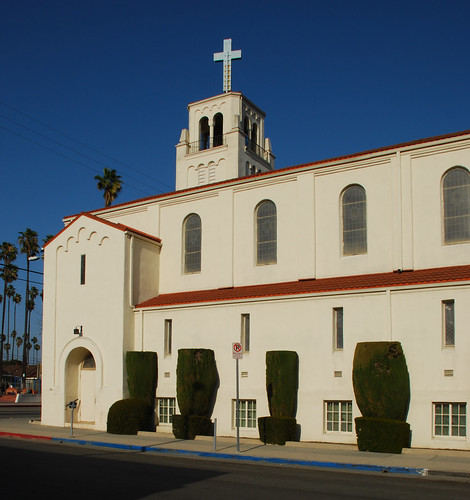
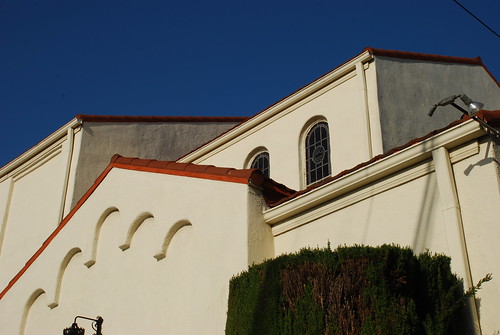
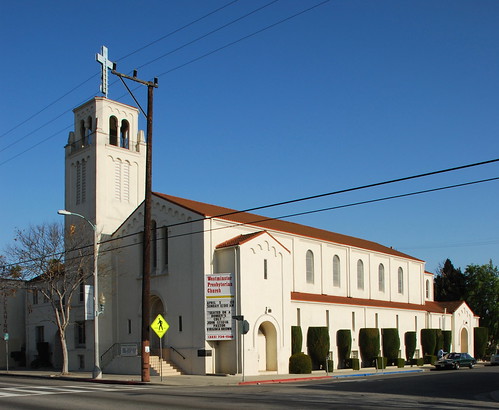
Historic-Cultural Monument No. 229 is a Romanesque church building that has served as headquarters for two Presbyterian congregations during its seventy-eight year history – St Paul’s and Westminster.
At the end of 1930, Southwest Builder and Contractor announced Alhambra architect Scott Quentin – well, the magazine spelled his name Quintin – had completed preliminary plans for a new building for St Paul’s Presbyterian Church at Jefferson and 3rd. The new church would run $60,000, the magazine went on, and would contain a “basement, banquet room, social hall, auditorium to seat 600 people and Sunday School rooms to accommodate 800 pupils. Dimensions 86 x 124 feet, frame and stucco construction, tile and composition roofing, cement and ample floors, art glass, gas steam heating, etc.” The church’s pastor in 1930 was the Reverend Gustav A. Briegleb, who had been leading St Paul’s since leaving Westlake Presbyterian Church in October 1926. He succeeded Dr William G. Mills at St Paul’s.
Constructed by the Myers Brothers Company, the four-story building would replace a two-story, $35,000 church building put up just seven-and-a-half years earlier. That structure, designed by H.H. Whitely, was an addition to an older building, circa 1915 (the congregation was founded in May 1910). Whitely’s building seated about 600 worshippers, a little more than 100 larger than the congregation’s size during its March 18, 1923, dedication.
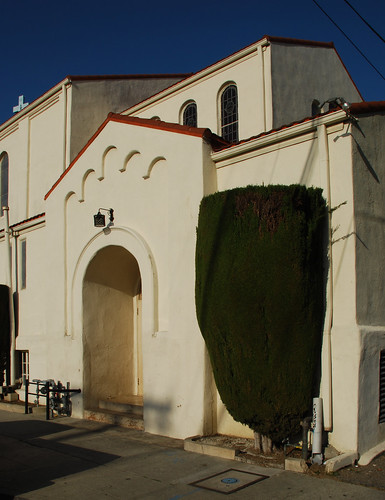
In January 1931, the Los Angeles Times reported demolition of the old church buildings would begin on the 12th and that the congregation would hold services at the Home Theater on Jefferson west of Arlington till the new structure was complete. The article also quoted Rev. Briegleb’s saying St Paul’s had just received a $40,000 loan from the Bank of America along with a gift of a diamond ring – valued at $3,554 – from “well-known politician Charles Crawford”. It turns out Crawford would give more than jewelry to finance the new church building.
Charles H. Crawford was a Los Angeles saloon-keeper-turned-crime-boss who surprised many folks with his conversion to the faith as a new member of St Paul’s Presbyterian Church in 1930. It was during his baptism that June when he donated the pricey ring, telling Rev. Briegleb to sell it and put the proceeds to the construction of a new Sunday School for the parish. At the time, Crawford was under indictments of bribery charges (those charges were later dismissed, as were charges of extortion and conspiracy in other cases). Briegleb’s acceptance of Crawford into the fold along with the racketeer’s gift was controversial, of course. The Reverend R.P. Shuler, a former pal of Briegleb, broadcasted he would “just as soon baptize a skunk as to receive Crawford.” Shuler also maintained it was Crawford’s money that was financing Briegleb’s radio sermons in which he endorsed some of Charles H.’s pals for political office, a charge which the reverend later copped to. (In fact, Crawford’s unrealized plans to finance a permanent radio station in St Paul’s were revealed after his death.)
Five months later after his baptism, Crawford donated a full $25,000 to St Paul’s for a new church building. When detractors criticized Briegleb’s receiving a donation from the “sinister influence”, the pastor replied, “If you know of any more sinners who have $25,000, send ‘em along: I can use it.”
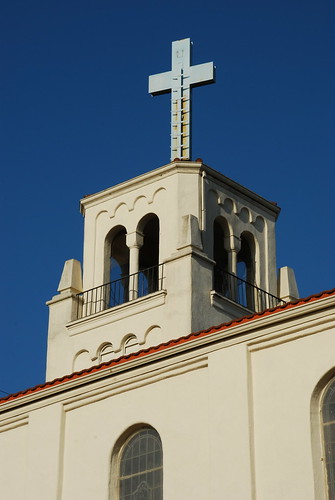
Rev. Briegleb and his 700-member congregation dedicated the new St Paul’s Presbyterian Church building on May 17, 1931, with a sermon entitled, “Should We Build New Churches When Multitudes Are Hungry?” Of special note was the structure’s twelve-foot revolving lighted cross perched atop its tower. The church’s new parish house was named the Amelia Crawford Memorial, in honor of benefactor Charles H.’s mom.
Crawford didn’t attend the new church building for long, though. Four days after St Paul’s dedication, former deputy district attorney David H. Clark entered Crawford’s office at 6665 Sunset Boulevard and shot to death the politico (good thing he got in his baptism) and newspaper man Herbert Spencer. While Clark was acquitted of Spencer’s murder after pleading self-defense (prosecutors dropped the case of Crawford’s death), he eventually went to prison for the November 1953 shotgun slaying of the wife of his best friend and former law partner in Costa Mesa (seems she was bugging him to get a job). By the way, Clark, during the Spencer murder trial, was still running for municipal judge. He received 60,000 votes while in prison, proving some folks weren’t too broken up to see Crawford bite it.
In 1949, following its merger with Baldwin Hills Community Church, St Paul’s Presbyterian left its home on Jefferson and 3rd for a new building designed by Robert E. Alexander at Coliseum Street and La Brea Avenue. The Westminster Presbyterian Church took over the future landmark, moving a few blocks from their headquarters at 35th Place and Denker Avenue on land they had bought back in 1906.
The Westminster Presbyterian Church got its official start in Los Angeles on October 9, 1904, when seventeen worshippers who had been holding services in the Central Presbyterian Church were “received by confession of faith and examination.” Twelve days later, the church was officially reported to and enrolled in the L.A. Presbytery.
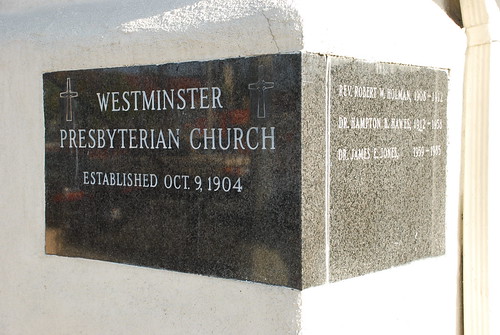
When it dedicated its church building – built the previous summer – in March 1908, Westminster Presbyterian was the sole all-black Presbyterian congregation in the west. It’s minister in charge, the Reverend E.P. Baker, was also the west’s only African-American minister. The Reverend Robert W. Holman became the congregation’s first official pastor later that year. In 1912, Rev. Hampton B. Hawes succeeded him, retiring after nearly half a century of service in 1958. Subsequent Westminster pastors included Reverends James E. Jones, Oliver L. Brown, and Glenn Jones. The current pastor is the Reverend Virginia Brown.
Sources:
“Colored People Finance Well.” The Los Angeles Times; Mar 9, 1908, p. I5
“To Build Church.” The Los Angeles Times; Oct 2, 1921, p. V2
“To Worship in New Homes” The Los Angeles Times; Mar 17, 1923, p. II2
“Dr. Briegleb at New Post”; The Los Angeles Times; Oct 2, 1926, p. A2
“Charles Crawford Joins Church of Dr. Briegleb” The Los Angeles Times; Jul 1, 1930, p. A1
“Crawford’s Latest Gift Announced” The Los Angeles Times; Nov 3, 1930, p. A1
Southwest Builder and Contractor; Dec 5, 1930, p. 49
“Briegleb Congregation to Build” The Los Angeles Times; Jan 5, 1931, p. A9
“Schuler Scored by Dr. Briegleb” The Los Angeles Times; Jan 20, 1931, p. A1
“Let Us Go Into the House of the Lord” The Los Angeles Times; May 16, 1931, p. A8
“Briegleb’s New Church Dedicated” The Los Angeles Times; May 18, 1931, p. A1
“Crawford and Writer Victims of Assassin” The Los Angeles; May 21, 1931, p. 1
“Victims of Assassins’ Bullets” The Los Angeles Times; May 21, 1931, p. 2
“Crawford Likened to Matthew” The Los Angeles Times; May 25, 1931, p. 2
“Books of Murder Victims Examined” The Los Angeles Times; May 27, 1931, p. 2
“Presbytery Officials to Dedicate Building” The Los Angeles Times; Oct 1, 1949, p. A3
“Ex-L.A. Attorney Held in Slaying” The Los Angeles Times; Nov 12, 1953, p. 1
Up next: Villa Maria
continue reading...
Posted by
Floyd B. Bariscale
at
10:53 PM
4
comments
Tuesday, August 19, 2008
No. 174 - Village Green
Village Green
1942 – Reginald D. Johnson, Lewis Wilson, Edwin Merrill, and Robert E. Alexander
5112 – 5595 Village Green, Baldwin Hills – map
Declared: 5/4/77
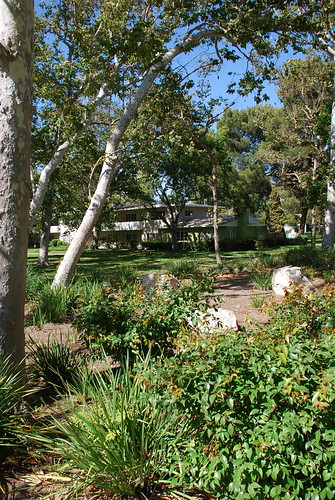
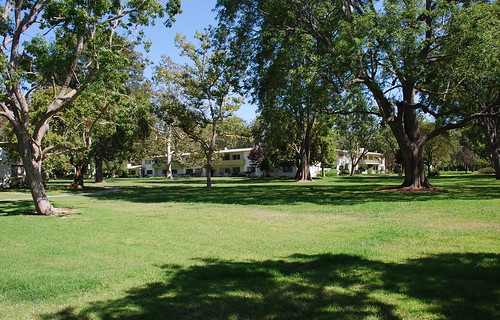
The park-like, planned community of Village Green in Baldwin Hills is one of the hidden sanctuaries of the city of Los Angeles. You’d think, though, that a chunk of land nearly seventy acres huge wouldn’t be such a secret, but my guess is this is the way the Green’s home owners like it.
With Sunnyside Gardens in Long Island City, New Jersey’s Radburn, and Greenbelt in Maryland, the planned communities movement in the United States had been around for about a decade by the time preparations began on the L.A. version. Planners chose a site – on land owned by Lucky Baldwin – as early as 1934. Baldwin had bought the land back in the 1870s.
In 1938, a group of L.A. architects – Lewis Wilson, Edwin Merrill, Robert E. Alexander, and led by principal architect Reginald D. Johnson (whom we met at HCM Nos 32 and 66) – began to cobble together the various approvals, loans, and insurances needed to go forward with the project. (For starters, the city had to annex the site.) Clarence S. Stein, who had worked on the Sunnyside, Radburn, and Greenbelt projects, acted as consultant.
When the group got its ducks in a row in February 1941, construction began on the east side, on Sycamore, and moved west. The several years of planning gave the architects the opportunity to come up with around fifty different plot plans.
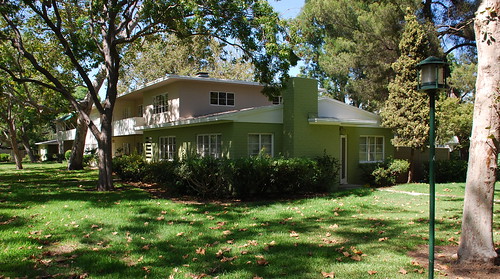
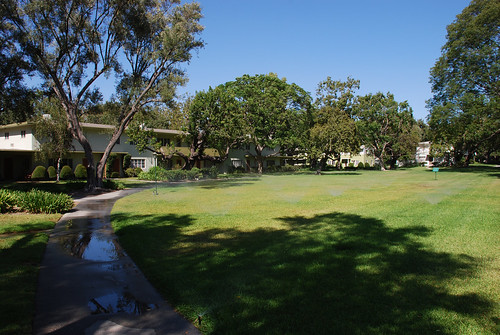
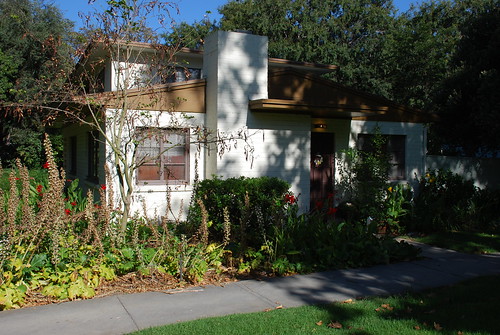
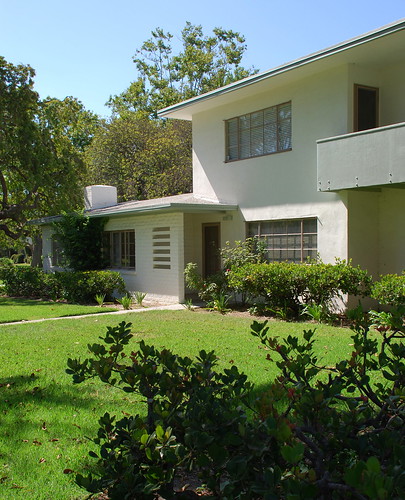
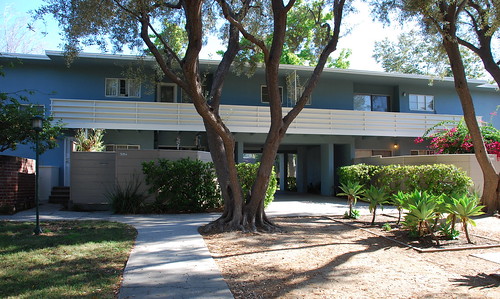
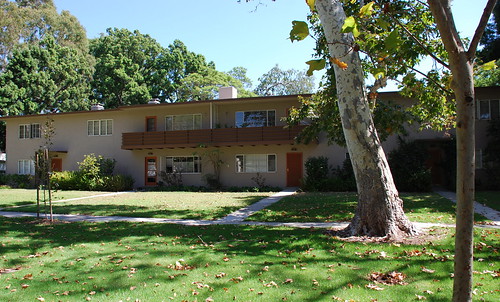
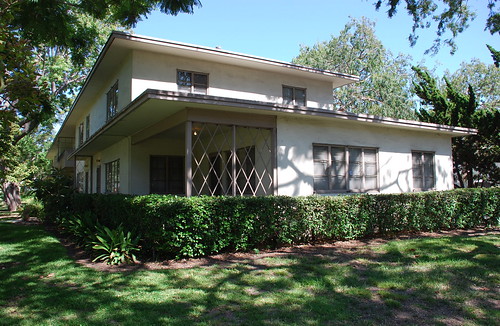
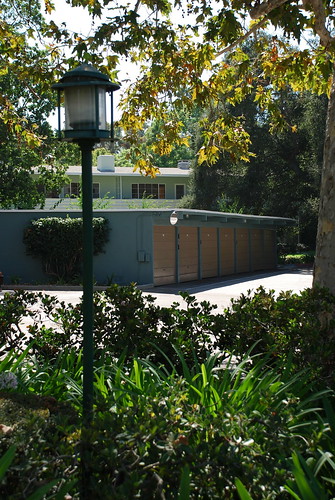
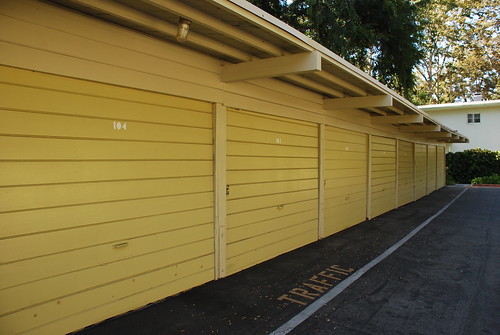
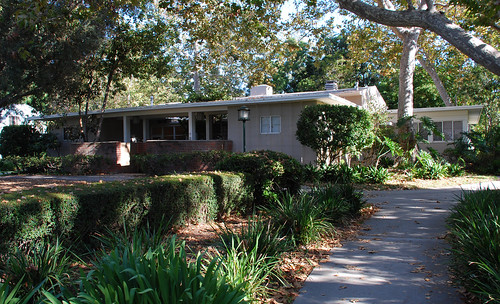
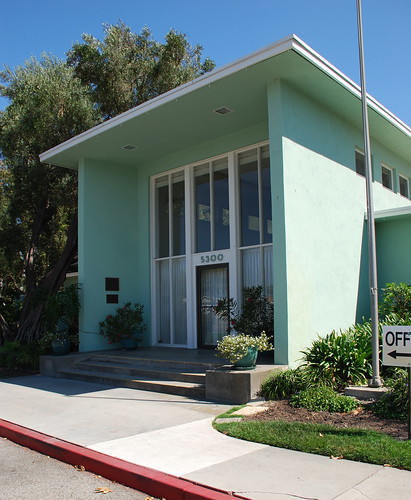
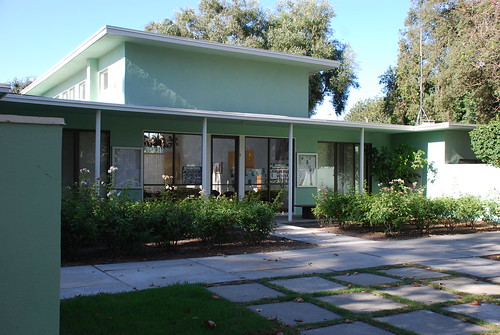
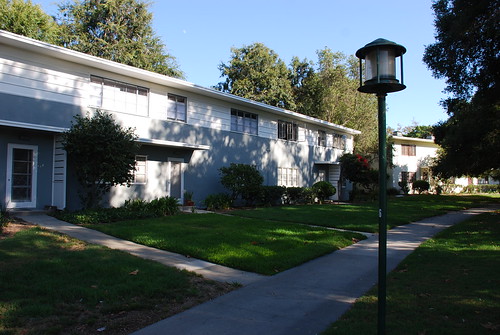
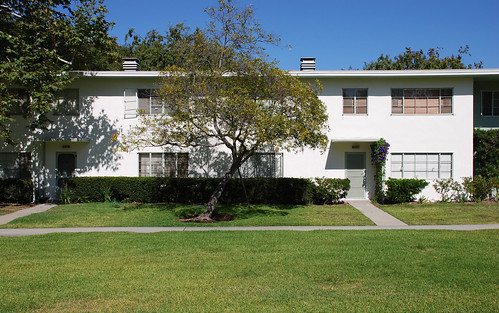
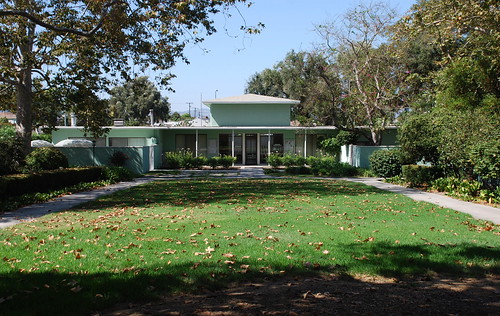
The ultimate plan called for a street-free “super-block” spread out over an undivided sixty-eight acres, twenty of which were to be devoted to several large greens and lots of garden courts. Ninety-five buildings containing 629 rental units were built using sixteen different floor plans. 450 of the apartments had private patios, most of which were enclosed by six-foot walls. The buildings, all one- and two-stories, were painted with light pastels, including cream, salmon, light green, apricot, and aquamarine. As then, each unit today faces one of the greens or a garden court. The access roads, garages, and parking are all located around the landmark’s perimeter. Included originally were a pair of playgrounds, a pool, tennis and badminton courts, even horseshoe pits.
The first residents, mostly middle-class, moved into what was then named Baldwin Hills Village on December 7, 1941 (I knew I heard that date before), ten months before work was more or less completed. I say ‘more or less’ because, among those moving into the new community were architects Johnson, Alexander, Wilson, Merrill, and the site’s landscape architect, Fred Barlow, Jr, who continued to make refinements to the community.
Below is the old clubhouse, originally intended to be a nursery school. It had a rental library, darkroom, kitchen, pantries, and billiard and ping pong tables. The building was converted to a pair of residences when new owners took over a few years after WWII.
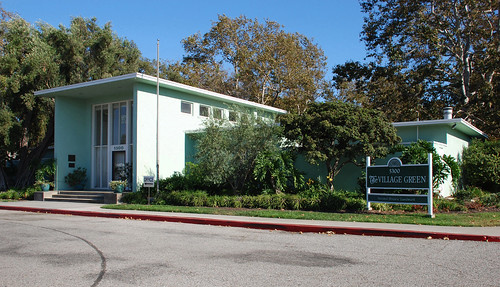
Here are four shots of the Green’s former administration building, now the clubhouse. Not only did it hold various offices and the reception center, it was also home to a large Rico Lebrun mural. Wait. Actually, it still is home to a Rico Lebrun mural, only it’s been mournfully covered up (recovering the artwork will run into the hundreds of thousands of dollars – a replica hangs in place of it). Just last year, the old administration building was restored to its original 1941 pastel green color you see here.
The architects originally planned the village to be larger, with a shopping center, school, church, and movie theater. Beginning in 1948, Robert Alexander’s designs, in fact, were used for a school at the corner of Rodeo Road and Hauser Boulevard. His movie theater and shopping center, including a Thriftimart and a Hody's Coffee Shop, were put up at La Brea and Rodeo. Unfortunately, not only is the shopping center separated from Village Green by Sycamore Avenue (at the city’s insistence), but it’s been altered to the point of having about zero percent of the charm of the Village Greens homes. To break your heart, compare my recent shot of the Baldwin Theater below (now office space) to how it originally looked (I know the Julius Shulman photo is a step down from what you're used to here, sorry.)
In 1949, the original investors sold Baldwin Hills Village to the New England Mutual Life Insurance Company of Boston. Sometime after that, Lucky Baldwin’s grandson, Baldwin M. Baldwin, bought back the complex. A year after his death in 1970, Terramics, Inc., purchased the property, converting it to condominiums from 1973 to 1978. The condo conversion was initially overseen by original architect Robert Alexander.
In 1972, the AIA awarded the Village Green its fourth-ever twenty-five-year National Award for Excellence, in recognition of architectural design of enduring significance. A city landmark in 1977, Village Green was made a National Historic Landmark in January 2001.
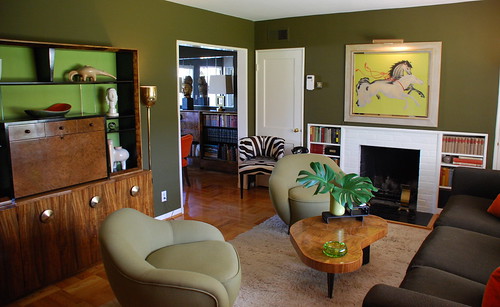
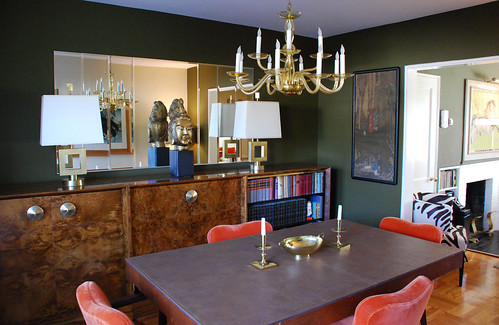
Finally, an interior - not from 1942, but from August, 2008. Nice, huh?
A very, very big thanks goes to Mr Steven Keylon, Vice-President and Secretary of the Village Green Owners' Association, who not only took the time to welcome me to Village Green the other weekend, but also provided me with scads of research he’s been compiling for years. Village Green could not have a better, more passionate custodian than Steven. Want proof? Go see his more than 300 archival photos of the community by clicking right here. Thanks, Steven.
Sources:
Stein, Clarence Toward New Towns for America The University Press of Liverpool 1951 Chicago, Illinois
Berry, Richard D. “Baldwin Hills Village – Design or Accident” Arts and Architecture Oct. 1964
Bauer, Catherine Pencil Points September 1944
Keylon, Steven “The Use of Color at Baldwin Hills Village: From 1941 to the Present Day”
Up next: Y.W.C.A. Hollywood Studio Club
continue reading...
Posted by
Floyd B. Bariscale
at
11:20 PM
7
comments
Wednesday, August 6, 2008
No. 170 - Paul R. Williams Residence
Paul R. Williams Residence
1952 – Paul R. Williams
Declared: 12/1/76
Paul Revere Williams was born on February 18, 1894, at 842 Santee Street in Los Angeles, allowing the city to lay claim not only to the majority of the architect’s work but also to Williams himself as a born and bred Angeleno.
Williams was certified as an architect in 1915, a year before he entered U.S.C. to study architectural engineering. He apprenticed with Reginald Johnson and John C. Austin, whom he helped prepare drawings for the Shrine Auditorium and other buildings. In 1921, he received his California architect’s license, setting up his own firm, Paul R. Williams and Associates, in late 1922.
From the L.A. Public Library.
Some P.R. highlights: he was appointed to L.A.’s first City Planning Commission and first Housing Commission; he was the American Institute of Architects’ first African-American member, later being elected to the AIA College of Fellows; authored monographs Small Homes of Tomorrow and New Homes for Today; served as vice president of Broadway Federal Savings and Loan; and President Coolidge appointed him to the National Monuments Committee and President Eisenhower named him to the National Housing Commission. For a dozen years, he served as president of L.A.’s Cultural Affairs Department’s Municipal Arts Commission, now known as the Cultural Affairs Commission.
Williams is the designer behind a trove of L.A. Historic-Cultural Monuments, including the Second Baptist Church Building (No. 200), the Barbara Stanwyck Residence AKA Oakridge (No. 484), the 28th Street Y.M.C.A. Building (No. 851), and (co-designer of) the Airport Theme Building (No. 570). He also contributed to the County Courthouse and the County Hall of Administration.
He designed more than 300 Beverly Hills houses and businesses, notably Saks Fifth Avenue and the MCA headquarters, the latter for which he won an AIA Award of Merit. And how many production deals have you made in his Polo Lounge in the Beverly Hills Hotel?
Although often associated with expensive, fancy period revival homes for the well-to-do, remember Williams was also the chief architect on the Pueblo del Rio Public Housing Project in Vernon and Hacienda Village at 103rd Street and Compton Boulevard.
Besides Stanwyck and others, Williams’s celebrity clientele listed Frank Sinatra, Desi Arnaz and Lucille Ball, Bert Lahr, Tyrone Power, Cary Grant, Julie London, Will Rogers, Anthony Quinn, Lon Chaney, and Zsa Zsa Gabor. No wonder he was known as "Architect to the Stars."
Unfortunately, not all of Williams’s works are still around (with around 3,000 homes to his credit, that’s not so much a surprise). His $400,000, sixteen-bedroom Beverly Hills home for auto manufacturer E.L. Cord, Cordhaven, was torn down in 1963, and 1934’s Sunset Plaza Apartments (HCM No. 233) bit the dust in 1987. A good place to lament the passing of these and other buildings would be at the Ambassador Hotel’s coffee shop, also designed by Williams.
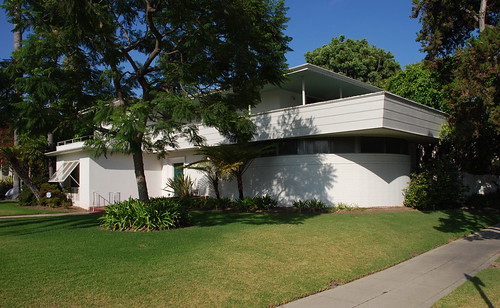
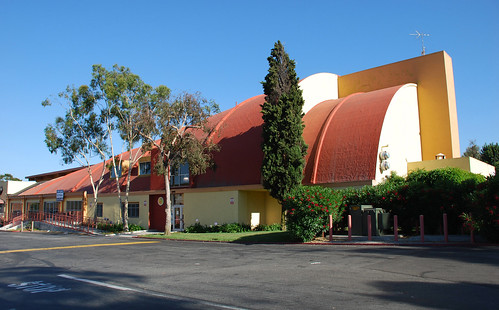
Of course, the big irony is that while the architect was creating homes and businesses for folks in Palm Springs, Beverly Hills, Pasadena, and Hancock Park, Williams himself wasn’t welcome to live in many of these areas, for Pete’s sake (he was black, remember). He wound up building this home, HCM No. 170, for his family in the early fifties in one of the few areas of L.A. open to upscale African-Americans. Williams made his name designing period revival homes, but this one is International Moderne. Is there an International Moderne Revival style?
Paul R. Williams retired in 1973 and died seven years later, on January 23, 1980.
By the way, you may’ve noticed I didn’t post the landmark’s address. This is to appease the current owner, who wasn’t happy I was taking pictures of her home. (She was curious as to how I even found the place, claiming she’s gone to great lengths of keeping the address from being published in books. Er, right.) But, I don’t want to ruffle any feathers, making the poor woman lose sleep over my humble blog. In the end, any of you with the resourcefulness of a three-year-old can quickly unearth the address in case you want to see this elegant home in person.
Sources:
Williford, Stanley O. “Early American Black Architect, 85, Dead” The Los Angeles Times; Jan 28, 1980, p. B22
Hudson, Karen E. Paul R. Williams, Architect: A Legacy of Style Rizzoli International Publications, Inc. 1993 New York, NY
Hudson, Karen E. The Will and the Way Rizzoli International Publications, Inc. 1994 New York, NY
Up next: (Site of) Timms Landing
continue reading...
Posted by
Floyd B. Bariscale
at
10:27 PM
10
comments
Tuesday, August 21, 2007
No. 57 - Second Church of Christ Scientist of Los Angeles
Second Church of Christ Scientist of Los Angeles
1910 – Alfred F. Rosenheim
948 West Adams Boulevard – map
Declared: 7/17/68
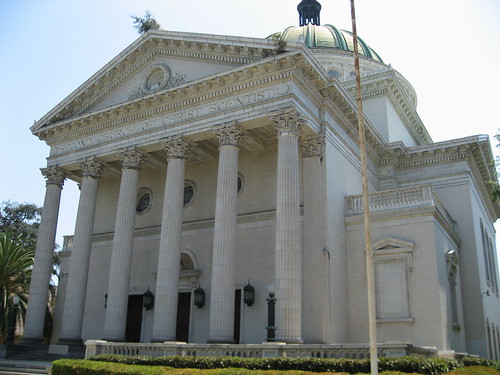
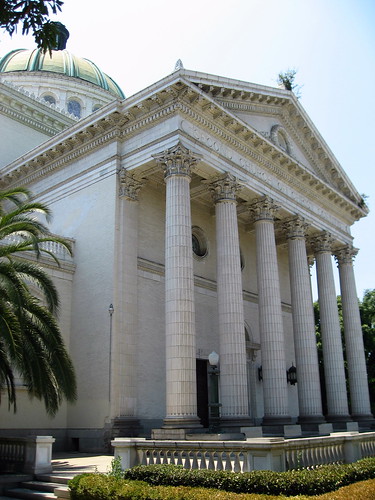
Man, this is a big building. Commodious, if you will. No wonder the church, what with its giant copper dome and all, stands as a neighborhood landmark in the broadest of terms.
The church was designed in the Beaux Arts/Italian-Renaissance style by Alfred F. Rosenheim, also responsible for other Los Angeles landmarks, including the nearby Britt Residence (No. 197), Hamburger’s Department Store (No. 459), Clune’s Broadway Theatre Building (No. 524), and the Hellman Building (No. 729). Gebhard and Winter say the Second Church of Christ Scientist of Los Angeles was influenced by Boston’s Mother Church. Albert C. Martin was the engineer of the Second Church.
The SCoCoLA cost more than $300,000 and took two and a half years to build. It opened for holy business on January 23, 1910.
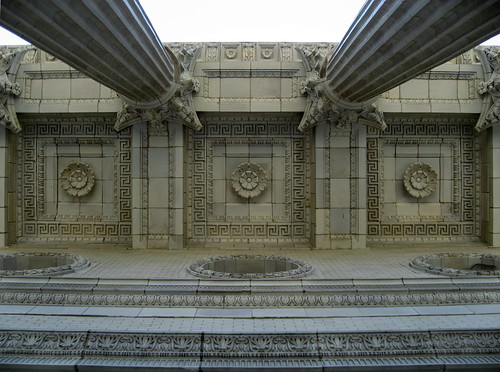
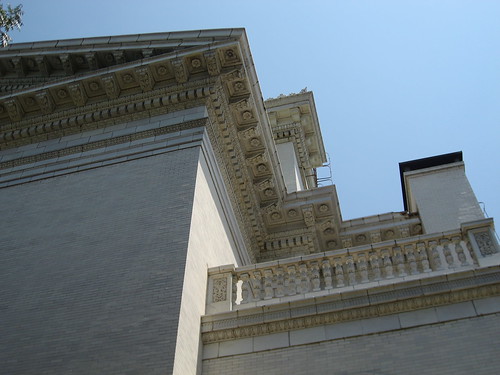
This is the view when you look up as you enter the church. Designed when things like this mattered.
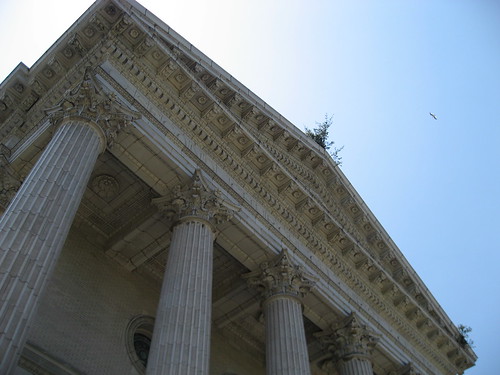
A June 28th, 1908, Los Angeles Times article categorized the architecture as “pure Roman Corinthian… built with white glazed brick and terra cotta trimmings”. At the time, it was “the largest and most elaborate church west of Chicago.” It was designed to accommodate 1200 worshippers. A Sunday School room seats 700.
As far as the interior goes, a 1910 L.A. Times article reports “the wainscoting, doors, pews and all other interior woodwork is in selected mahogany, stained a soft brown tone, and the floor is covered with interlocking rubber tile of harmoniously contrasting colors.” That same article heralded the church as the “Most Beautiful and Costly in the West.” The church also boasted a $14,000 pipe organ upon opening.
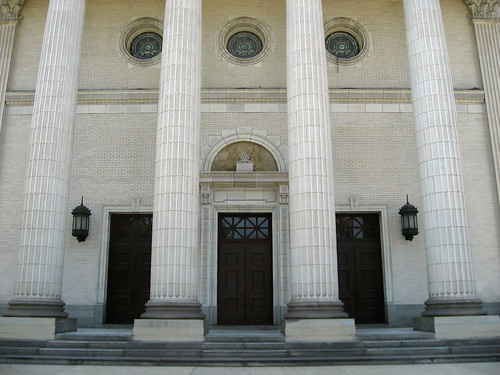
The Corinthian columns reach forty feet in height.
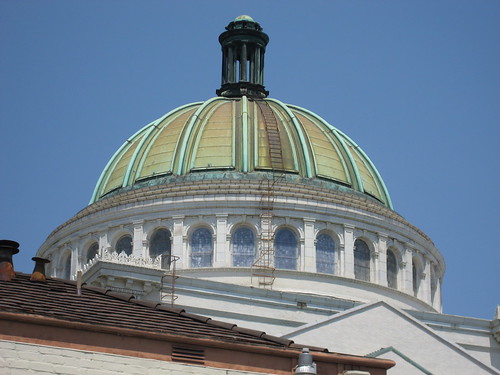
The dome is 130-foot tall, seventy feet in diameter, and weighs 1400 tons.
You can tell by these fuzzy pictures that the church is still in good shape, but could use a little help, especially around the leaded windows, also designed by Rosenheim.
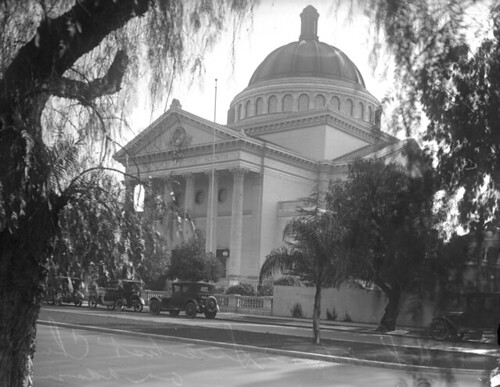
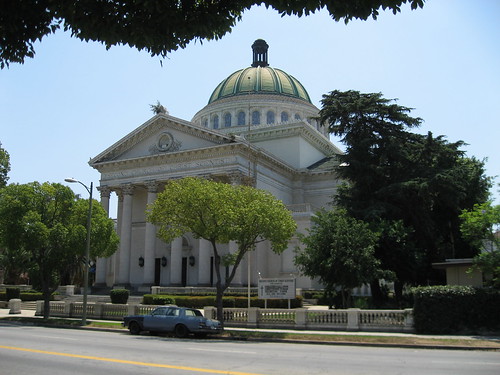
As you can see, not much has changed except the trees and the car(s). Oh, and the median, too. Still known as The Second Church of Christ Scientist of Los Angeles with Sunday services, the L.A. landmark is also listed on the National Register of Historic Places.
Sources:
“Magnificent Scientist Church Assuming Shape.” Los Angeles Times; June 28, 1908, p. V1.
“Marvelous Work in Reinforced Concrete Found in Local Church” Los Angeles Times; September 13, 1908, p. V1.
“Fine Temple of Scientists.” Los Angeles Times; January 22, 1910, p. II6.
Up next: A & M Records Studio
continue reading...
Posted by
Floyd B. Bariscale
at
9:48 PM
5
comments
Subscribe to:
Posts (Atom)