Showing posts with label Central City North. Show all posts

Wednesday, March 18, 2009

No. 224 - Cesar E. Chavez Avenue Viaduct

Cesar Chavez Avenue Viaduct

Cesar E. Chavez Avenue Viaduct
1926 – Merrill Butler
Cesar E. Chavez Avenue between Mission Road and Vignes Street – map
Declared: 8/1/79

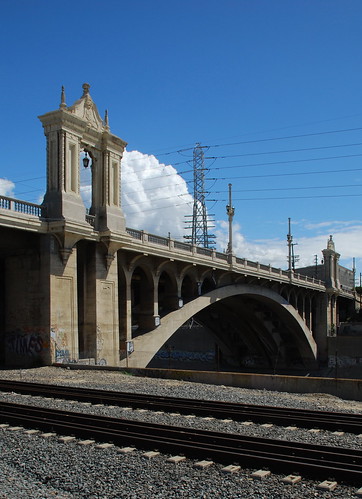
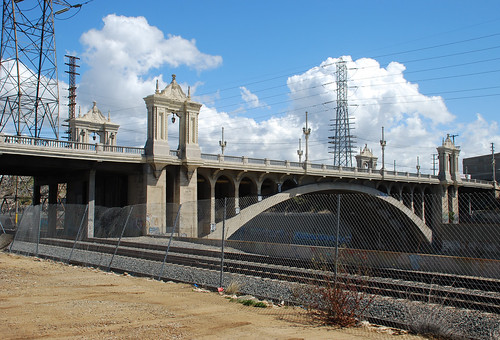
What’s today called the Cesar E. Chavez Avenue Viaduct was the second span realized as part of a major bridge-building program in Los Angeles begun in the mid-1920s (the one at Ninth Street, or the Olympic Boulevard Bridge, built by the North Pacific Construction Company, was the first completed). Lead by the Chamber of Commerce, a collection of groups started lobbying hard in the spring of 1923 for the replacement of six of the city’s outdated bridges and viaducts, but mainly at First, Seventh, Ninth, and Macy Streets.
Cesar Chavez Avenue Viaduct

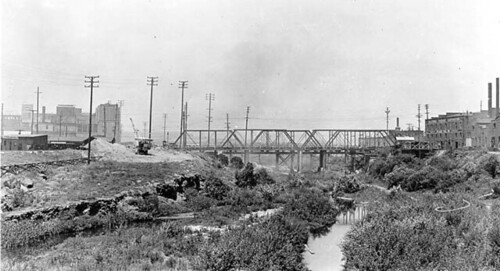
Now, there had been a couple of bridges over the years connecting Macy Street with Brooklyn Avenue in Boyle Heights (or with Pleasant Avenue in East Los Angeles, depending on when you lived). In fact, the first span over the Los Angeles River was a covered bridge, lit with kerosene lamps, built on this spot in 1870 (has anyone seen a photo of that bridge?). By 1923, however, you would cross the L.A. River at Macy on the metal truss bridge pictured below. What was a particular drag was, while crossing, you were required to contend with the trains of both the Santa Fe (on the eastern side) and the Union Pacific (on the western), as the tracks for each were at the same grade as the bridge’s. Hoping the tracks would be lowered, this brought the Chamber of Commerce to recommend the railroads pay for at least the cost of the new span’s approaches.
Macy Street Bridge
The penultimate Macy Street Bridge, from the L.A. Public Library Photo Collection

On June 5, 1923, the electorate voted for a $2 million bond issue to be put toward the big bridge initiative. A few months later, in September, City Council asked the State Railroad Commission to figure an equitable way for the city, the county, the Santa Fe Railroad, the Los Angeles and Salt Lake Railroad Company, the Pacific Electric Railway Company, and the Los Angeles Railway Corporation to all chip in for the project.
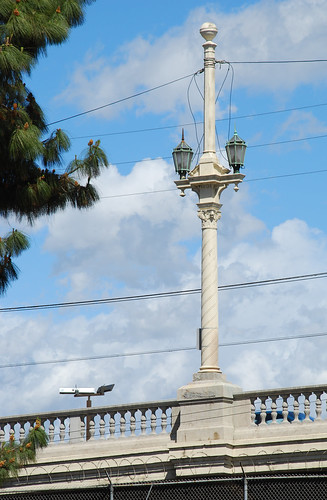
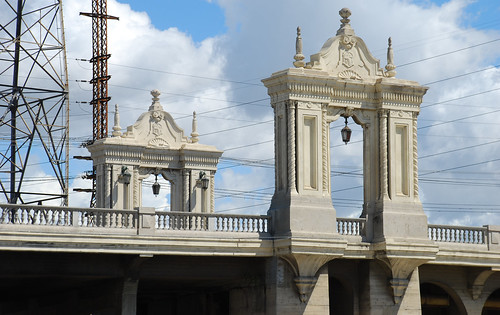
Cesar Chavez Avenue Viaduct

When the city presented plans to the State Railroad Commission in mid-July 1924, the projected cost for the new Macy Street Viaduct was estimated at $507,261.70. In addition to that half a million, there was another $94,000 to pay for damages to “abutting property” and $378,578 for the Santa Fe and Union Pacific’s estimates at lowering their tracks. (I should point out here I’ve seen several figures as to how much the viaduct ultimately cost – nearly all from contemporary accounts in the L.A. Times. These tallies include $400,000, $450,000 (including rights of way), $516,000, $655,000, and even a million dollars.)
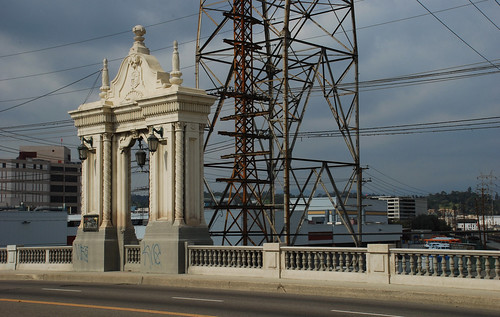
Cesar Chavez Avenue Viaduct

The city’s bridge engineer, Merrill Butler, oversaw the design of the viaduct while H.P. Cortelyou, construction engineer, and Ross H. Rook, inspector of public works, supervised the construction. The Atkinson-Spicer Company, who had the lowest bid in May 1925 of $324,824.50, were the contractors. While a small legal to-do had construction delayed until August 1925, the builders finished the viaduct a few months early. The Macy Street Viaduct opened formally on April 17, 1926.
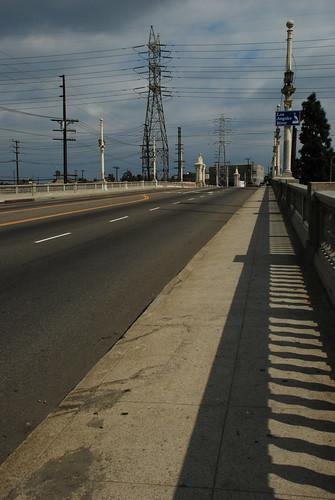
Cesar Chavez Avenue Viaduct

Do you know why the bridges features elements of the Spanish Colonial persuasion? It turns out Macy Street/Cesar Chavez Avenue was once part of the El Camino Real, the road linking the twenty-one missions up and down Alta California from San Diego to Sonoma. To further drive home the connection, the city dedicated the span to the founder of the missions, Father Junipero Serra. A pair of plaques on the bridge says so. Here’s the one less tagged:
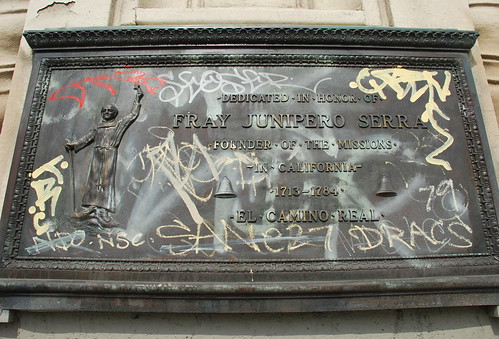
Cesar Chavez Avenue Viaduct

The viaduct is seventy-one-feet wide, large enough to have originally accommodated a pair of tracks for the Los Angeles Railway. It stretches 1270 feet, and boasts a central span of about 215 feet in length. If you look at the porticos’ cornices, you’ll even see the city seal of Los Angeles.
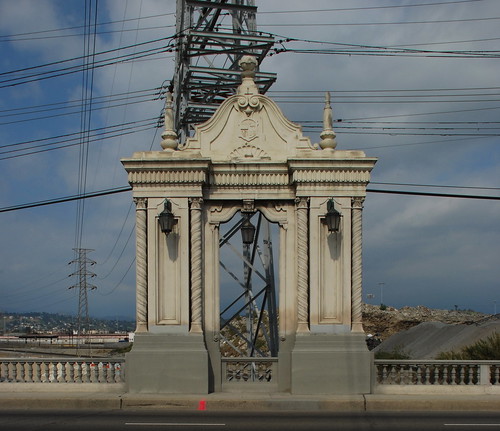
Cesar Chavez Avenue Viaduct

On opening day that spring of 1926, there was all the usual speechmaking and ceremonies – including the ribbon-cutting and main address by Mayor George Cryer – along with a contractor-sponsored luncheon under the bridge for about 300 guests. The picture below shows how, apparently, the opening day picnickers lacked the good sense to clean up after themselves.
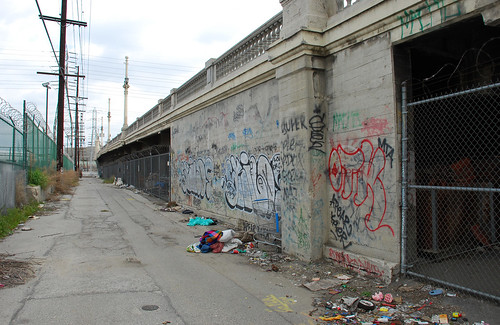
Cesar Chavez Avenue Viaduct

Oh, and there’s a story behind the pair of $600 memorial bronze plates you can find on the bridge, too. In April 1926, City Council voted to add its members’ names to the viaduct’s tablets, pointing to the fact the recently completed Ninth Street Bridge had plaques bearing the names of the Mayor, the Board of Public Works, and engineers, “but no mention of the men who did the heavy work and who raised the money” (i.e. City Council). The board of Public Works, though, shot down the idea pronto, pissing off council to no end.
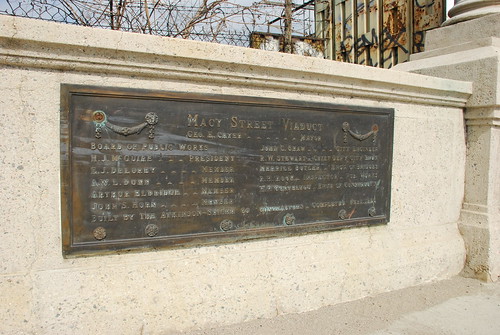
Cesar Chavez Avenue Viaduct

Views north of the viaduct (a bonus):
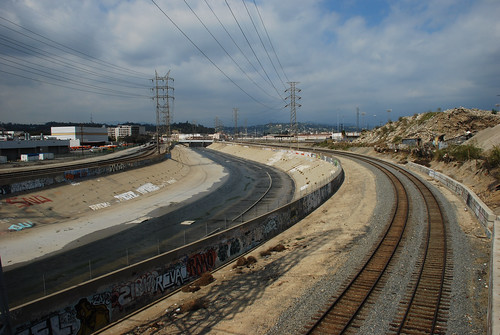
View from the Cesar Chavez Avenue Viaduct

A seismic retrofit was completed on the bridge in 1995, right around the same time the city decided Los Angeles pioneer Dr Obed Macy really wasn’t worthy of the honor of having a street named after him those century-plus years. (Actually, while Macy Street and Brooklyn Avenue were renamed to honor labor leader Cesar Chavez, there’s a chance the Macy Street Viaduct may have kept its name. I shouldn’t assume just because the street was renamed, so too was the bridge. A quick call to the Board of Public Works can answer the question, so someone let me know how that turns out.)
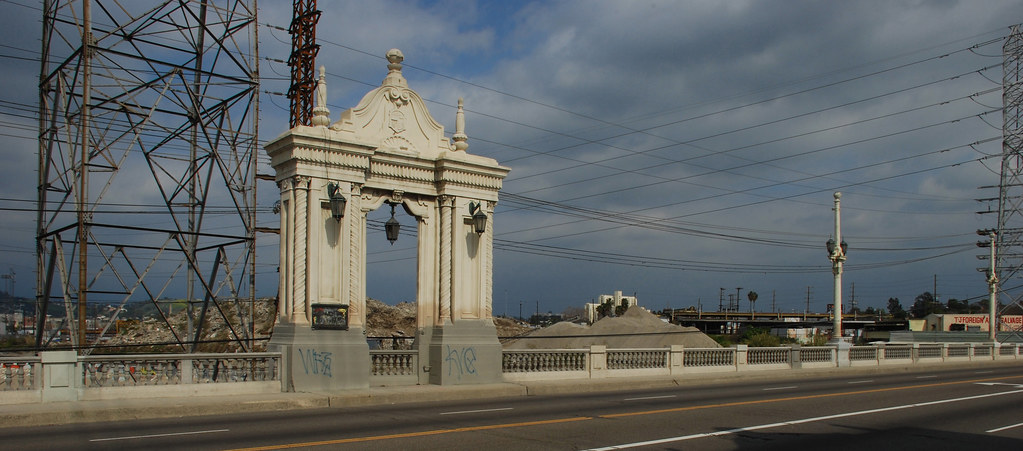
Cesar Chavez Avenue Viaduct


Sources:

“Start Move to Obtain Bridges” The Los Angeles Times; Mar 27, 1923, p. II5

“Bridge Cost Division Urged” The Los Angeles Times; Sep 26, 1923, p. II1

“Macy Viaduct Plan Offered” The Los Angeles Times; Jul 16, 1924, p. A8

“Macy Viaduct Contract Let” The Los Angeles Times; May 18, 1925, p. A3

“Councilmen Vote Honor for Selves” The Los Angeles Times; Apr 8, 1926, p. A2

“Council not to Live in Bronze” The Los Angeles Times; Apr 10, 1926, p. A1

“Macy Viaduct is Completed” The Los Angeles Times; Apr 18, 1926, p. E13

“Macy Street Span Opened” The Los Angeles Times; Apr 18, 1926, p. 17

“Municipal Art Commission, Los Angeles, Annual Reports 1921-1929” 1929 Los Angeles, CA

Up next: Los Angeles Theatre

continue reading...

Sunday, February 1, 2009

No. 211 - Granite-Block Paving

Granite-Block Paving

Granite-Block Paving
1913
Bruno Street between Main Street and Alameda Street – map
Declared: 3/7/79

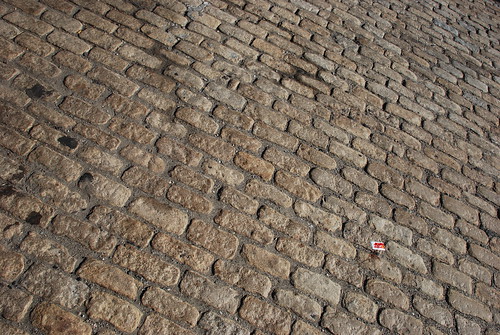
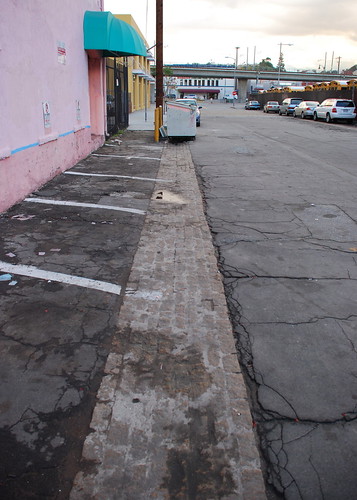
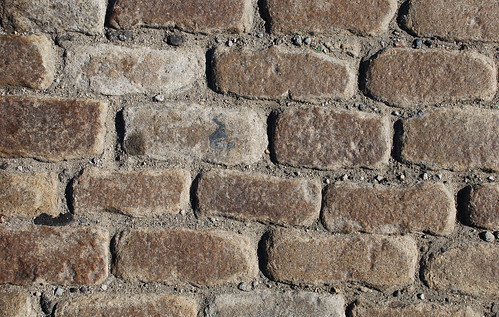
If you’re ever on the Gold Line traveling to downtown from Pasadena, turn to the east when you hit the Chinatown stop. Here, you’ll look down on Bruno Street, containing a great – but small and getting smaller – example of vintage hand-hewn granite, cobblestone street-paving typical of Los Angeles around the turn of the last century (in this case, from 1913).

Granite-Block Paving
All of Bruno Street, from Alameda to Main.

Granite-Block Paving

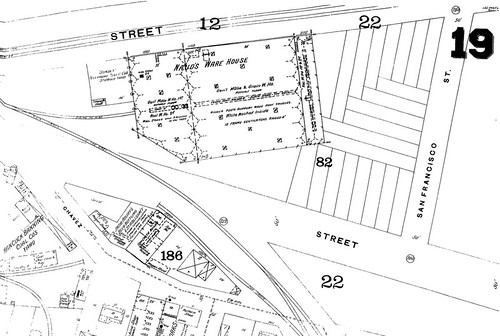
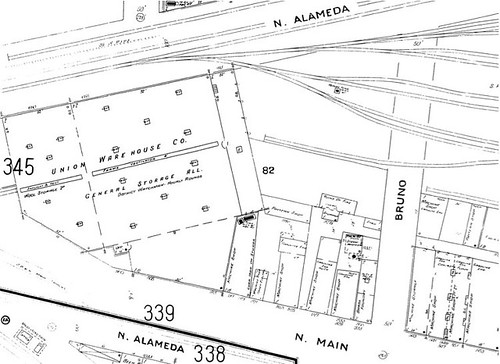
Take a look at the section of an 1894 Sanborn fire insurance map below. On this, Bruno Street is a called San Francisco Street. I don’t know when the change was made to Bruno, but it was by 1900. As far as where the name Bruno comes from, it could be it’s from the Spanish word for a little black plum or plum tree. However, in this neck of the woods at the end of the 1800s, plum trees had to be few and far between.

Los Angeles, 1894

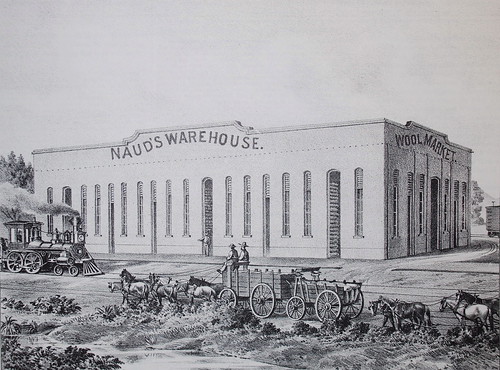
What’s also of note in the above map is the site of Naud’s Ware House. After arriving in L.A. in 1850, baker Edouard Naud first opened a pastry shop on Commercial Street, selling ladyfingers at fifty cents a dozen. He later dove into the wool industry, building a warehouse on Alameda in 1878. The building – by then 600,000 square-feet, owned by Kaspare Kohn, and known as Union Warehouse – fell to a million dollar fire on September 22, 1915. Dozens of businesses were affected by the blaze, yet it appears the only uninsured loss was of $2,500 worth of toothpicks stored by the – heh – Breast Manufacturing Company (imagine a company by that name in Los Angeles, of all places).

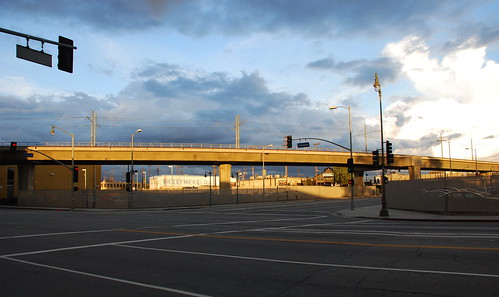
From Thompson & West’s 1880 History of Los Angeles County California, here’s a lithograph of the warehouse by C.L. Smith. Below it is a shot of what the site looks like today.

Naud's Warehouse
Site of Naud's Warehouse
Alameda and Alpine, starring the Gold Line.

You can see by 1906, in another Sanborn map, San Francisco had made the switch to Bruno, and it was Union Warehouse, not Naud’s. (Maybe a street name more appropriate than Bruno would’ve been Taller de Máquinas Street.) Also notice how nine different Southern Pacific spurs crossed Bruno at the time.

Los Angeles, 1906
Granite-Block Paving
Looking up Bruno to Alameda.

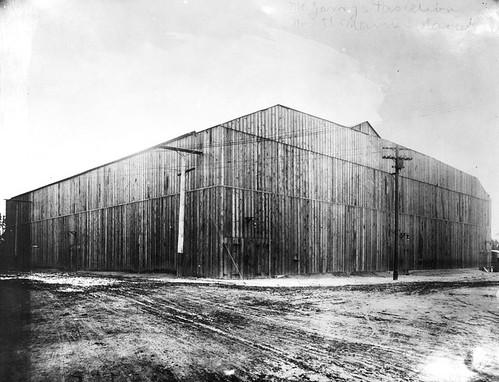
Speaking of Naud’s, this area of Los Angeles, thanks to M. Naud and his warehouse, is today still known as Naud Junction. In fact, when boxing promoter Uncle Tom McCarey left Hazard’s Pavilion he built a large barn for matches in the area called, varyingly, Naud Junction Arena, McCarey’s Pavilion, and the Pacific Athletic Club. This was in 1905. I’ve been unable to pin down exactly where it was, but The BAWLI Papers (Boxing as We Like It) reports it was “near the confluence of Main Street, Alhambra Avenue and Macy Street”, while William David Estrada, in his very fine book, The Los Angeles Plaza, says it was “slightly northeast of Alameda Street on Chavez and Quierolo Streets.” (A 1908 city directory lists McCarey and the Pacific Athletic’s office at 102 South Spring, room 331.) In any event, the venue lasted only to 1910 when McCarey put up the outdoor Vernon Arena, competing with Jack Doyle’s indoor Vernon Arena. (Tangent to a tangent: McCarey was the the father of Hollywood director Leo McCarey.)

From USC’s Digital Archive, here’s McCarey’s Pavilion in Jaud Junction. A regular L.A. Live.

McCarey's Pavilion, Los Angeles
McCarey's Pavilion

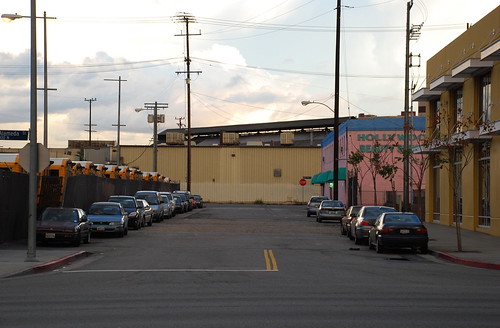
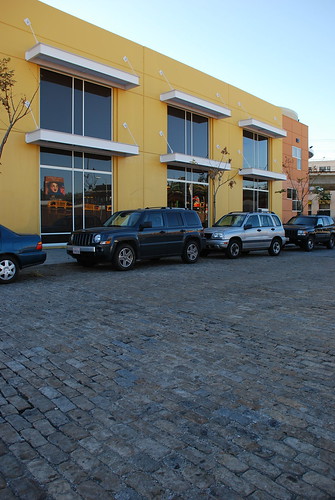
More of the cobblestoned Bruno, the point of the post:

Granite-Block Paving
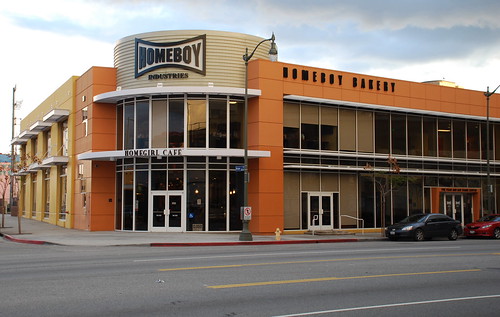
Homeboy Industries and Homegirl Cafe

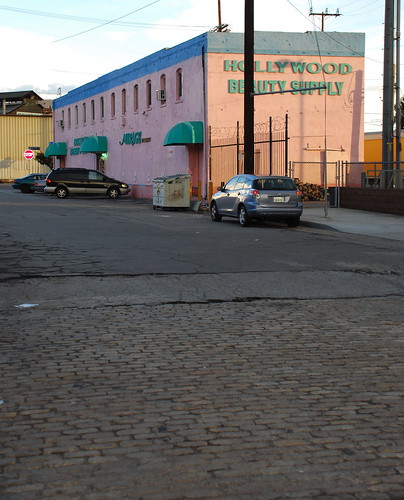
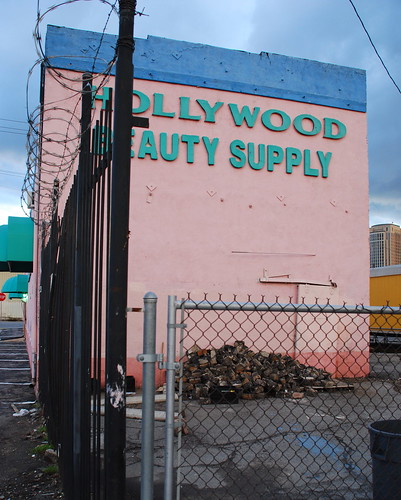
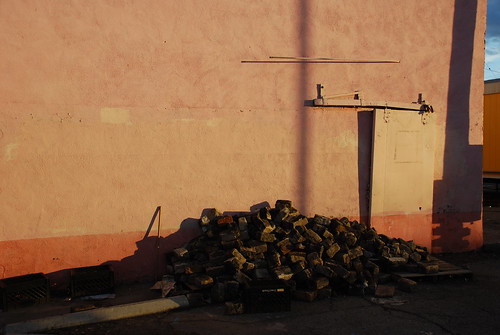
In between where once stood Naud’s Warehouse and today’s partially-cobblestoned Bruno Street stands Homeboy Industries and the Homegirl Café. And in between Homeboy Industries and Hollywood Beauty Supply, lies a big pile of Bruno Street’s 96-year-old granite paving-blocks, cut by hand. Hey, landmarked or not, sometimes they need to be removed and “stored”, right?

Hollywood Beuaty Supply with Vintage Cobblestones
Vintage Los Angeles Cobblestones

Granite-Block Paving

Sources:

Thompson & West History of Los Angeles County California; Pacific Press 1880 Oakland, CA

“Cause of Large Fire Under Sharp Scrutiny.” The Los Angeles Times; Sep 23, 1915, p. II1

Newmark, Harris Sixty Years in Southern California 1853-1913; The Knickerbocker Press 1916 New York, NY

Kenyon, J. Michael, editor The BAWLI Papers (Boxing as We Like It); May 24, 1999, Issue 84, New York, NY

Springer, Steve “This City Was Full of Fight” The Los Angeles Times; Mar 30, 2006

Estrada, William David The Los Angeles Plaza; The University of Texas Press 2008 Austin, TX


Up next: Stimson Residence

continue reading...
Wednesday, January 2, 2008

No. 101 - Union Station Terminal and Landscaped Grounds
Union Station, Los Angeles

Union Station Terminal and Landscaped Grounds
1939 – John and Donald B. Parkinson
800 North Alameda Street – map
Declared: 8/2/72

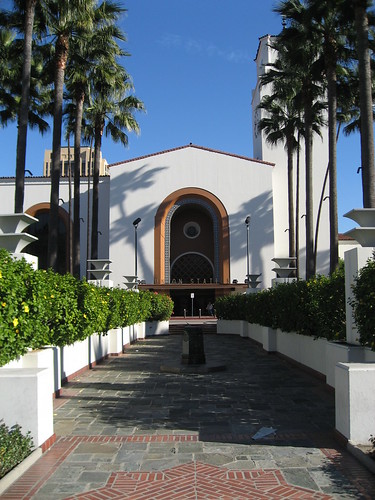
In Landmarks of Los Angeles, McGrew and Julian point to the coincidence of 1939 seeing the opening of both the city’s Union Station – “the last of America’s great railroad stations” – and the Arroyo Seco Parkway – “the first freeway in the west”, stretching from downtown to Pasadena. Also, it bears noting that the Parkway more or less began in L.A.'s Chinatown, the community relocated to make way for L.A. Historic-Cultural Landmark No. 101.

Site of Union Station, Los Angeles
This is the site, towards the lower right, mainly, of today's Union Station.


While there had been talk, negotiations, and promises for such a facility for decades, it wasn’t until 1933, when three of the biggest railroad lines – the Southern Pacific, Santa Fe, and Union Pacific – got together to create the terminal terminal. (By the way, try and find a reference that doesn’t use the words “pool” and “resources” when referring to the banding together of the three companies.)

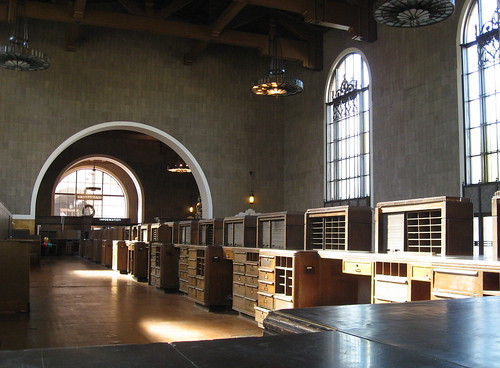
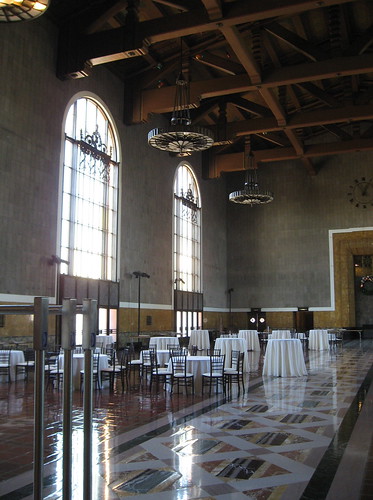
Below is the old ticket concourse. Back in the day, you’d wait in line in front of one of thirty windows to get your ticket.

Union Station, Los Angeles

The architectural team of the Parkinsons, John and Don, was hired to build this monument to transportation (Parkinson and Parkinson also designed HCM Nos 278, the Title Guarantee and Trust Company Building, and 575, the Security Savings and Trust Bank, among many others.) With help from J. H. Christie, H. L. Gilman, R. J. Wirth, color consultant Herman Sachs, and landscaping artist Tommy Tomson, they came up with the resulting design in the Streamline Moderne and Spanish Colonial/Moorish style.

In order for construction to begin, though, the city first had to clear forty-plus acres of L.A.’s Chinatown, moving the community up and over a few hundred yards. Prior to the being Chinatown, the land comprised of acres and acres of vineyards.

Poor Chinatown. It's safe to say that, had it been just a year or so later, because of the explosion in automobile use, this railway station would not have been built, and the community would probably still be standing in its original location.

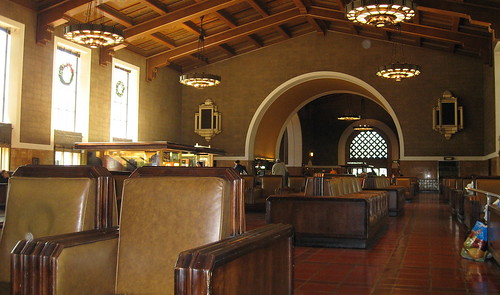
Another shot of the ticketing area, now used for private events. I was at a Christmas party here years ago and had too much to drink.

Union Station, Los Angeles

The eleven million dollar building opened on May 3, 1939, and saw one and a half million people pass through its doors in its first three days. L.A. mayor Fletcher Bowron and Culbert Olson, the state’s governor, presided over dedication ceremonies. There was also a parade, highlighting the history of L.A. transportation, with horsemen, muleskinners, stagecoaches, horse-car trolleys, and an appearance of the Southern Pacific's No. 1 engine from 1869.

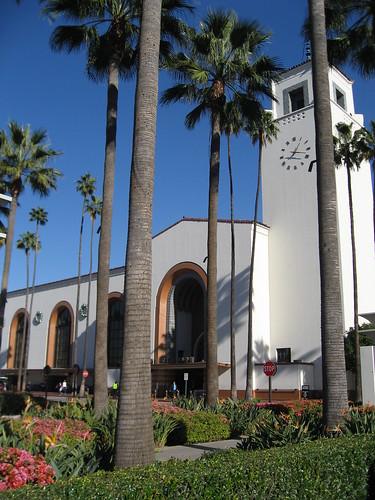
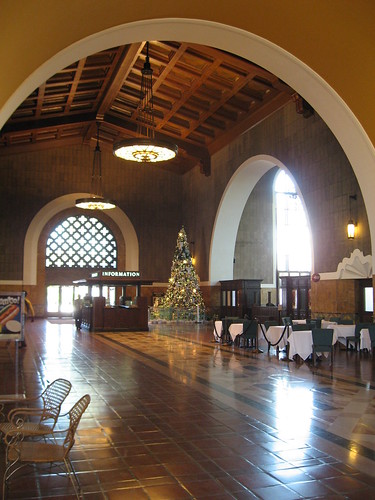
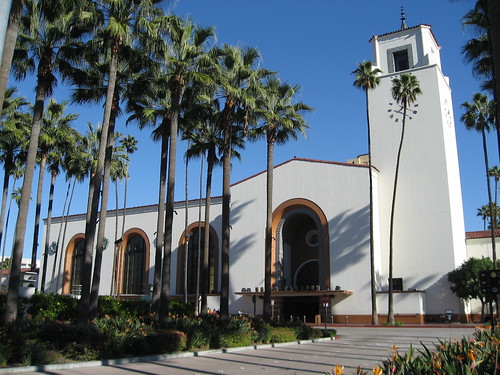
The station's main entrance, Christmastime, 2007:

Union Station, Los Angeles

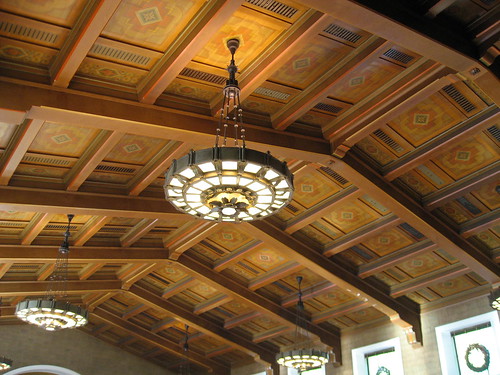
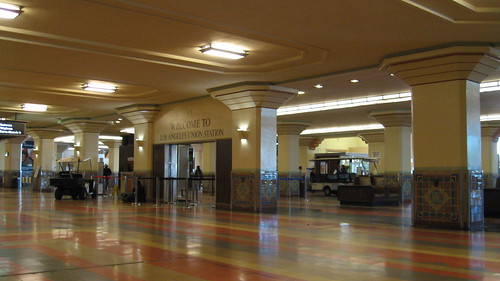
Here’s the interior waiting room, 52 feet from floor to ceiling. The lower part of the walls is made of travertine marble, and the upper part is acoustical tile made partially of ground corncobs (no lie). The floor is terra cotta tile and inlaid marble.

Union Station, Los Angeles

Union Station, Los Angeles

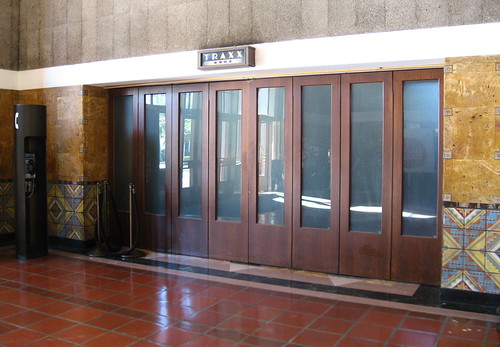
Below is Traxx Restaurant, formerly used by Western Union for sending wires.

Union Station, Los Angeles

Union Station, Los Angeles

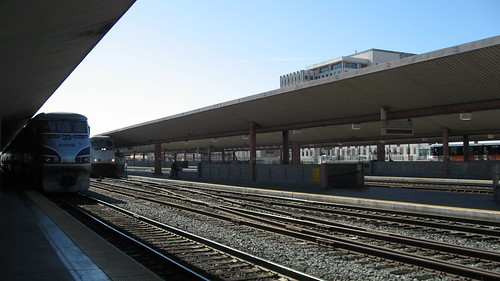
By the time the 1970s rolled around railway passenger and freight service in the U.S had reached its nadir (Union Station was sometimes seeing less than ten passenger trains a day). Amtrak began servicing the complex in 1971, but things really began to turn around in the early 1990s with the introduction of Metrolink service followed by the Metro’s Red, Purple, and, eventually, Gold lines. Patsaouras Transit Plaza, an addition opening in 1995, serves bus lines and shuttles.

Union Station, Los Angeles

Union Station, Los Angeles

Today Union Station is busier than ever, seeing 201 arrivals and departures daily (the odd number is a result of a single departure/arrival after midnight).

Union Station, Los Angeles

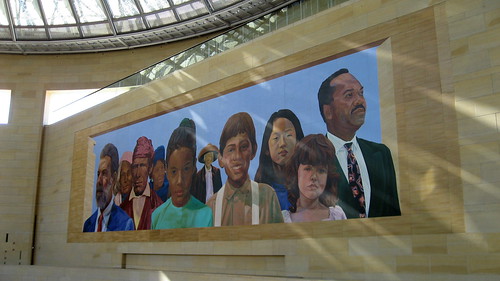
In the 1990s, with renovations and additions to Union Station to accommodate the new subway service, several pieces of public art were commissioned. 1995 saw the unveiling of Richard Wyatt, May Sun, and Paul Diez's "City of Dreams/River of History". The installment includes a few pieces including this 79-foot long mural by Wyatt.

Union Station, Los Angeles

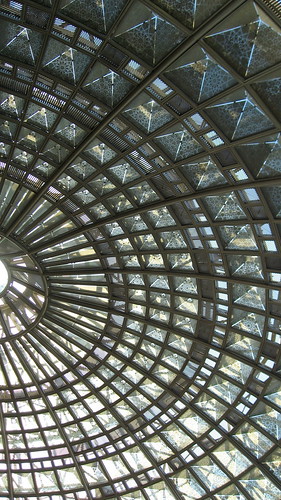
Looking up in the east lobby by the mural, you see this ceiling.

Union Station, Los Angeles

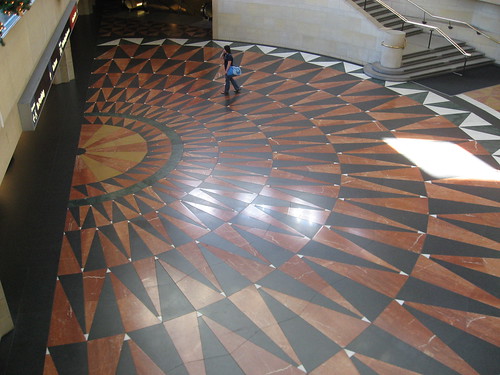
Looking down, this floor.

Union Station, Los Angeles

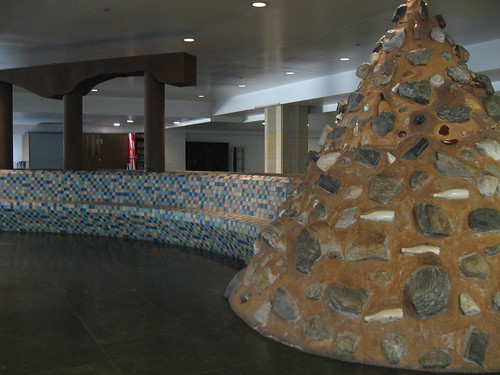
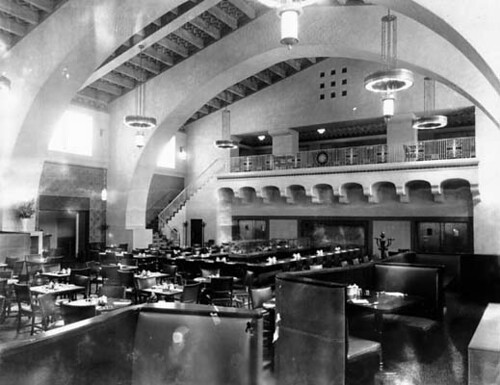
Below is May Sun's "Riverbench". Embedded in that mountain and in the "river" laid in the top of the bench are vintage artifacts found in the station's excavation. Nearly everything - bottles, kitchenware, etc. - is a remnant from when the area was the city's Chinatown. (If you want to see images of tons of pieces of old Chinatown dug up during construction, search USC's Digital Archive site. The webpage is also the source of the black and white photo above.)

Union Station, Los Angeles

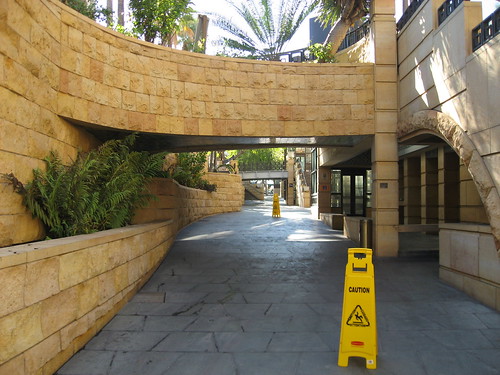
The stretch below, not including the caution marker, is the entrance to 1995's "La Sombra el Arroyo" by the artist team called East Los Streetscapers.

Union Station, Los Angeles

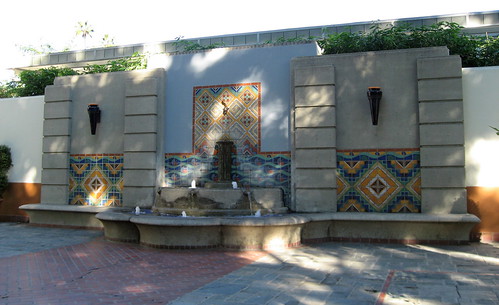
There are enclosed patios are on each side of the main waiting room. This is a picture of the restored fountain in the north patio.

Union Station, Los Angeles

Back in the day, passengers exiting Union Station would leave through the southern garden patio, below.

Union Station, Los Angeles

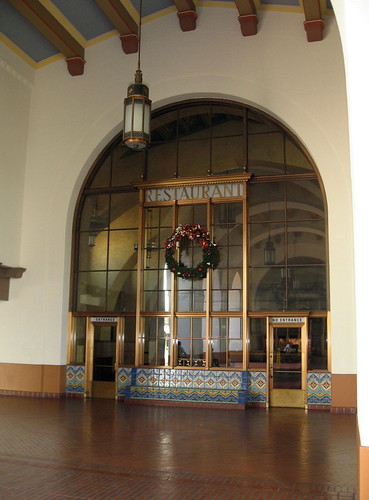
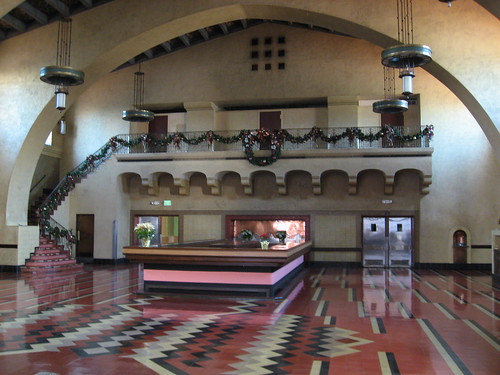
Next to the southern garden held Fred Harvey’s last Harvey House restaurant to be built as part of a railway station. At its busiest, the restaurant served 800 people an hour. Designed by Mary Colter, Union Station’s Harvey House closed in the late 1960s. It's used today for special events.

Union Station, Los Angeles

Union Station, Los Angeles

Harvey House, Union Station, Los Angeles

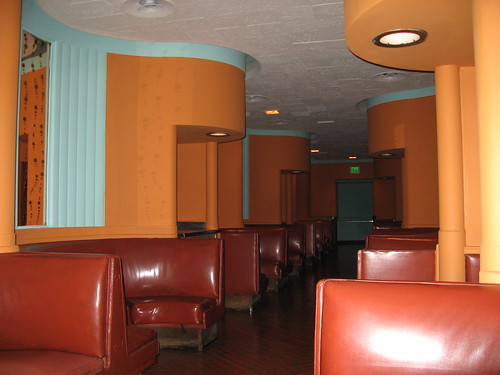
Also part of the old Harvey House is this small bar and dining area, which you really can't fail to appreciate in person.

Union Station, Los Angeles

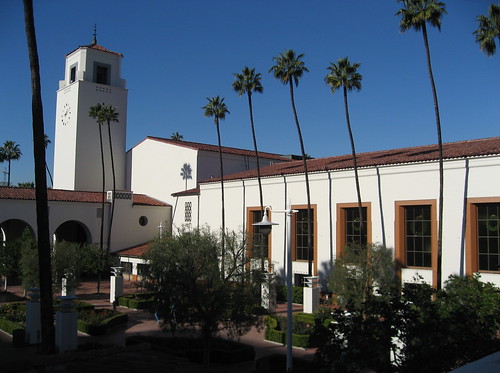
The clock tower is 135 feet tall.

Union Station, Los Angeles

If you haven't yet taken a Los Angeles Conservancy walking tour of Union Station, you really need to do so. They're held the third Saturday of each month, running $10 or $5 for Conservancy members (cheap!).

Union Station, Los Angeles

Source:

“Union Station Celebration Opens Today, Transportation Parade to Start Three-Day Dedication Festival” Los Angeles Times; May 3, 1939, p. 1


Up next: 1030 Cesar E. Chavez Avenue Residence

continue reading...