Tuesday, June 10, 2008

No. 152 - Faith Bible Church

Faith Bible Church

Faith Bible Church
1917
18531 Gresham Street, Northridge – map
Declared: 4/7/76

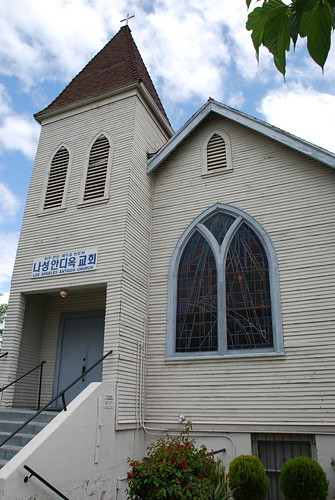
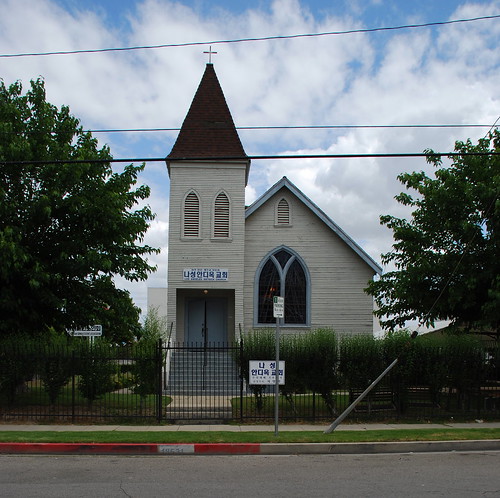
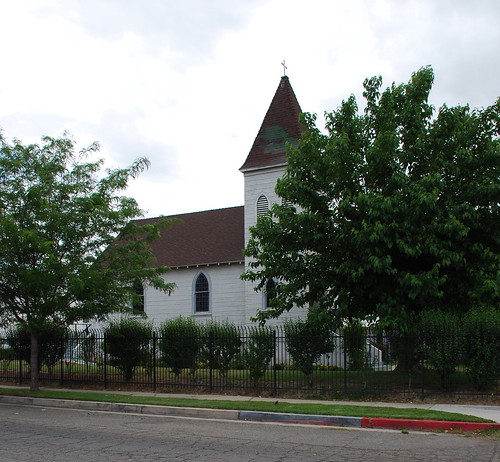
Next up on the list of Los Angeles Landmarks is Faith Bible Church, the first church in Northridge. However, when it was built in 1917, it wasn’t called Faith Bible Church, and Northridge wasn’t called Northridge.
Faith Bible Church

In 1910, Francis Marion “Bud” Wright and Henry Hubbard turned over their 1,100-acre Hawk Ranch to the Valley Farms Company for subdivision. (Messrs Wright and Hubbard had bought the land from Benjamin Porter in 1887; Porter had become a part owner of the land with Senators Charles Maclay and George K. Porter, his cousin; Maclay and G.K. Porter had purchased the land from heirs of Eugolio de Celis, a Spaniard who had bought the “Rancho Ex-Mission de San Fernando” from the Mexican government for $14,000 back in 1846. Got all that?)
Faith Bible Church

Just before the subdividing began, though, Wright’s wife, Emily Vose Wright, named the development “Zelzah”, “watering place in the desert”, a biblical oasis. Just a few years earlier, what would be Zelzah had become the only Valley stopping point on the Southern Pacific Railroad line on this side of the newly blown out Chatsworth Tunnel. In May 1915, residents voted to annex a chunk of the Valley – including Zelzah – to the city of Los Angeles.
Faith Bible Church

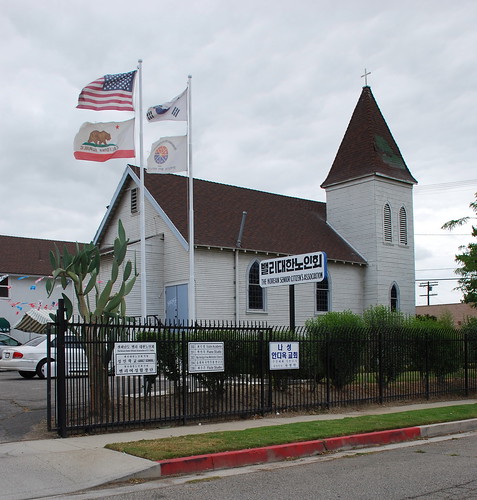
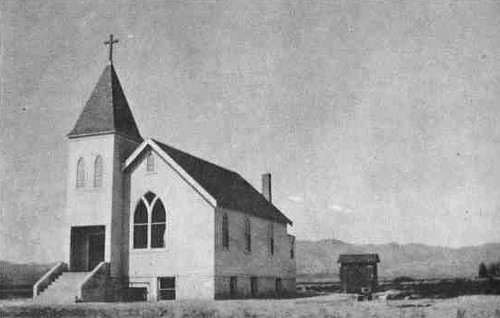
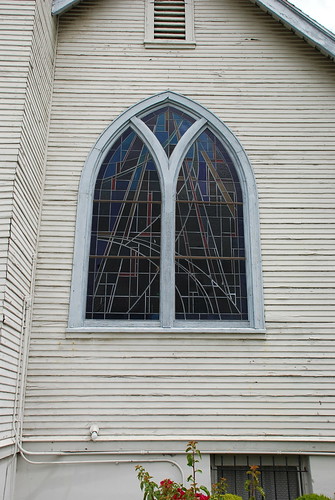
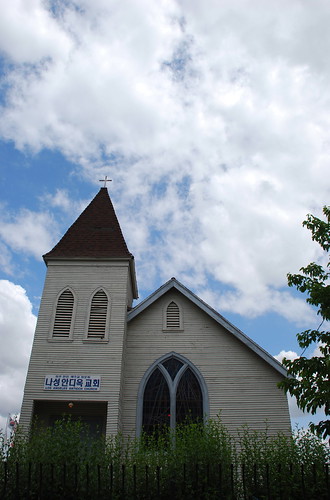
Six families of Norwegian ancestry got together in 1917 to build Zelzah’s first church, the Zelzah Norsk Evangelisk Luther’s Kirke, or the Norwegian Lutheran Church. The white, clapboard building in the Gothic Revival style sits about a block off the main drag of Reseda Boulevard. The church itself hasn’t changed very much since whenever this picture was taken:
Faith Bible Church

On July 1, 1929, Zelzah’s citizens renamed their community “North Los Angeles”. Nine years later, on November 1, 1938, the name changed again, this time, based on a suggestion from Carl S. Dentzel (who would go on to be director of the Southwest Museum and, significantly, was the primary author of the 1962 ordinance which founded the L.A. Cultural Heritage Board), to the Northridge we know today.
Faith Bible Church

From the Oviatt Library Digital Collections, here’s a program of service from December 11, 1938, when the building was home to the First Lutheran Church of Northridge, Pastor O. Qualen presiding. It must’ve still been thick with Norwegians; church officers included the names Hegland, Amundson, and Ullensvang.
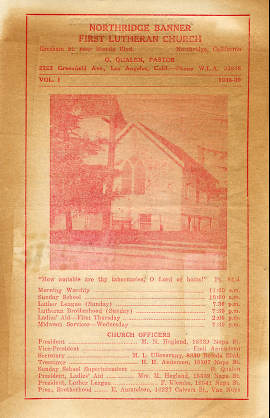
First Lutheran Church of Northridge

In 1976, the Cultural Heritage Board, on which Dentzel was still a member (he remained on the Board until 1980), and the city of L.A. designated the church – then Faith Bible Church – HCM No. 152, Northridge's first Landmark (it didn't get its second, No. 484, until 1990).
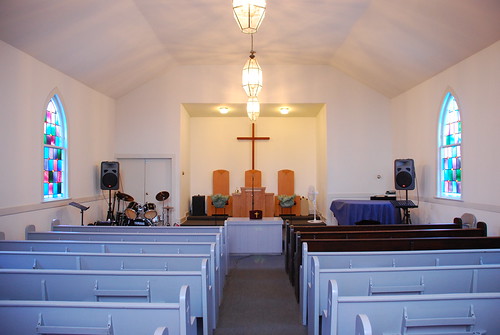
Faith Bible Church
Faith Bible Church

Visiting the Monument today, you’d expect the church was on the verge of becoming yet another area auto shop (there are a bunch close by). But look at all the many organizations which claim an address of 18531 Gresham: Antioch Church; Northridge Free Methodist Church; Sae Soon Church; The Korean Senior Citizen Association of San Fernando Valley; Eine Kleine Musik Klasse; and Soo Kyung Choi Violin Academy.
Faith Bible Church

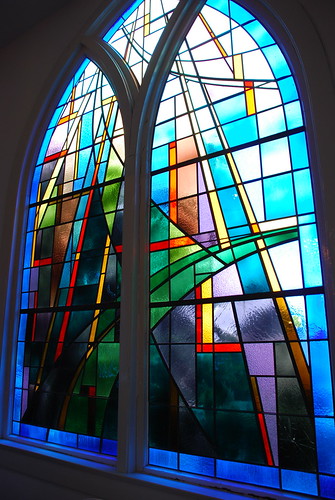
Thanks to the reverend who welcomed me to take the interior pictures here.
Faith Bible Church

Source:

“The Romantic History of Northridge, 1769-1975” San Fernando and Que Magazine San Fernando Valley Pub. Co. September 1975 Vol. 19 No. 1 Sherman Oaks, CA


Up next: (Site of) Lincoln Park Carousel

continue reading...

Saturday, June 7, 2008

No. 151 - Chateau Marmont

Chateau Marmont

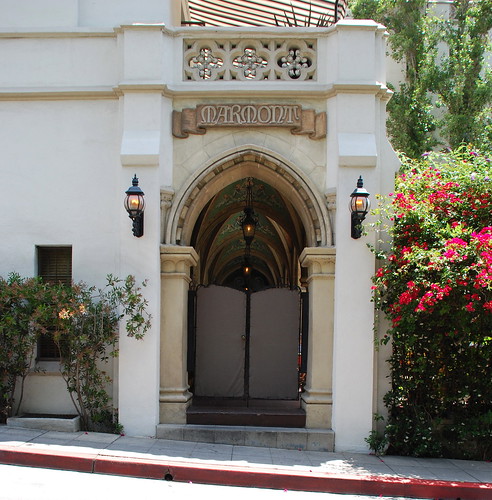
Chateau Marmont
1929 – Arnold Weitzman
8221 Sunset Boulevard – map
Declared: 3/24/76

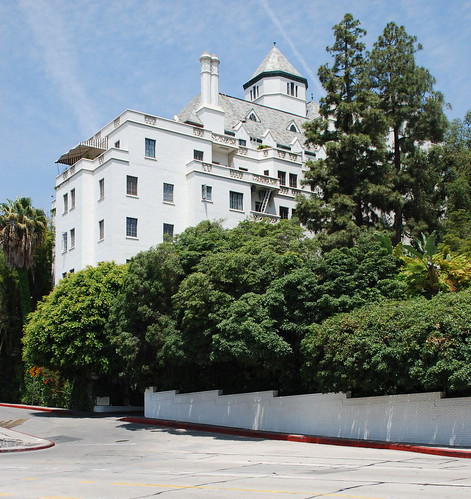
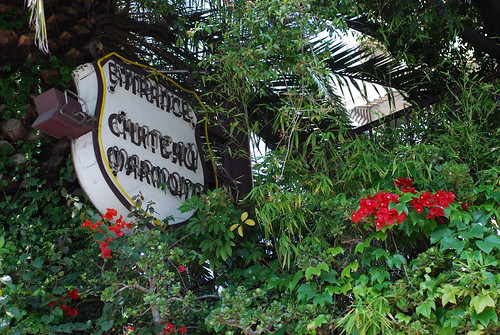
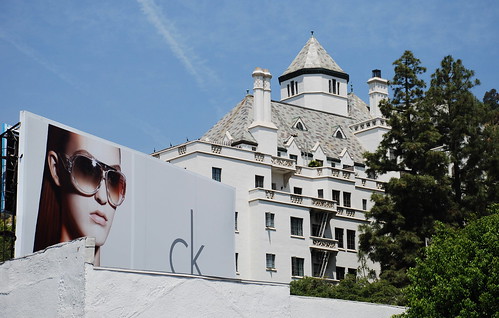
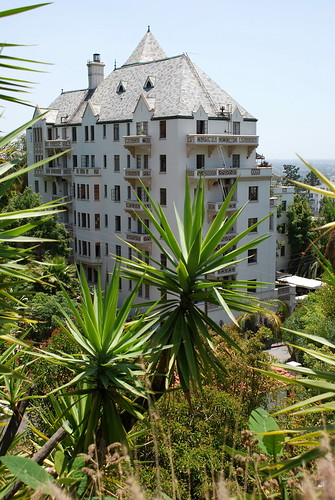
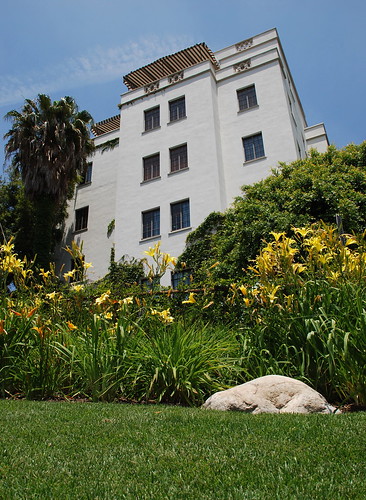
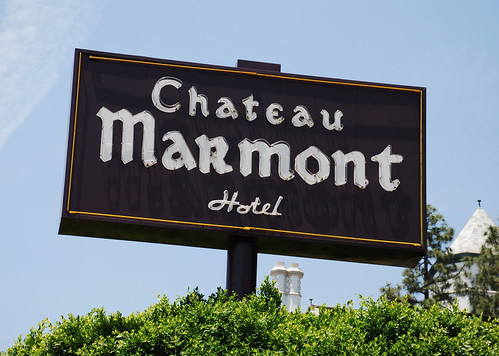
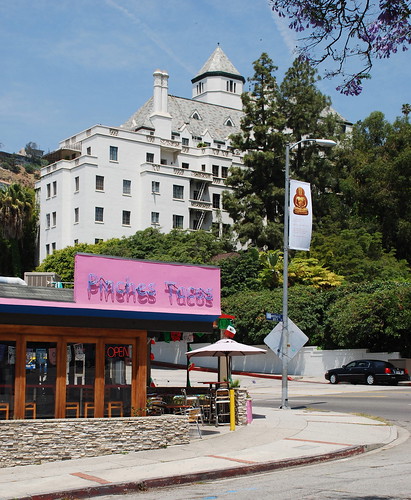
Huh. I would’ve bet the farm Chateau Marmont was not in Los Angeles but in West Hollywood. I would’ve lost, too, as the old hotel is, obviously, in the city of L.A. But just barely.

Chateau Marmont
Chateau Marmont

Inspired by Chateau Amboise in France’s Loire Valley, attorney Fred Horowitz was looking to create a more old-school-styled apartment house in L.A. to attract the movie industry’s talent flowing in from the east coast. He pulled in partners Inez Fredericks, who coughed up some cash, and Florence Dean, who donated her land at the intersection of Marmont Lane and Monteel Road. Horowitz thought the hillside spot next to the unpaved Sunset Boulevard perfect. (It was probably also a bonus that it overlooked the Garden of Allah.)

Chateau Marmont

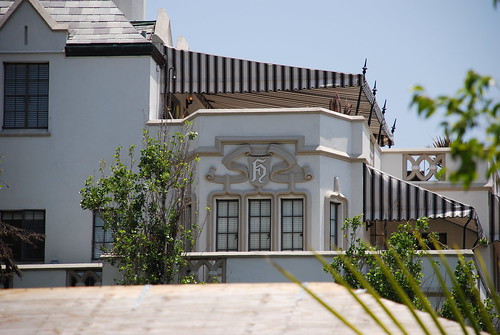
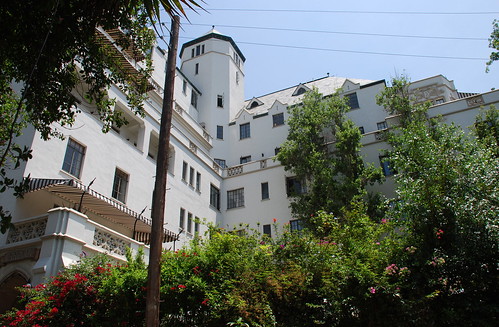
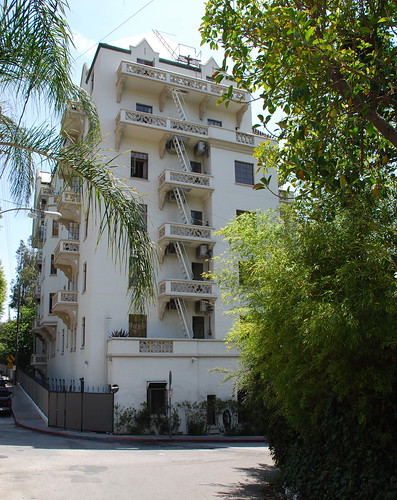
Horowitz hired his brother-in-law, Arnold A. Weitzman, to design the L-shaped, seven-storied, steel and concrete, 43-room Marmont. The original, Gothic main entrance was on the west side, on Marmont Lane. (Also on the west side, but much higher, is still a Baroque letter ‘h’, for ‘Horowitz’). On April 3, 1929, crews broke ground.

Chateau Marmont
Chateau Marmont
The Baroque 'h', for Horowitz.

The Marmont officially opened February 1, 1929. Eight months later – BAM! – the stock market crashed. To save the apartment building, Horowitz brought in property manager Ben Weingart to trim costs and generally whip things into shape. Things didn’t pick up enough, though, and the partners sold the Marmont in October 1931 for a cool $750,000 (at a profit of several hundred thousand dollars). The new owner was Albert E. Smith, co-founder of Vitagraph. Smith dumped Weingart, turned the building into a hotel, and, with his wife, Lucille, took advantage of the fallout of the Depression by buying up classy furnishings at local estate sales and auctions to re-stock the hotel. It was Smith who is credited for giving the hotel “the Marmont look.”

Chateau Marmont

Smith sold out to the Ajax Corporation at the beginning of WWII, but the company turned around and sold the hotel to Edwin C. Brethauer in late 1943. The German held onto the Marmont for nearly two decades.

Chateau Marmont

In the 1940s, Brethauer bought and added to the property nine neighboring cottages built a decade earlier. Craig Ellwood, in 1956, created four additional bungalows as miniature versions of the types of the Case Study houses he was designing. Brethauer had the swimming pool installed in 1947.

Brethauer sold the Marmont in March 1963. A string of owners followed over the next decade, but, in early 1975, Raymond Sarlot and Karl Kantarjian bought the building and began an ambitious restoration project.

Chateau Marmont

By the late 1980s, Messers Sarlot and Kantarjian’s relationship began to sour, and hotelier Andre Balazs bought the Marmont in 1990 for just more than $12 million. He hired set designers Shawn Hausman and Fernando Santangelo to refurbish the landmark. Today, Balazs is getting closer to owning Chateau Marmont longer than anyone else in its history.

Chateau Marmont

For a hotel that’s famous for its discreet handling of celebrities, providing them with the utmost privacy, there sure are a lot of legendary stories – and rosters of its well-known guests – coming out of the Marmont. From Jean Harlow’s “honeymoon”, Garbo, creepy Howard Hughes renting out the penthouse, script-readings for Rebel Without a Cause in one of the bungalows, John Belushi's dying in another, Billy Wilder, Boris Karloff, Stan Laurel, Jim Morrison hanging from a balcony, Paul Newman and Joanne Woodward, Diahann Carroll and Sidney Poitier, Nick Ray and Natalie Wood, Roman Polanski and Sharon Tate, Erroll Flynn, Helmut Newton’s dying while pulling out of the parking lot, Humphrey Bogart, Marilyn Monroe, William Holden and Glenn Ford (“If you’re going to get into trouble…”), Montgomery Clift, Vivien Leigh moping over Laurence Olivier, Grace Kelly letting loose, Warren Beatty, Led Zeppelin, Robert DeNiro, to Lindsay Lohan, Heath Ledger, and Britney Spears, a steady stream of really big names and somewhat big tales have made the Marmont the place in L.A. which can make the best claim to being a timeless Hollywood haunt.

Chateau Marmont
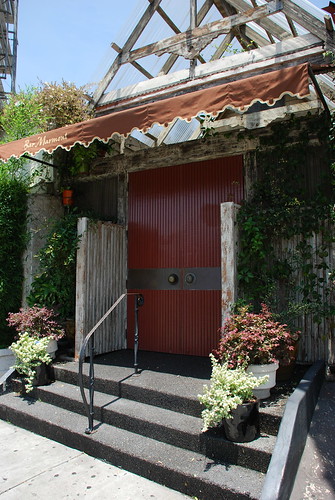
Chateau Marmont's Bar Marmont
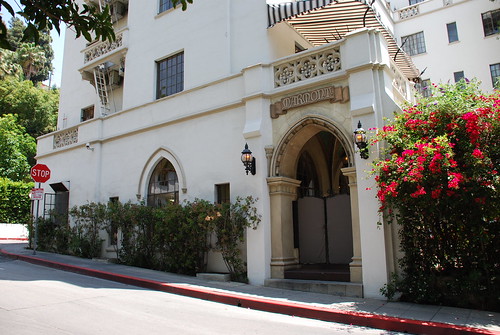
A look at the door to the trendy Bar Marmont on Sunset Boulevard.

I’ve had lunch at Chateau Marmont a couple of times and, except for stressing about parking, I don’t remember them all that well. Also, I had planned on renting a room here for one night just for the sake of exploring, but, in the end, I think I went bowling instead. Now, if the Garden of Allah were still around, that’d be a different story.

Surprise: photography at the Marmont is, um, discouraged (unless you're Helmut Newton and you're shooting a series of domestic nudes – click here for a not-safe-at-work photo).

Chateau Marmont

Sources:

Webb, Michael “Chateau Marmont Revisited” Architectural Digest Dec 1996 p. 76

Nathan, Jean “What’s Up in the Old Hotel?” The New York Times, Aug 1, 1993

Sarlot, Rayomnd R. and Fred E. Basten Life at the Marmont Roundtable Publishing, Inc. 1987 Santa Monica


Up next: Faith Bible Church

continue reading...
Wednesday, June 4, 2008

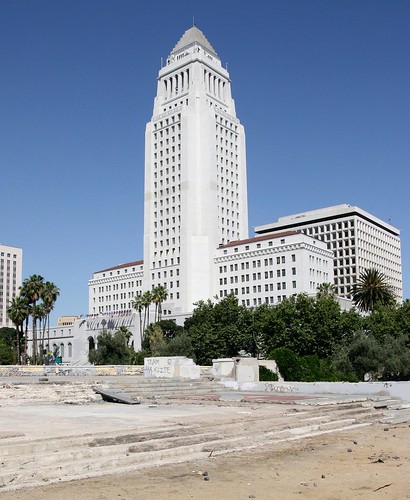
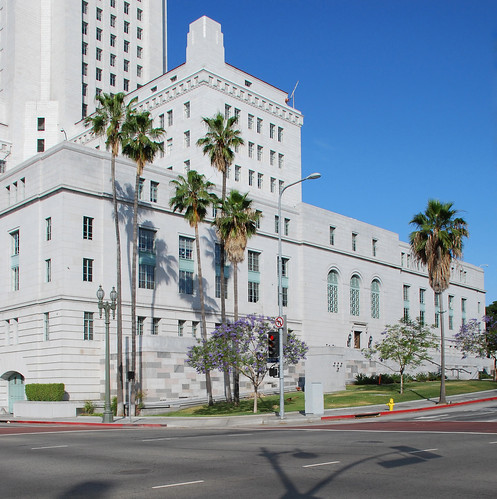
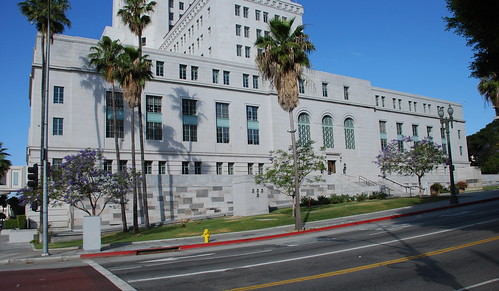
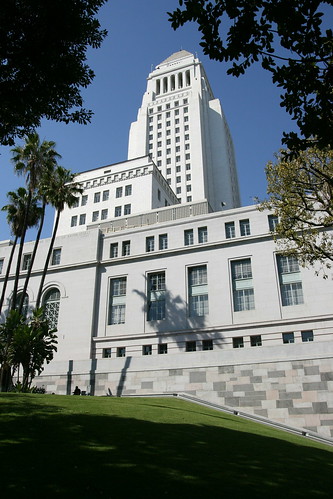
No. 150 - Los Angeles City Hall
Los Angeles City Hall

Los Angeles City Hall
1928 – John C. Austin, Albert C. Martin, and John Parkinson
200 North Spring Street – map
Declared: 3/24/76

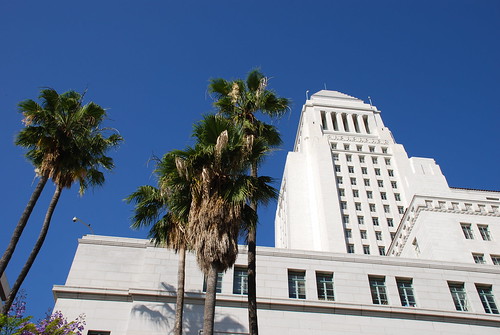
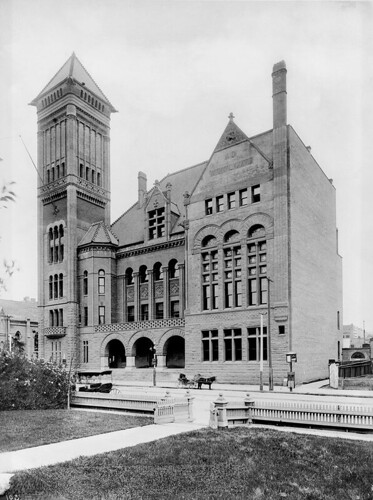
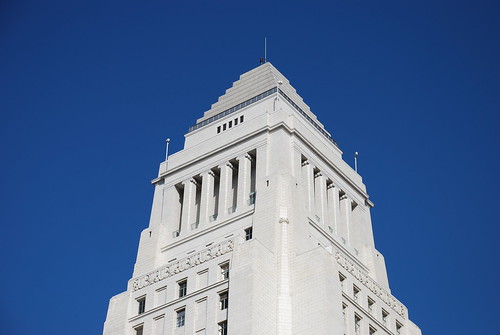
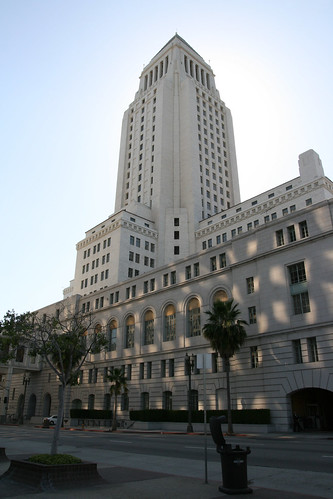
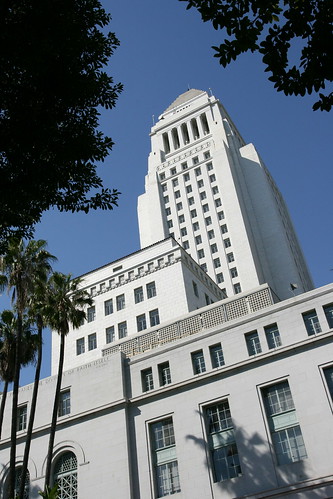
When Los Angeles’s brand new, 28-story City Hall was officially dedicated on April 26, 1928, it was replacing a building on Broadway between 2nd and 3rd Streets that had been government headquarters since 1889. (That building had replaced a one-story adobe City Hall, formerly the old Rocha House, on the northeast corner of Spring and Court Streets.) From the USC Digital Archive, here’s a picture of the 1889 City Hall:

Old L.A. City Hall

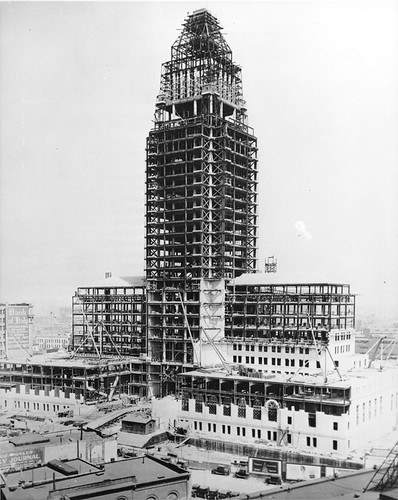
After authorizing a bond issue on June 5, 1923, the city commissioned John C. Austin, Albert C. Martin, and John Parkinson as architects in August, 1925. The trio’s deal called for a payment of 6% of the building’s cost. With the project running $5 million, the boys wound up getting $315,027. Pretty sweet back in 1928.

L.A. City Hall Under Construction
Los Angeles City Hall

Ground was broken March 4, 1926, and the Superior Court of the County of Los Angeles was the first agency to move in, on January 2, 1928.

Los Angeles City Hall

The big dedication, overseen by Sid Grauman and attended by an estimated 15,000 people, featured emceeing by Joseph Schenck and speeches by Mayor George E. Cryer and San Francisco Mayor James Rolph, Jr. After Rolph spoke, Irving Berlin sang, as did “Chief Yowlache, the Yakima Indian; Elsa Alsen, the grand opera singer; the Mexican chorus of Los Angeles, in costume; Virgil Johannson, and others.”

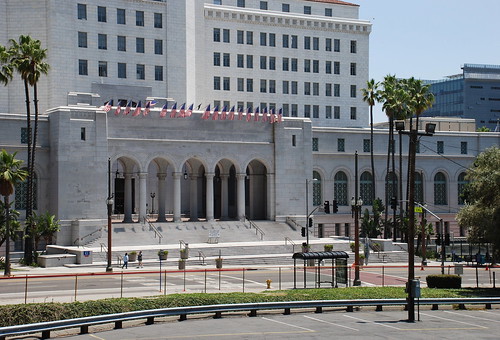
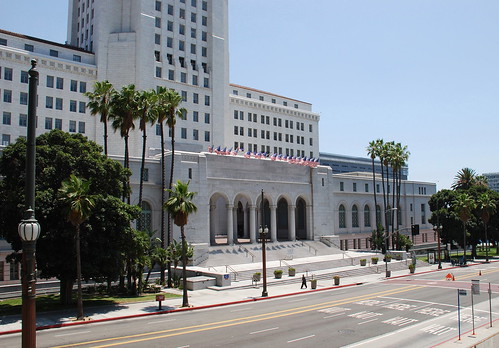
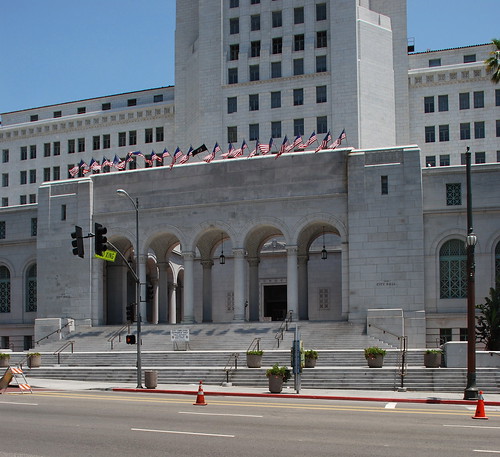
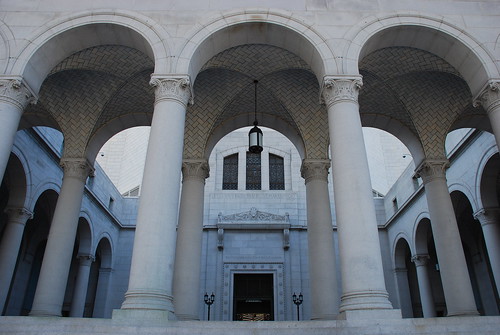
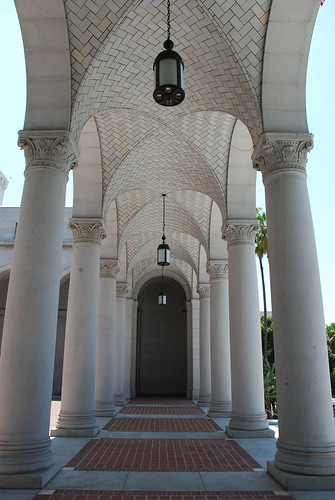
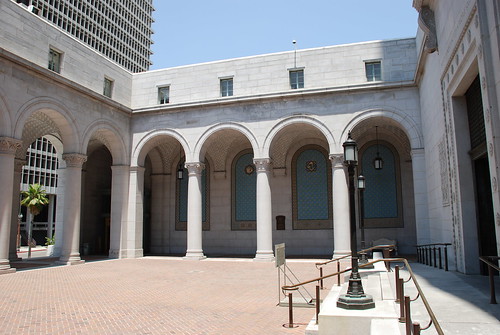
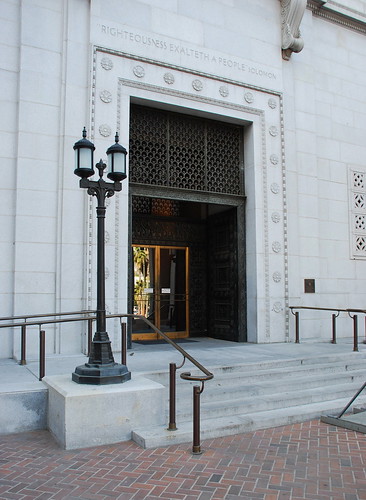
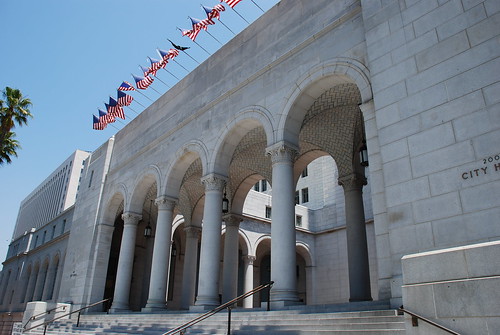
When you walk up the granite steps on the Spring Street side, you’ll see Grecian detail for the main entrance, followed by a more Romanesque style for the forecourt. The city had plans to carve a 75-foot long historical bas relief in that big space above the columns, fronting Spring. Still smooth, though.

Los Angeles City Hall
Los Angeles City Hall Forecourt

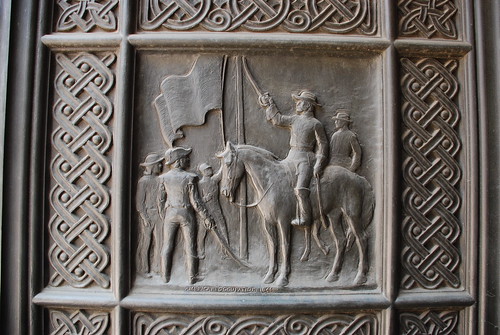
Entering, check out the bronze doors with half a dozen hand-carved bas reliefs by Henry Lion. Restored in 1992, the doors’ panels show key events in L.A. history. Here’s Lion’s take on Commodore Robert Field Stockton and Major John Charles Fremont saluting the flag in “American Occupation 1846”.

Los Angeles City Hall
Los Angeles City Hall Forecourt

The interior of City Hall is pretty much Byzantine. Austin Whittlesey handled much of the design of the inside, with assistance from Herman Sachs and Anthony Heinsbergen.

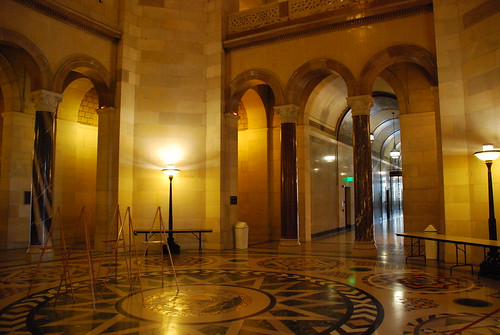
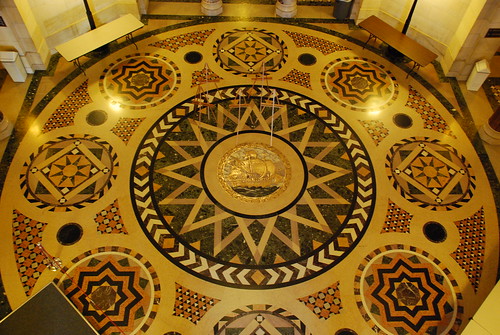
The main attraction at City Hall is the building’s Rotunda.

Los Angeles City Hall
Los Angeles City Hall Rotunda

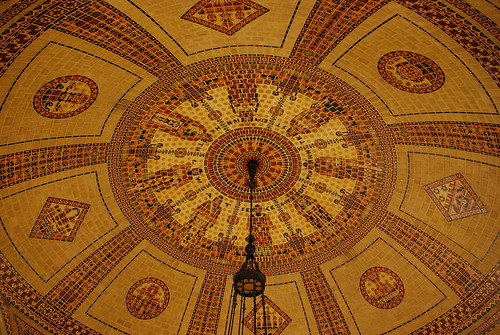
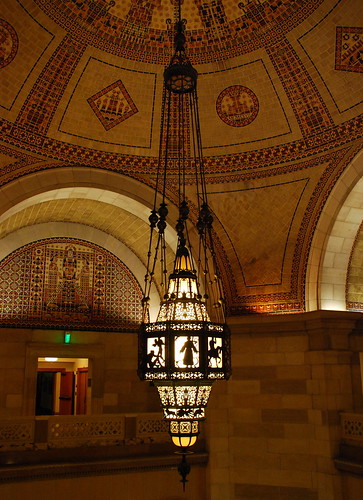
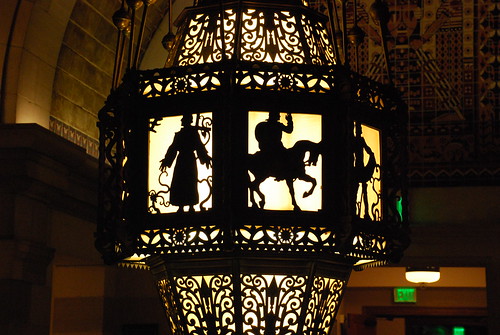
High above its marble floor, the space’s ceiling contains eight figures representing Art, Public Service, Government, Protection, Trust, Education, Health, and Law. Hanging down from its center is a cast bronze electrolier with silhouetted figures of folks instrumental in California history, from Native Indians and Vasca Nunez de Balboa to John Drake Sloat, who raised the U.S flag at Monterey in 1846.

Los Angeles City Hall Rotunda

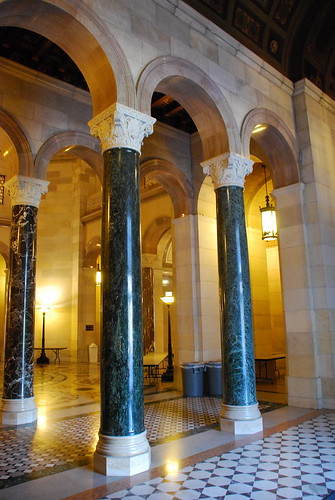
Surrounding the Rotunda are ten columns, each of different kinds of marble, including Curly Green, Tinos, and Verde Campan Melange.

Los Angeles City Hall

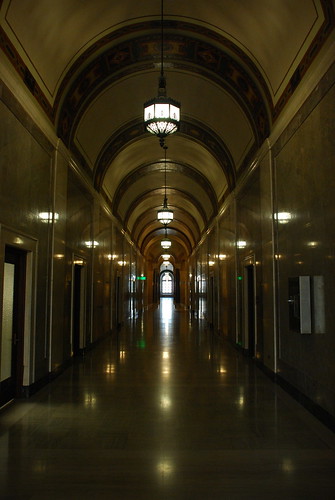
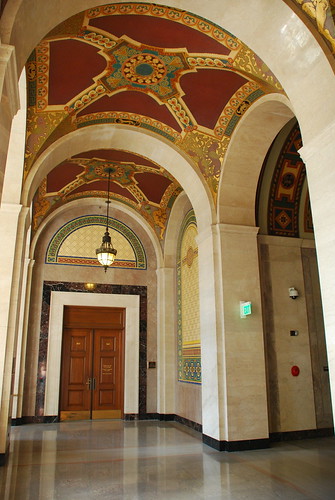
You can also see corridor ceilings supported by California Redwood beams. The walls of the passages are French limestone.

Los Angeles City Hall

Los Angeles City Hall
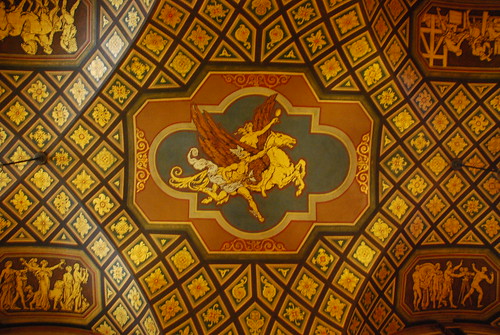
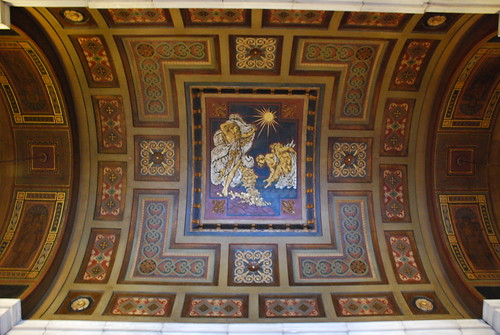
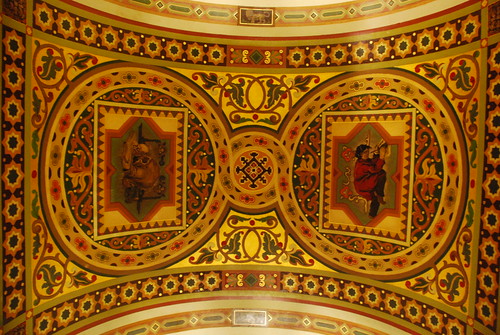
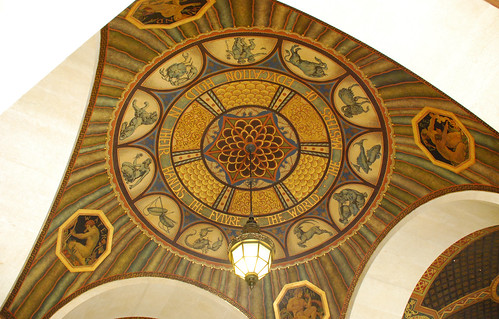
Ceiling detail.

The East Lobby, off the Main Street entrance, features a Zodiacal dome designed by Heinsbergen.

Los Angeles City Hall

In a tragic 1953 incident, reform mayor Fletcher Bowron had his own problems with illegal aliens when a group destroyed the upper floors of City Hall:


Los Angeles City Hall

For years and years, City Hall was the tallest building in L.A. as laws forbid any other structure from going higher than thirteen stories. Okay, when was that rule done away with, and what was the first building to rise higher than City Hall?

Los Angeles City Hall

By 1989, the building was in need of much rehabilitation. Read about some of the restoration here. Then, when you’re through with that, soak up the scoop on the big seismic retrofit, 1998-2001.

Los Angeles City Hall

Of course, the landmark has been the location of many movies and teevee shows. I like to point out it served as the Daily Planet in The Adventures of Superman and, naturally, was featured in the Dragnet series. Also look for it in Mildred Pierce and D.O.A.

Finally, a word of caution if you're intending to drive downtown to visit Los Angeles City Hall. Making a U-turn in a business district is illegal. Even at 7:30 a.m. on Memorial Day morning. $149 worth of illegalness, in fact.

Los Angeles City Hall

Sources:

“Hall Architects Praised” Los Angeles Times; Mar 27, 1928, p. A22

Kirkman, George Wycherley “City Hall on Historic Spot” Los Angeles Times; Apr 15, 1928, p. B1

“Hall Dedicated to Service” Los Angeles Times; Apr 27, 1928, p. A1

Hales, George P. Los Angeles City Hall Times-Mirror Printing and Binding House 1928 Los Angeles


Up next: Chateau Marmont

continue reading...