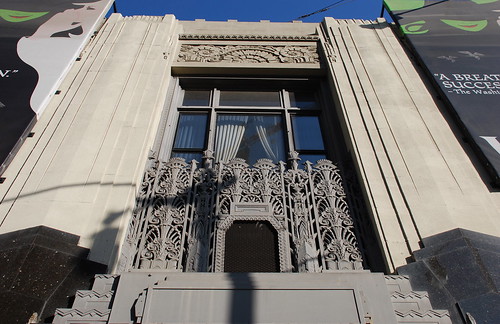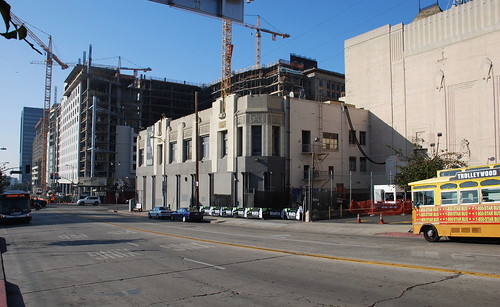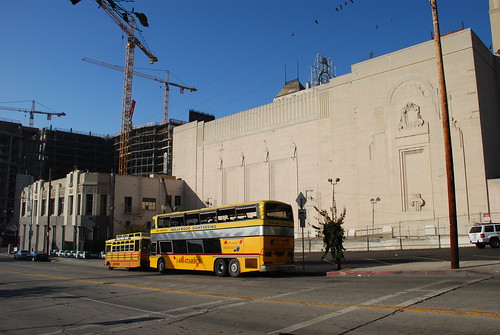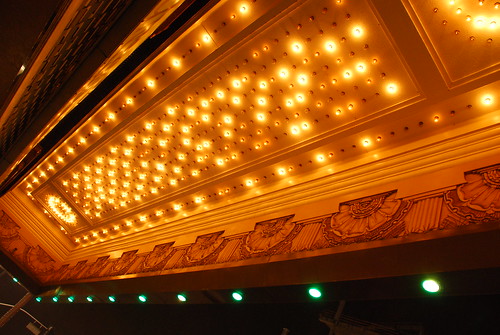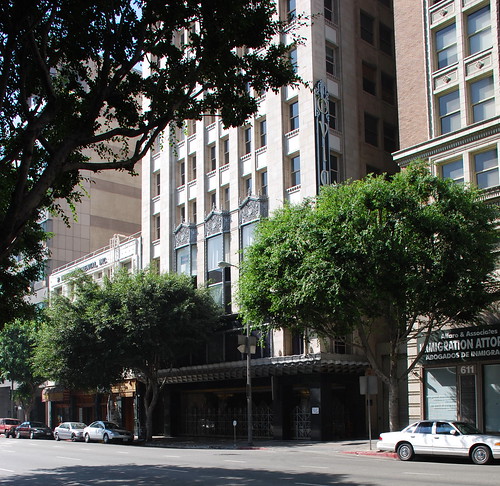
Oviatt Building
1928 – Albert Walker and Percy Eisen
617 South Olive Street – map
Declared: 7/19/78
“THE DOORS of the new Oviatt Building are open – the magnificent new store of Alexander & Oviatt is ready for you – the incomparable Oviatt styles are now given a setting of unprecedented elegance. The whole of this towering building owes its conception to the richness of Alexander & Oviatt merchandise – merchandise that deserved a setting worthy of it. So the building was planned to provide the store – and the store was designed to properly show the merchandise.”That’s from the opening day announcement on May 15, 1928, of the James Oviatt Building, the new headquarters of Los Angeles’s premiere luxury clothing store, Alexander & Oviatt.
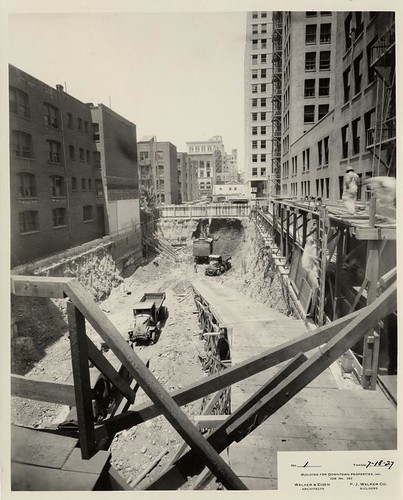
Oviatt excavation.
Born in 1888, James Oviatt arrived in L.A. from Utah in 1907, getting a job as a haberdasher in Desmond’s department store downtown. In 1912, he, along with partner Frank Alexander (the “money man”), opened their new store, Alexander & Oviatt, at 609 West Fourth Street. Quickly building a high-end clientele, A&O relocated to Sixth and Hill in 1914, later expanding twice.
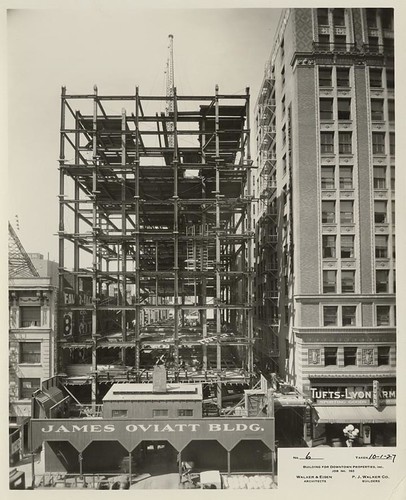
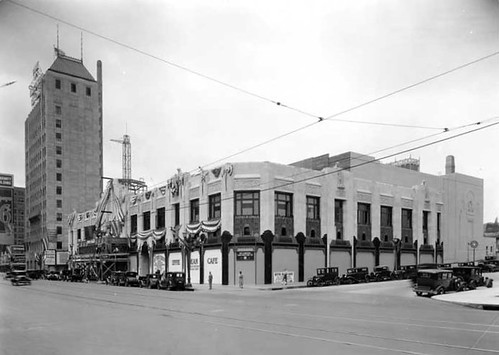
The vintage shots are from the CA State Library.
Plans for the new, twelve-story structure behind the Sixth and Hill shop were announced as early as January 1923. Architects Albert Walker and Percy Eisen were already working on designs for a new building when Oviatt, on a 1925 European trip, became inspired by Paris’s Exposition Internationale des Arts Decoratifs et Industriels Modernes. He knew the direction he wanted his building to take.
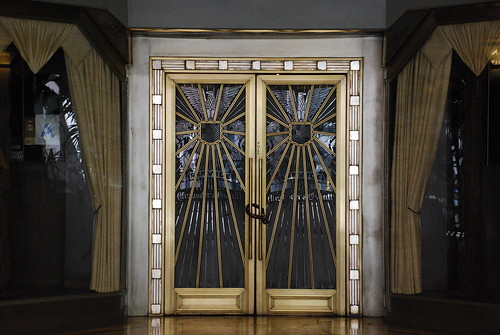
The Oviatt Building was loaded with the work of famed French glassmaker Rene Lalique, who designed and built the entrance doors, the elevator doors for both the store and the building, and art glass windows throughout the building. While larger entrance doors sported a pair of bell-ringing angels representing Los Angeles, smaller doors feature the Alexander & Oviatt crest. The smaller doors with the crests remain (below), but the larger “Angel” doors are now in the Utah Museum of Fine Arts.
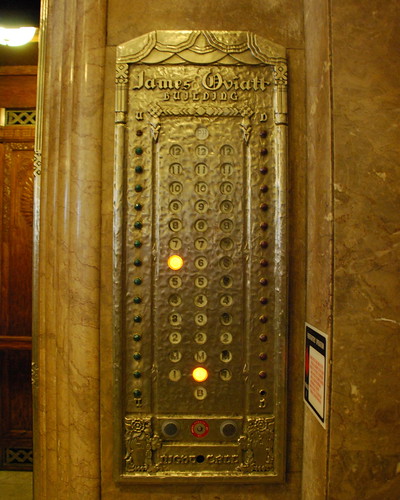
Lalique was also responsible for the metalwork for the elevator doors, the mailboxes, and directories.
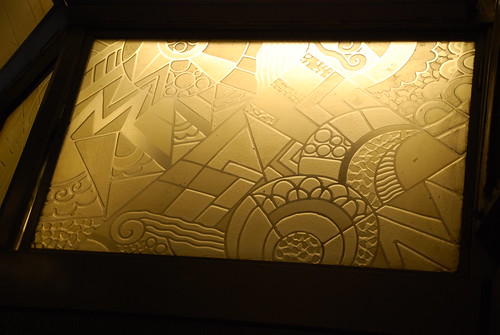
Interiors were designed by Joseph Feil of Feil & Paradise. Fiel and Oviatt also collaborated with artist Gaëtan Jeannin on one of the building’s two most famous features – the entrance arcade’s ceiling. Made up of thirty-two tons of etched glass panels, that original ceiling was eventually sold off for fifty dollars and removed. See much of the original glass at this website. However, a small handful of original Jeannin panels, like this one, remain at the building:
The other of the landmark’s most-famous components remains – Oviatt’s ten-room penthouse. Decorated by Parisian cabinetmakers Saddier et Fils, the penthouse, full of of burled maplewood and mahogany and theya wood, burgundy silk and gold satin, is considered L.A.’s first Art Deco residence. There’s lots of Lalique, too. But you don’t need me to tell you about the penthouse. Just watch and listen to Delilah Anderson (even though she’s clearly talking to me, personally) tour the bedroom, bathroom, bar, and more.
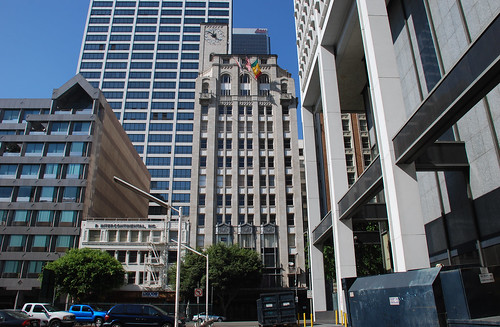
The penthouse opens to a pair of terraces. Back in the day, the lower terrace held a swimming pool, tennis court, and a putting green. For the upper, Oviatt imported sand from the French Riviera for his own rooftop beach. The roof also sports that landmark neon clock, with its trio of faces, thirteen feet in diameter. Imported from France, the clock played “Chimes of Normandy” along with “several other old-world melodies, as well as national airs and Christmas carols.”
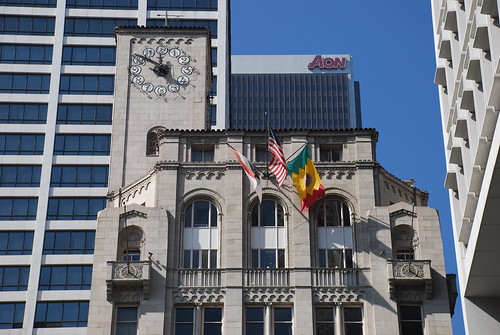
When it opened in the spring of 1928, the building’s lower three floors were dedicated to the haberdashery of Alexander & Oviatt (though Frank Alexander died in 1921, Oviatt, for a dozen years, continued using the full name): the first floor held “furnishings, hats, golf hose, sweaters and custom shirts”; the mezzanine was devoted in part to the Salon des Elegances, the women’s department; on the second floor, along with “luggage, leather goods, traveling accessories, riding clothes, and shoes”, the Outdoor California Palm Grove gave shoppers the opportunity to inspect Oviatt clothing in “natural daylight”; the third floor held the company’s offices and workrooms.
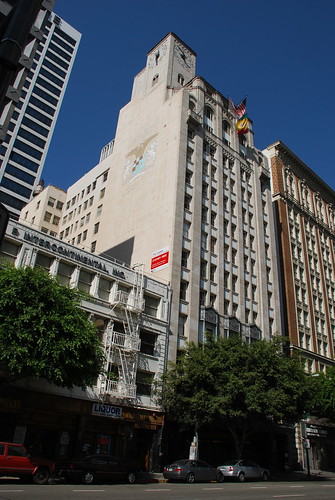
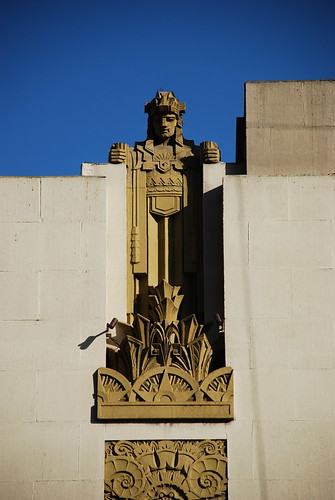
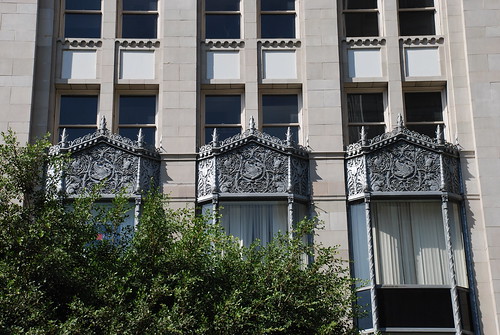
The interior is Art Deco, but the exterior is Romanesque.
Oviatt’s clothing store closed its doors in February, 1967. Two years after Oviatt’s death in 1973 (even anti-Semite John Birch members die, by the way), the ownership of the Oviatt Building somehow transferred to the Roman Catholic Archdiocese of L.A. In 1977, a group, headed by developers Wayne Ratkovich and Don Bowers, calling itself Oviatt Associates, bought the 87,000-square-foot building for $400,000 and kicked off what would amount to a $5 million restoration. Jean Clyde Mason directed the restoration of the penthouse. Restaurateur Mauro Vincenti leased out the ground floor for Rex il Ristorante and the ubiquitous Brenda Levin was hired for the restaurant’s renovation (you can see it in Pretty Woman).
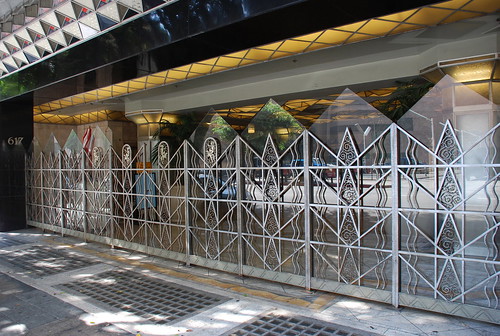
The gate is great, but not original. It was designed by Jean Clyde Mason as part of the 1970s restoration.
The Oviatt Building was listed on the National Register of Historic Places in 1983. A year later, Ratkovich sold the Oviatt Building to a Japanese company for $13.5 million.
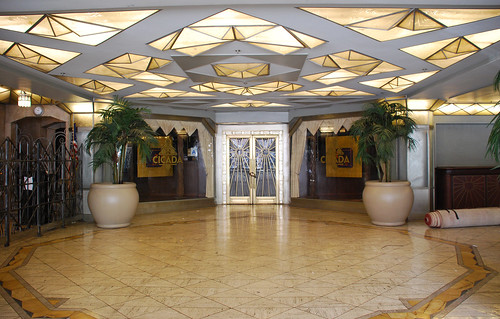
The renovated arcade.
Today, the Oviatt Building is owned by Blue Real Estate Management, and Cicada has been the restaurant since 1997. Here are three films you should watch – the Hollywood Hotshot Dancers, Rusty Frank & Chester Whitmore, and Dean Mora’s Modern Rhythmists, all part of Maxwell DeMille’s Cicada Club.
It’s painfully obvious I didn’t get inside the Oviatt Building. Since the interior, especially the penthouse, is what the landmark’s all about, I don’t know if I can even justify having visited the Oviatt. Now, like Delilah said, you can rent the penthouse for private parties and wedding receptions and such. Or, you can try what I did – take the L.A. Conservancy’s Art Deco Walking Tour, as the penthouse is part of the tour, subject to availability. But while I extremely recommend it, on the recent Saturday I took the tour, the penthouse was being prepped for a wedding reception, preventing our group’s access.
It’s painfully obvious I didn’t get inside the Oviatt Building. Since the interior, especially the penthouse, is what the landmark’s all about, I don’t know if I can even justify having visited the Oviatt. Now, like Delilah said, you can rent the penthouse for private parties and wedding receptions and such. Or, you can try what I did – take the L.A. Conservancy’s Art Deco Walking Tour, as the penthouse is part of the tour, subject to availability. But while I extremely recommend it, on the recent Saturday I took the tour, the penthouse was being prepped for a wedding reception, preventing our group’s access.
"The Oviatt Building"
Finally, if you’re interested in the history of the Oviatt Building, I can’t recommend highly enough your buying a DVD of Puzzled Pictures’ brand new documentary, The Oviatt Building. Directed by Seth Shulman and produced by Marc Chevalier, The Oviatt Building gives you the whole history – and then some – of the eighty-year-old building. Order your copy from the Puzzled Pictures website, and view the trailer right above. Thanks, guys, for the great work.
Sources:
“Addition to Busy Section” The Los Angeles Times; Jan 21, 1923, p. V2
“New Store is Opened to the Public” The Los Angeles Times; May 4, 1923, p. I12
“New Store Building to Start Soon” The Los Angeles Times; Mar 12, 1927, p. A6
“Genius Honors Local Builder” The Los Angeles Times; Dec 4, 1927, p. B9
“The New Store of Alexander & Oviatt Opens Today!” The Los Angeles Times; May 15, 1928, p. 9
Gray, Olive “Alexander and Oviatt Goal Won.” The Los Angeles Times; Aug 12, 1931, p. A7
Turpin, Dick “Oviatt Building Ready to Make a Comeback” The Los Angeles Times, Feb 27, 1977, p. J1
Kinchen, David M. “Restaurant Planned for Oviatt” The Los Angeles Times; Apr 8, 1979, p. H1
McMillian, Elizabeth Deco & Streamline Architecture in L.A. Schiffer Publishing Ltd 2004 Atglen, PA
Up next: Variety Arts Center Building
“Addition to Busy Section” The Los Angeles Times; Jan 21, 1923, p. V2
“New Store is Opened to the Public” The Los Angeles Times; May 4, 1923, p. I12
“New Store Building to Start Soon” The Los Angeles Times; Mar 12, 1927, p. A6
“Genius Honors Local Builder” The Los Angeles Times; Dec 4, 1927, p. B9
“The New Store of Alexander & Oviatt Opens Today!” The Los Angeles Times; May 15, 1928, p. 9
Gray, Olive “Alexander and Oviatt Goal Won.” The Los Angeles Times; Aug 12, 1931, p. A7
Turpin, Dick “Oviatt Building Ready to Make a Comeback” The Los Angeles Times, Feb 27, 1977, p. J1
Kinchen, David M. “Restaurant Planned for Oviatt” The Los Angeles Times; Apr 8, 1979, p. H1
McMillian, Elizabeth Deco & Streamline Architecture in L.A. Schiffer Publishing Ltd 2004 Atglen, PA
Up next: Variety Arts Center Building
continue reading...